
In the figure above, line segments AB and DE are parallel. The lengths of AC, BC, and AB are 6,...
GMAT Geometry & Trigonometry : (Geo_Trig) Questions
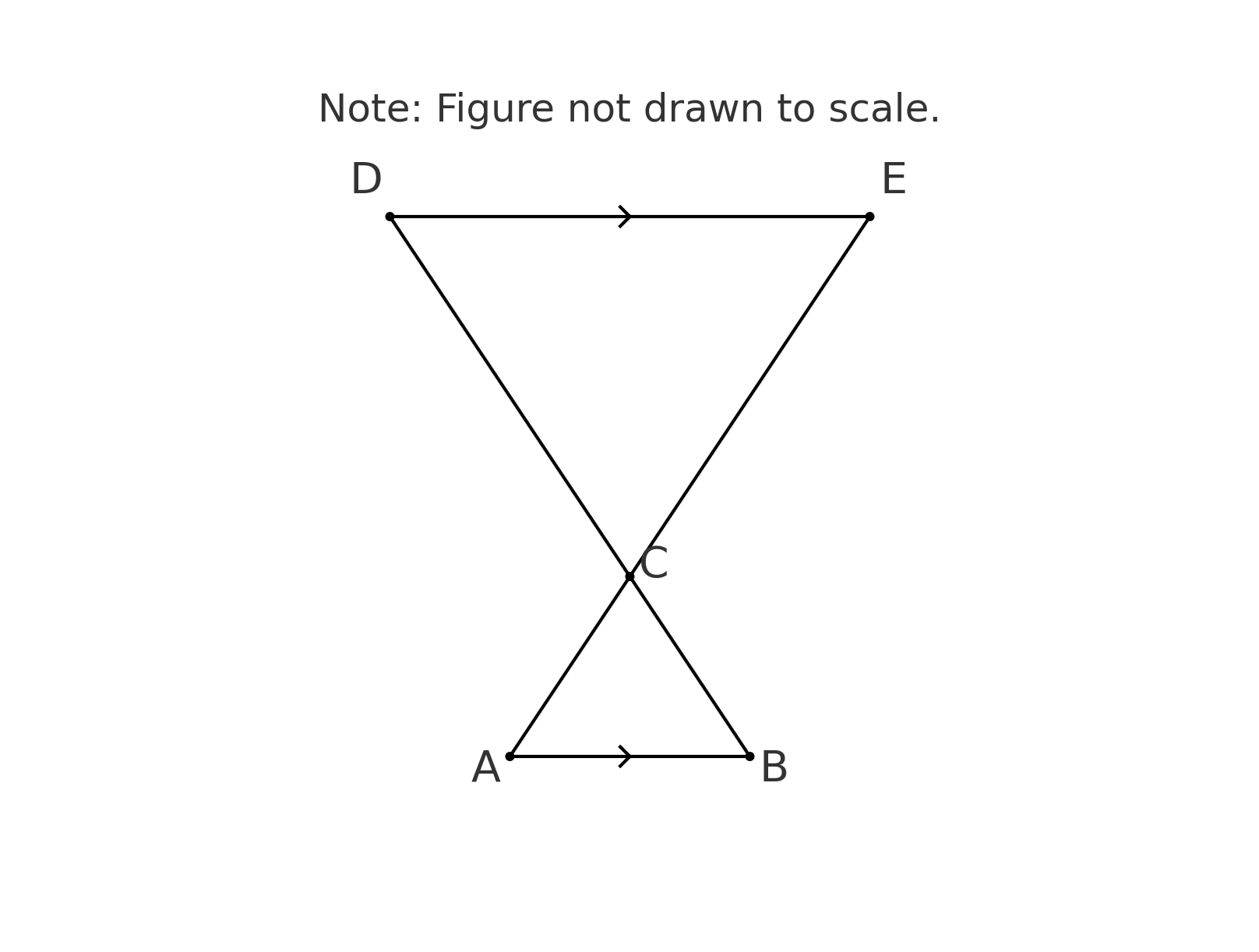
In the figure above, line segments \(\mathrm{AB}\) and \(\mathrm{DE}\) are parallel. The lengths of \(\mathrm{AC}\), \(\mathrm{BC}\), and \(\mathrm{AB}\) are 6, 8, and 9, respectively. If the length of \(\mathrm{CE}\) is 15, what is the length of \(\mathrm{DE}\)?
Note: Figure not drawn to scale.
1. INFER the angle relationships from parallel lines
When you see parallel lines cut by transversals, look for equal angles:
- Since AB || DE:
- \(\angle\mathrm{CAB} = \angle\mathrm{CED}\) (alternate interior angles)
- \(\angle\mathrm{CBA} = \angle\mathrm{CDE}\) (alternate interior angles)
- \(\angle\mathrm{ACB} = \angle\mathrm{DCE}\) (same angle at point C)
- What this tells us: All three corresponding angles are equal between triangles ABC and EDC.
2. INFER that the triangles are similar
- With two (or all three) corresponding angles equal, we can conclude:
\(\triangle\mathrm{ABC} \sim \triangle\mathrm{EDC}\) (by AA similarity) - This is the crucial strategic insight—similarity means we can use proportions.
3. INFER which sides correspond
- From the similarity \(\triangle\mathrm{ABC} \sim \triangle\mathrm{EDC}\), match up vertices carefully:
- A corresponds to E (both at "top" of their respective triangles relative to parallel lines)
- B corresponds to D (both at "bottom" relative to parallel lines)
- C corresponds to C (shared vertex)
- Therefore, corresponding sides are:
- \(\mathrm{AC} \leftrightarrow \mathrm{EC}\)
- \(\mathrm{BC} \leftrightarrow \mathrm{DC}\)
- \(\mathrm{AB} \leftrightarrow \mathrm{ED}\)
4. TRANSLATE the similarity into a proportion
- For similar triangles, corresponding sides are in the same ratio:
\(\frac{\mathrm{AC}}{\mathrm{EC}} = \frac{\mathrm{AB}}{\mathrm{ED}}\) - TRANSLATE the given information:
- \(\mathrm{AC} = 6\)
- \(\mathrm{EC} = 15\) (this is CE in the problem)
- \(\mathrm{AB} = 9\)
- \(\mathrm{ED} = ?\) (this is DE, what we're looking for)
5. SIMPLIFY to find DE
- Substitute into the proportion:
\(\frac{6}{15} = \frac{9}{\mathrm{DE}}\) - Cross-multiply:
\(6 \times \mathrm{DE} = 15 \times 9\)
\(6 \times \mathrm{DE} = 135\) - Divide both sides by 6:
\(\mathrm{DE} = \frac{135}{6}\) - SIMPLIFY the fraction:
\(\mathrm{DE} = \frac{135}{6} = \frac{45}{2} = 22.5\)
Answer: D (22.5)
Why Students Usually Falter on This Problem
Most Common Error Path:
Weak INFER skill—Incorrect vertex correspondence: Students recognize the triangles are similar but match the wrong vertices, thinking \(\triangle\mathrm{ABC} \sim \triangle\mathrm{DEC}\) instead of \(\triangle\mathrm{ABC} \sim \triangle\mathrm{EDC}\).
This leads them to set up the proportion as \(\frac{\mathrm{AC}}{\mathrm{DC}} = \frac{\mathrm{AB}}{\mathrm{DE}}\) instead of \(\frac{\mathrm{AC}}{\mathrm{EC}} = \frac{\mathrm{AB}}{\mathrm{DE}}\). Since they don't know DC, they might try to find it first using \(\frac{\mathrm{AC}}{\mathrm{DC}} = \frac{\mathrm{BC}}{\mathrm{EC}}\), getting \(\mathrm{DC} = 11.25\). Then using \(\frac{6}{11.25} = \frac{9}{\mathrm{DE}}\), they'd get \(\mathrm{DE} = 16.875\), which doesn't match any answer choice.
This causes confusion and may lead them to guess or reconsider their approach, possibly selecting Choice B (18) as the "closest reasonable value."
Second Most Common Error:
Weak INFER skill—Flipping the proportion: Students set up the similarity correctly but write the proportion backwards as \(\frac{\mathrm{EC}}{\mathrm{AC}} = \frac{\mathrm{DE}}{\mathrm{AB}}\).
This gives them:
\(\frac{15}{6} = \frac{\mathrm{DE}}{9}\)
So:
\(\mathrm{DE} = \frac{15 \times 9}{6} = \frac{135}{6} = 22.5\)
Interestingly, this still gives the correct answer! The reciprocal property of proportions means this error doesn't affect the final result in this case.
Third Most Common Error:
Weak TRANSLATE skill—Confusing which segment is which: Students might confuse CE with the entire length of something else, or misread which measurement corresponds to which segment in the figure.
For instance, thinking AC + CE = some total and trying to use that, or confusing the 15 as being CD instead of CE. This leads to setting up incorrect proportions and getting stuck, leading to guessing.
The Bottom Line:
The key challenge is the spatial reasoning required to correctly identify corresponding vertices in two triangles that share a vertex but have different orientations. Students must carefully trace which angle in one triangle matches which angle in the other, then translate that understanding into the correct proportion. The figure's orientation (inverted triangles meeting at a point) makes this correspondence less obvious than if the triangles were side-by-side in the same orientation.