
In the figure provided, lines l and m are parallel. What is the value of y?
GMAT Geometry & Trigonometry : (Geo_Trig) Questions
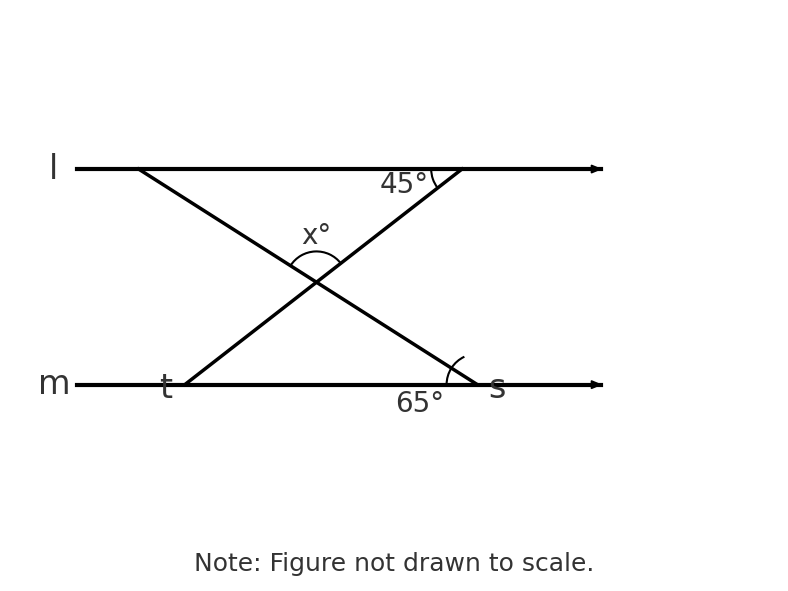
In the figure provided, lines \(\mathrm{l}\) and \(\mathrm{m}\) are parallel. What is the value of \(\mathrm{y}\)?
1. TRANSLATE the diagram information
Looking at the figure:
- Lines l and m are parallel (given)
- There's an angle marked where a transversal crosses line l
- There's an angle marked where a transversal crosses line m
- Two transversals intersect between the parallel lines
- A triangle is formed by these transversals and the parallel lines
- We need to find angle y
2. INFER the supplementary angle relationship
- The angle at line l: If an angle is marked on one side of the transversal, the angle on the other side (inside the triangle) is supplementary
- Supplementary angles sum to \(180°\)
For example, if the exterior angle is \(115°\):
Interior angle = \(180° - 115° = 65°\)
3. INFER alternate interior angles
- Because lines l and m are parallel, when a transversal crosses both lines, it creates alternate interior angles
- Alternate interior angles are equal when lines are parallel
- The \(65°\) angle we found at line l equals the corresponding angle at line m (alternate interior angles)
- Therefore, one angle of the triangle is \(65°\)
4. TRANSLATE to identify all triangle angles
The triangle has three angles:
- The angle at one vertex: \(65°\) (from alternate interior angles)
- Another angle: \(32°\) (marked or derived from the diagram)
- The angle we're solving for: \(\mathrm{y}°\)
5. INFER using triangle angle sum
- All triangles have interior angles that sum to \(180°\)
- We can write an equation with the three angles
6. SIMPLIFY to solve for y
Set up the equation:
\(65 + 32 + \mathrm{y} = 180\)
Combine the known angles:
\(97 + \mathrm{y} = 180\)
Subtract 97 from both sides:
\(\mathrm{y} = 180 - 97\)
\(\mathrm{y} = 83\)
Answer: \(83°\)
Why Students Usually Falter on This Problem
Most Common Error Path:
Weak INFER skill: Not recognizing the alternate interior angle relationship when parallel lines are cut by a transversal
Students see the angles marked at lines l and m but don't connect them to angles within the triangle. They might try to use the marked angles directly without finding their corresponding alternate interior angles, or they might not recognize that a supplementary angle needs to be calculated first.
This leads to confusion and guessing, or selecting an incorrect angle measure that doesn't properly account for the parallel line properties.
Second Most Common Error:
Incomplete TRANSLATE reasoning: Misidentifying which angles belong to the triangle
Students might confuse exterior angles with interior angles, or fail to recognize which three angles actually form the triangle in question. They might add angles that aren't part of the same triangle, leading to an incorrect equation setup.
For example, they might add the marked angles directly (like \(45° + 65° = 110°\)) without applying the supplementary or alternate interior angle relationships first.
This causes them to set up the wrong equation and arrive at an incorrect value for y.
The Bottom Line:
This problem requires you to layer multiple geometric concepts: you must recognize supplementary angles, apply the alternate interior angles theorem for parallel lines, identify the correct triangle, and then use the triangle angle sum theorem. Missing any step in this chain breaks the solution path. The key insight is that parallel lines create equal alternate interior angles - this is what allows you to transfer angle information from one parallel line to the other and determine the triangle's angles.