
In the figure above, line m is parallel to line n. What is the value of x?
GMAT Geometry & Trigonometry : (Geo_Trig) Questions
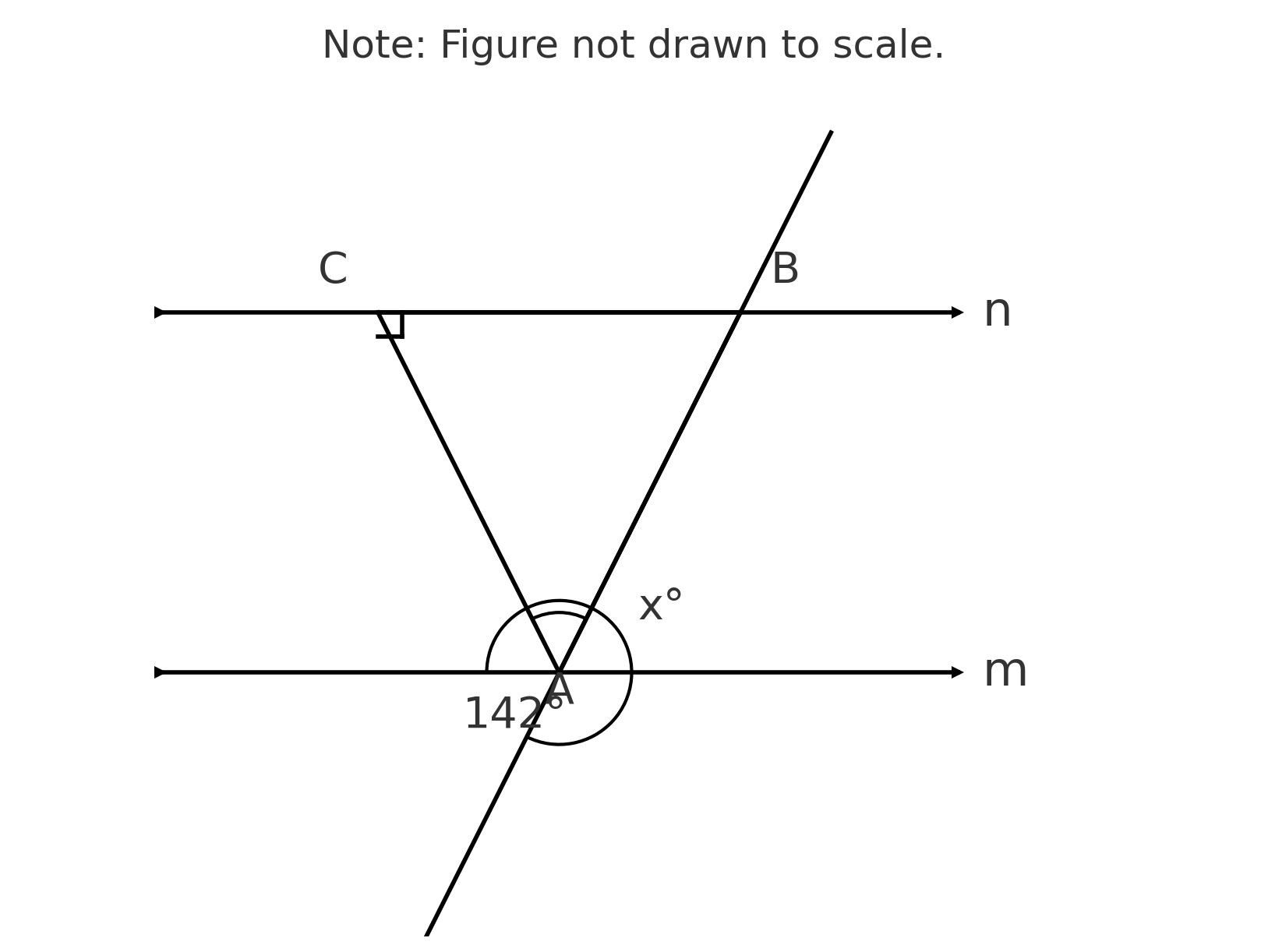
In the figure above, line \(\mathrm{m}\) is parallel to line \(\mathrm{n}\). What is the value of \(\mathrm{x}\)?
1. TRANSLATE the diagram information
Looking at the figure, here's what we have:
- Two parallel lines: m and n
- A point A on line m where two lines originate
- These lines extend to points B and C on line n, forming triangle ABC
- An angle of \(142°\) marked at point A (below line m)
- An angle \(x°\) inside the triangle at vertex A
- A right angle symbol at vertex C
2. INFER the supplementary angle relationship
The \(142°\) angle and the angle inside the triangle at vertex A are on opposite sides of the transversal line. But first, we need the angle on the same side of line m as the triangle.
- Since the angles on a straight line sum to \(180°\):
- The angle between line m (going to the left) and line AB (going up to B) = \(180° - 142° = 38°\)
3. INFER the alternate interior angles
Now we have a key insight: Since m || n, and line AB is a transversal cutting through both parallel lines:
- The \(38°\) angle at A (between line m and line AB)
- And angle ABC (at vertex B, between line BA and line n)
- These are alternate interior angles, so they're equal!
- Therefore: \(\mathrm{angle\ ABC} = 38°\)
4. TRANSLATE the right angle at C
The diagram shows a right angle symbol at point C:
- This tells us \(\mathrm{angle\ ACB} = 90°\)
5. INFER and SIMPLIFY using triangle angle sum
Now we can use the triangle angle sum theorem. In triangle ABC:
\(x + \mathrm{angle\ ABC} + \mathrm{angle\ ACB} = 180°\)
\(x + 38° + 90° = 180°\)
\(x + 128° = 180°\)
\(x = 180° - 128°\)
\(x = 52°\)
Answer: 52
Why Students Usually Falter on This Problem
Most Common Error Path:
Weak INFER skill - Missing the supplementary angle step: Students might try to use the \(142°\) angle directly as part of the triangle or as the alternate interior angle. They might think "the angle at A is \(142°\)" and try to calculate:
\(142° + 38° + 90° = 270°\) (which doesn't work for a triangle)
Or they might think angle ABC = \(142°\) (using the wrong angle as the alternate interior angle), leading to:
\(x + 142° + 90° = 180°\)
\(x = 180° - 232° = -52°\) (impossible!)
This leads to confusion and guessing.
Second Most Common Error:
Poor TRANSLATE skill - Missing the right angle at C: Students might not notice or misinterpret the right angle symbol at point C. Without knowing \(\mathrm{angle\ ACB} = 90°\), they cannot set up the complete equation to solve for x. They might try to work with just two angles:
\(x + 38° = ?\) (incomplete information)
This causes them to get stuck and randomly select an answer.
Third Most Common Error:
Conceptual confusion about parallel line angle relationships: Students might confuse alternate interior angles with corresponding angles or co-interior angles. If they incorrectly apply co-interior angles (which are supplementary):
\(\mathrm{angle\ ABC} = 180° - 38° = 142°\)
Then: \(x + 142° + 90° = 180°\), giving \(x = -52°\) (impossible!)
This also leads to confusion and guessing.
The Bottom Line:
This problem requires careful diagram interpretation and the ability to chain together multiple geometric relationships: supplementary angles → alternate interior angles → triangle angle sum. Missing any link in this chain makes it impossible to find x. The key is recognizing that you need to "translate" the \(142°\) into its supplementary angle before you can use the parallel lines property.