
Lines m and n are parallel, and a transversal p intersects both lines as shown in the figure.At the intersection...
GMAT Geometry & Trigonometry : (Geo_Trig) Questions
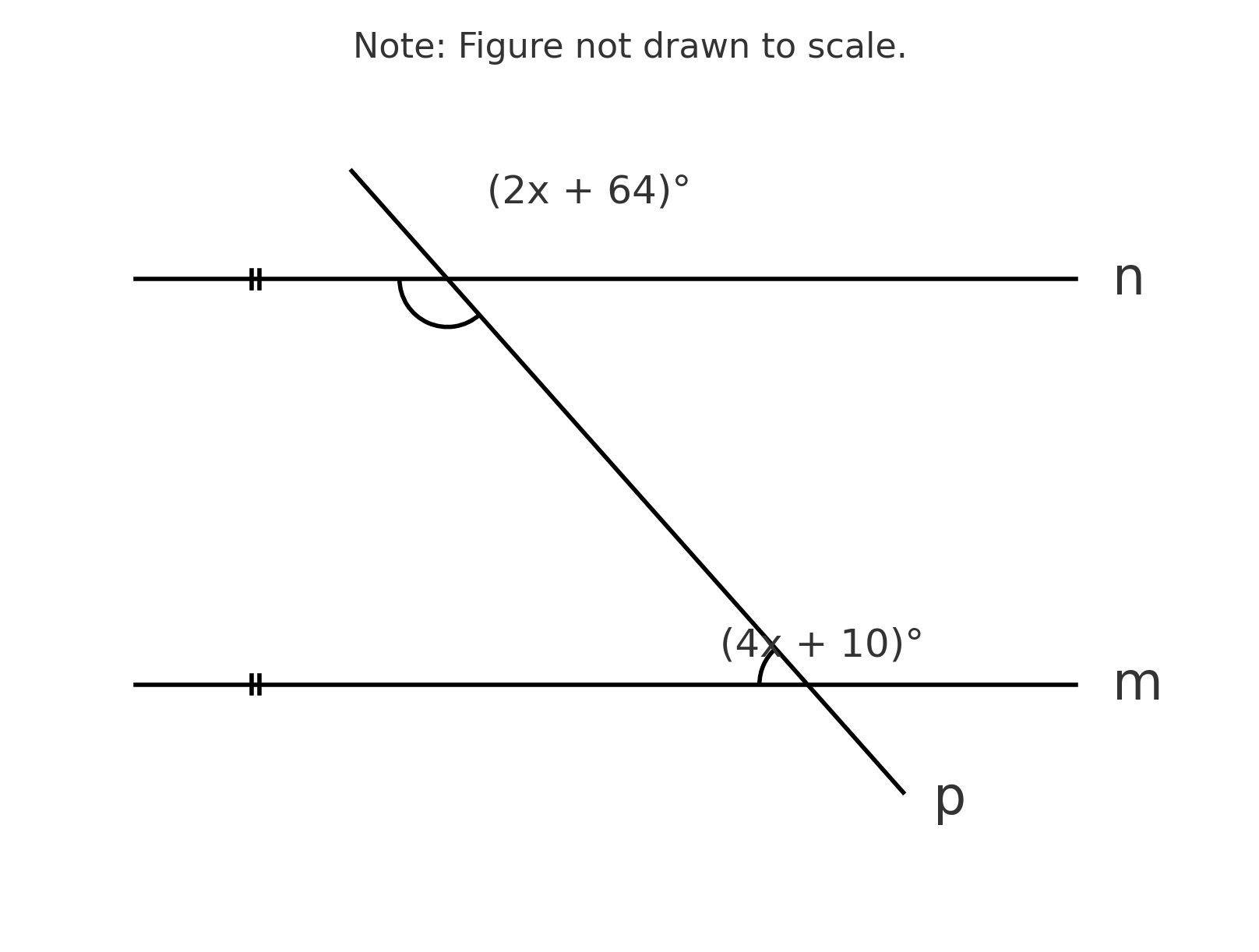
- Lines m and n are parallel, and a transversal p intersects both lines as shown in the figure.
- At the intersection with line m, the interior angle on the lower side of m and to the right of p measures \((4\mathrm{x} + 10)°\). At the intersection with line n, the interior angle on the upper side of n and to the left of p measures \((2\mathrm{x} + 64)°\).
- What is the value of x? (Grid-in your answer as an integer.)
1. TRANSLATE the problem information
- Given information:
- Lines m and n are parallel (shown by the tick marks on both lines)
- Transversal p intersects both lines
- At line n: the interior angle on the upper side of n and to the left of p is \((2\mathrm{x} + 64)°\)
- At line m: the interior angle on the lower side of m and to the right of p is \((4\mathrm{x} + 10)°\)
- We need to find the value of x
2. INFER the geometric relationship
- Look at the positions of the two marked angles:
- The \((2\mathrm{x} + 64)°\) angle is above line n (interior to the parallel lines) and on the left side of transversal p
- The \((4\mathrm{x} + 10)°\) angle is below line m (interior to the parallel lines) and on the right side of transversal p
- These angles are alternate interior angles because:
- Both are between (interior to) the parallel lines
- They're on opposite (alternate) sides of the transversal
- INFER the key theorem: When parallel lines are cut by a transversal, alternate interior angles are congruent (equal in measure).
3. TRANSLATE the relationship into an equation
- Since the alternate interior angles must be equal:
\((2\mathrm{x} + 64)° = (4\mathrm{x} + 10)°\)
Or simply: \(2\mathrm{x} + 64 = 4\mathrm{x} + 10\)
4. SIMPLIFY to solve for x
- Move all terms with x to one side and constants to the other:
- Subtract 2x from both sides: \(64 = 2\mathrm{x} + 10\)
- Subtract 10 from both sides: \(54 = 2\mathrm{x}\)
- Divide both sides by 2: \(\mathrm{x} = 27\)
5. Verify the solution
- Check by substituting \(\mathrm{x} = 27\) back into both angle expressions:
- First angle: \(2(27) + 64 = 54 + 64 = 118°\)
- Second angle: \(4(27) + 10 = 108 + 10 = 118°\) ✓
Both angles equal 118°, confirming our answer is correct.
Answer: 27
Why Students Usually Falter on This Problem
Most Common Error Path:
Weak INFER skill - Misidentifying the angle relationship: Students may see two angles marked on parallel lines and assume they're corresponding angles, or they might think these are same-side interior angles (which are supplementary, not equal).
If a student thinks these are same-side interior angles, they would set up:
\((2\mathrm{x} + 64) + (4\mathrm{x} + 10) = 180\)
\(6\mathrm{x} + 74 = 180\)
\(6\mathrm{x} = 106\)
\(\mathrm{x} \approx 17.67\)
This doesn't lead to an integer answer, which contradicts the grid-in instruction, causing confusion and potential guessing.
Second Most Common Error:
Poor SIMPLIFY execution - Algebraic manipulation errors: Even after correctly setting up \(2\mathrm{x} + 64 = 4\mathrm{x} + 10\), students might make sign errors or incorrectly combine terms:
Common mistakes include:
- Subtracting incorrectly: Getting \(2\mathrm{x} + 54 = 4\mathrm{x}\) instead of \(54 = 2\mathrm{x}\)
- Sign errors when moving terms: Getting \(-2\mathrm{x} = 64 - 10 = 54\), then \(\mathrm{x} = -27\)
- Arithmetic errors: Getting \(2\mathrm{x} = 64\) instead of \(2\mathrm{x} = 54\)
These algebraic errors lead to wrong values of x, which wouldn't verify when substituted back into the original expressions.
The Bottom Line:
This problem requires both geometric reasoning (recognizing alternate interior angles) and algebraic skill (solving linear equations accurately). The geometric identification is the critical first step - without correctly identifying the angle relationship, students cannot set up the right equation. Once the equation is established, careful algebraic manipulation is essential to avoid calculation errors.