
In the figure, two parallel lines are cut by a transversal. angle 3 and angle 4 are corresponding angles. The...
GMAT Geometry & Trigonometry : (Geo_Trig) Questions
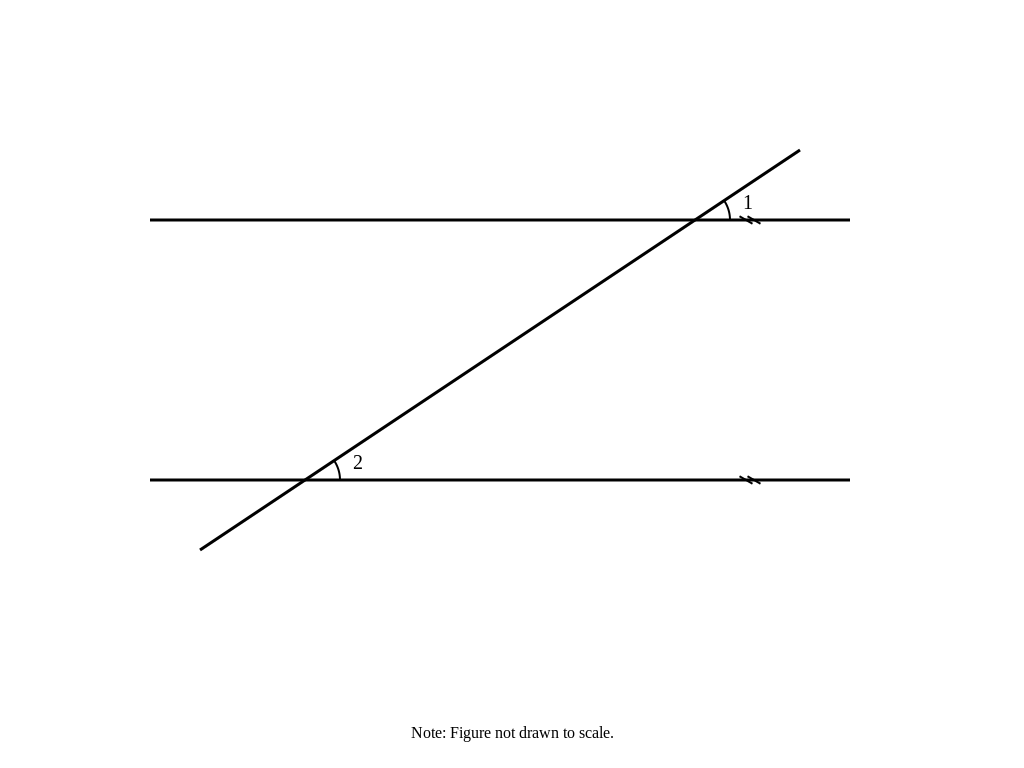
In the figure, two parallel lines are cut by a transversal. \(\angle 3\) and \(\angle 4\) are corresponding angles. The measure of \(\angle 3\) is \(58°\). What is the measure of \(\angle 4\)?
Express your answer in degrees.
\(32°\)
\(58°\)
\(122°\)
\(116°\)
1. TRANSLATE the problem information
- Given information:
- Two parallel lines cut by a transversal
- Angle 3 = 58°
- Angles 3 and 4 are corresponding angles
- What this tells us: We need to find the measure of angle 4, which has a specific geometric relationship with angle 3.
2. INFER what geometric theorem applies
- When you see parallel lines cut by a transversal, several angle relationships exist:
- Corresponding angles (same position at each intersection)
- Alternate interior angles (inside the parallel lines, on opposite sides)
- Supplementary angles (linear pairs that add to 180°)
- The problem explicitly states that angles 3 and 4 are corresponding angles.
- Key insight: The corresponding angles theorem tells us that when parallel lines are cut by a transversal, corresponding angles are congruent (equal in measure).
3. Apply the corresponding angles theorem
- Since angles 3 and 4 are corresponding angles formed by parallel lines and a transversal:
\(\mathrm{Angle\,4 = Angle\,3}\)
- Therefore:
\(\mathrm{Angle\,4 = 58°}\)
Answer: 58° (Choice B)
Why Students Usually Falter on This Problem
Most Common Error Path:
Conceptual confusion about angle relationships: Students may confuse corresponding angles with other angle pairs formed by a transversal.
If a student thinks angles 3 and 4 are supplementary (forming a linear pair), they would calculate:
- \(\mathrm{Angle\,4 = 180° - 58° = 122°}\)
This may lead them to select Choice C (122°).
Second Most Common Error:
Weak INFER skill - applying complementary angle relationship: Students might mistakenly think the angles are complementary (adding to 90°), perhaps confusing angle relationships or not recognizing the parallel lines context.
They would calculate:
- \(\mathrm{Angle\,4 = 90° - 58° = 32°}\)
This may lead them to select Choice A (32°).
The Bottom Line:
This problem tests whether students can identify corresponding angles in a diagram and recall that corresponding angles are congruent when formed by parallel lines and a transversal. The key is not getting confused by other angle relationships and directly applying the correct theorem. The presence of answer choices like 32° and 122° specifically targets common misconceptions about angle relationships.
\(32°\)
\(58°\)
\(122°\)
\(116°\)