
The point with coordinates \(\mathrm{(d, 4)}\) lies on the line shown.What is the value of d?Choose 1 answer:
GMAT Algebra : (Alg) Questions
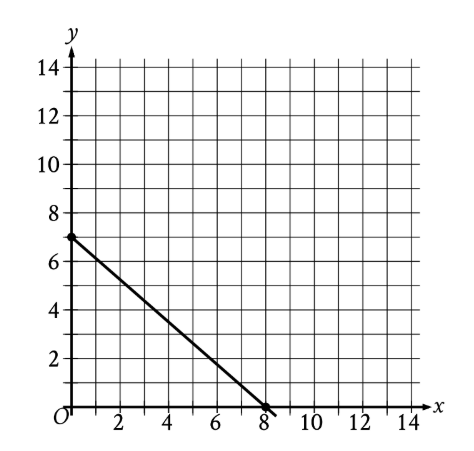
The point with coordinates \(\mathrm{(d, 4)}\) lies on the line shown.
What is the value of d?
Choose 1 answer:
\(\frac{7}{2}\)
\(\frac{26}{7}\)
\(\frac{24}{7}\)
\(\frac{27}{8}\)
1. TRANSLATE the graph information
Looking at the graph carefully:
- The line passes through (0, 7) - where it crosses the y-axis
- The line passes through (8, 0) - where it crosses the x-axis
- We need to find d where the point (d, 4) lies on this same line
2. INFER the solution strategy
Since all three points lie on the same line, they must all satisfy the same slope relationship. Here's the plan:
- First, calculate the slope using the two known points
- Then, use that slope with the point (d, 4) to find d
3. Calculate the slope using the two known points
Using the slope formula with (0, 7) and (8, 0):
\(\mathrm{m = \frac{0 - 7}{8 - 0} = \frac{-7}{8}}\)
The negative slope makes sense - the line is going downward from left to right.
4. INFER that the same slope applies to point (d, 4)
Since (d, 4) is also on the line, the slope between (0, 7) and (d, 4) must also equal \(\mathrm{\frac{-7}{8}}\):
\(\mathrm{\frac{-7}{8} = \frac{4 - 7}{d - 0}}\)
\(\mathrm{\frac{-7}{8} = \frac{-3}{d}}\)
5. SIMPLIFY to solve for d
Starting with: \(\mathrm{\frac{-7}{8} = \frac{-3}{d}}\)
Multiply both sides by d:
\(\mathrm{\frac{-7d}{8} = -3}\)
Multiply both sides by \(\mathrm{\frac{-8}{7}}\):
\(\mathrm{d = -3 \times \frac{-8}{7} = \frac{24}{7}}\)
Answer: C. \(\mathrm{\frac{24}{7}}\)
Why Students Usually Falter on This Problem
Most Common Error Path:
Weak TRANSLATE skill: Misreading the intercept coordinates from the graph
Students often misidentify where the line crosses the axes, perhaps reading (0, 7) as (7, 0) or reading (8, 0) as (0, 8). If they switch these coordinates, they might calculate the slope as \(\mathrm{\frac{-8}{7}}\) instead of \(\mathrm{\frac{-7}{8}}\). This leads to:
\(\mathrm{\frac{-8}{7} = \frac{-3}{d}}\)
\(\mathrm{\frac{-8d}{7} = -3}\)
\(\mathrm{d = -3 \times \frac{-7}{8} = \frac{21}{8} = 2.625}\)
While \(\mathrm{\frac{21}{8}}\) doesn't match any answer choice exactly, the student might see Choice A (\(\mathrm{\frac{7}{2} = 3.5}\)) or Choice D (\(\mathrm{\frac{27}{8} = 3.375}\)) as close and select one, or this causes confusion and guessing.
Second Most Common Error:
Poor SIMPLIFY execution: Making sign errors when solving \(\mathrm{\frac{-7}{8} = \frac{-3}{d}}\)
Students might incorrectly handle the negative signs:
- Forgetting that \(\mathrm{-3 \times \frac{-8}{7}}\) gives a positive result
- Or making errors like: \(\mathrm{d = 3 \times \frac{8}{7} = \frac{24}{7}}\) but then second-guessing because they dropped negatives
Another error: multiplying incorrectly to get \(\mathrm{d = 3 \times \frac{7}{8} = \frac{21}{8}}\), or making reciprocal errors to get \(\mathrm{d = \frac{7}{8} \times 3 = \frac{21}{8}}\)
This could lead them to miscompute and potentially select Choice A (\(\mathrm{\frac{7}{2}}\)) or Choice B (\(\mathrm{\frac{20}{7}}\)) through algebraic mistakes.
The Bottom Line:
This problem requires careful graph reading combined with algebraic fluency with fractions. The most critical moment is accurately identifying the intercepts from the graph - everything else flows from there. The second challenge is maintaining precision with negative fractions through multiple algebraic steps.
\(\frac{7}{2}\)
\(\frac{26}{7}\)
\(\frac{24}{7}\)
\(\frac{27}{8}\)