
The graph of a polynomial function is shown in the coordinate plane. The curve rises as x to -infty and...
GMAT Advanced Math : (Adv_Math) Questions
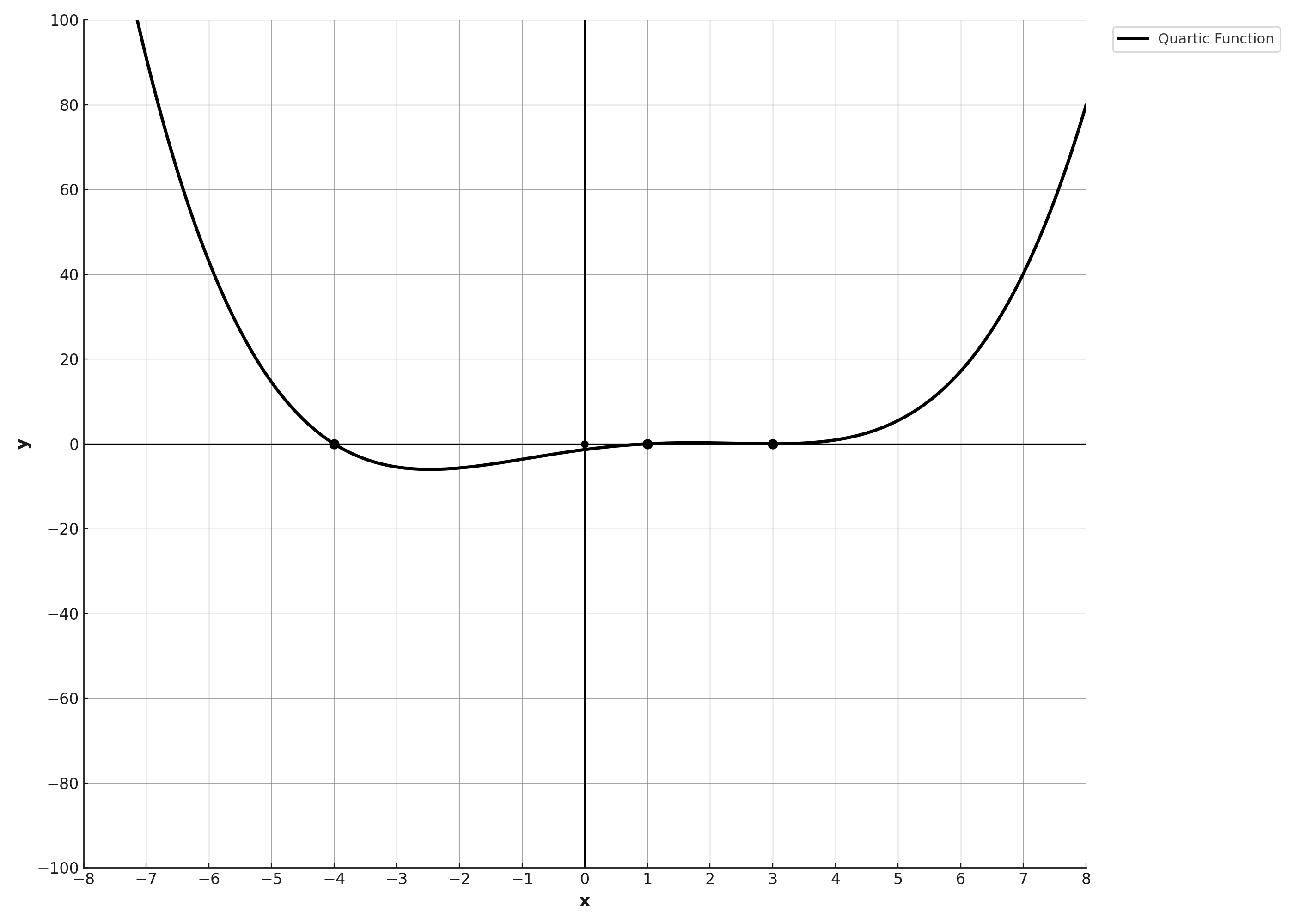
The graph of a polynomial function is shown in the coordinate plane. The curve rises as \(\mathrm{x \to -\infty}\) and also rises as \(\mathrm{x \to +\infty}\). It crosses the x-axis at \(\mathrm{x = -4}\) and \(\mathrm{x = 1}\) and just touches the x-axis (is tangent to it) at \(\mathrm{x = 3}\) before turning back up. Which of the following could be an equation of the graph?
1. INFER what the end behavior tells you
Look at what happens at the far left and far right of the graph:
- As \(\mathrm{x \to -\infty}\) (far left): \(\mathrm{y \to +\infty}\) (rises)
- As \(\mathrm{x \to +\infty}\) (far right): \(\mathrm{y \to +\infty}\) (rises)
What this tells us:
When both ends of a polynomial go in the SAME direction, the degree is EVEN. When both ends rise (positive y-values), the leading coefficient is POSITIVE.
So we need: Even degree + Positive leading coefficient
2. INFER the multiplicity from graph behavior at each zero
The graph has three x-intercepts. Look carefully at what happens at each one:
At \(\mathrm{x = -4}\):
- The graph crosses straight through the x-axis
- This indicates ODD multiplicity (most likely multiplicity 1)
At \(\mathrm{x = 1}\):
- The graph crosses straight through the x-axis
- This indicates ODD multiplicity (most likely multiplicity 1)
At \(\mathrm{x = 3}\):
- The graph touches the x-axis and turns back up WITHOUT crossing
- This indicates EVEN multiplicity (most likely multiplicity 2)
Key insight: The visual behavior tells you the multiplicity!
- Crosses → odd multiplicity → factor appears an odd number of times
- Touches and turns → even multiplicity → factor appears an even number of times
3. INFER the required factored form
Based on the zeros and their multiplicities:
- Zero at \(\mathrm{x = -4}\) (multiplicity 1) → factor: \(\mathrm{(x + 4)}\)
- Zero at \(\mathrm{x = 1}\) (multiplicity 1) → factor: \(\mathrm{(x - 1)}\)
- Zero at \(\mathrm{x = 3}\) (multiplicity 2) → factor: \(\mathrm{(x - 3)^2}\)
Therefore: \(\mathrm{y = k(x + 4)(x - 1)(x - 3)^2}\)
Check the degree: \(\mathrm{1 + 1 + 2 = 4}\) (even ✓)
And we need \(\mathrm{k \gt 0}\) (positive leading coefficient)
4. APPLY CONSTRAINTS to evaluate each answer choice
(A) \(\mathrm{y = \frac{1}{10}(x + 4)(x - 1)(x - 3)}\)
- Degree: \(\mathrm{1 + 1 + 1 = 3}\) (odd)
- An odd degree polynomial with positive leading coefficient falls to the left and rises to the right
- This doesn't match our graph → Eliminate
(B) \(\mathrm{y = -\frac{1}{10}(x + 4)(x - 1)(x - 3)^2}\)
- Degree: \(\mathrm{1 + 1 + 2 = 4}\) (even) ✓
- But the leading coefficient is NEGATIVE \(\mathrm{(-\frac{1}{10})}\)
- This would make both ends fall down
- This doesn't match our graph → Eliminate
(C) \(\mathrm{y = \frac{1}{8}(x + 4)(x - 1)(x - 3)^2}\)
- Degree: \(\mathrm{1 + 1 + 2 = 4}\) (even) ✓
- Leading coefficient: positive \(\mathrm{(\frac{1}{8})}\) ✓
- Has \(\mathrm{(x - 3)^2}\) so touches at \(\mathrm{x = 3}\) ✓
- Has single factors for \(\mathrm{x = -4}\) and \(\mathrm{x = 1}\), so crosses at both ✓
- Everything matches! ✓
(D) \(\mathrm{y = \frac{1}{8}(x + 4)^2(x - 1)(x - 3)}\)
- Degree: \(\mathrm{2 + 1 + 1 = 4}\) (even) ✓
- Leading coefficient: positive \(\mathrm{(\frac{1}{8})}\) ✓
- But wait—this has \(\mathrm{(x + 4)^2}\) which means the graph should TOUCH at \(\mathrm{x = -4}\)
- Looking at the graph, it CROSSES at \(\mathrm{x = -4}\), not touches
- This doesn't match → Eliminate
Answer: C
Why Students Usually Falter on This Problem
Most Common Error Path:
Weak INFER skill: Not recognizing that the visual behavior at each x-intercept directly corresponds to multiplicity
Students often know that zeros correspond to factors but miss the crucial connection between HOW the graph behaves at each zero and what power that factor should have. They might think all three zeros need multiplicity 1, or they might not carefully distinguish between "crossing" and "touching" behavior.
When they see that all answer choices have the three correct x-values as zeros, they might think "they all look right" and either guess randomly or focus only on the leading coefficient without checking multiplicities carefully.
This may lead them to select Choice A (if they only check for the three zeros without considering degree) or Choice D (if they recognize even degree is needed but don't carefully verify WHICH zero has multiplicity 2).
Second Most Common Error:
Inadequate INFER reasoning about end behavior: Confusing the relationship between degree, leading coefficient sign, and end behavior
Students might remember that "the leading coefficient affects end behavior" but mix up the rules:
- Forgetting that even degree means both ends go the same direction
- Or thinking that negative leading coefficient makes the graph rise (instead of fall)
This may lead them to select Choice B, thinking the negative coefficient is needed, or to not use end behavior as an effective constraint for eliminating wrong answers.
The Bottom Line:
This problem requires you to translate visual features (crossing vs. touching) into algebraic properties (multiplicity). The graph gives you all the information you need, but you have to INFER the deep connection between what you SEE and what the algebra must BE. Simply listing the x-intercepts isn't enough—you must analyze the behavior at each one.