
The figure above shows a system of two linear equations in the xy-plane.The equation of each line can be written...
GMAT Algebra : (Alg) Questions
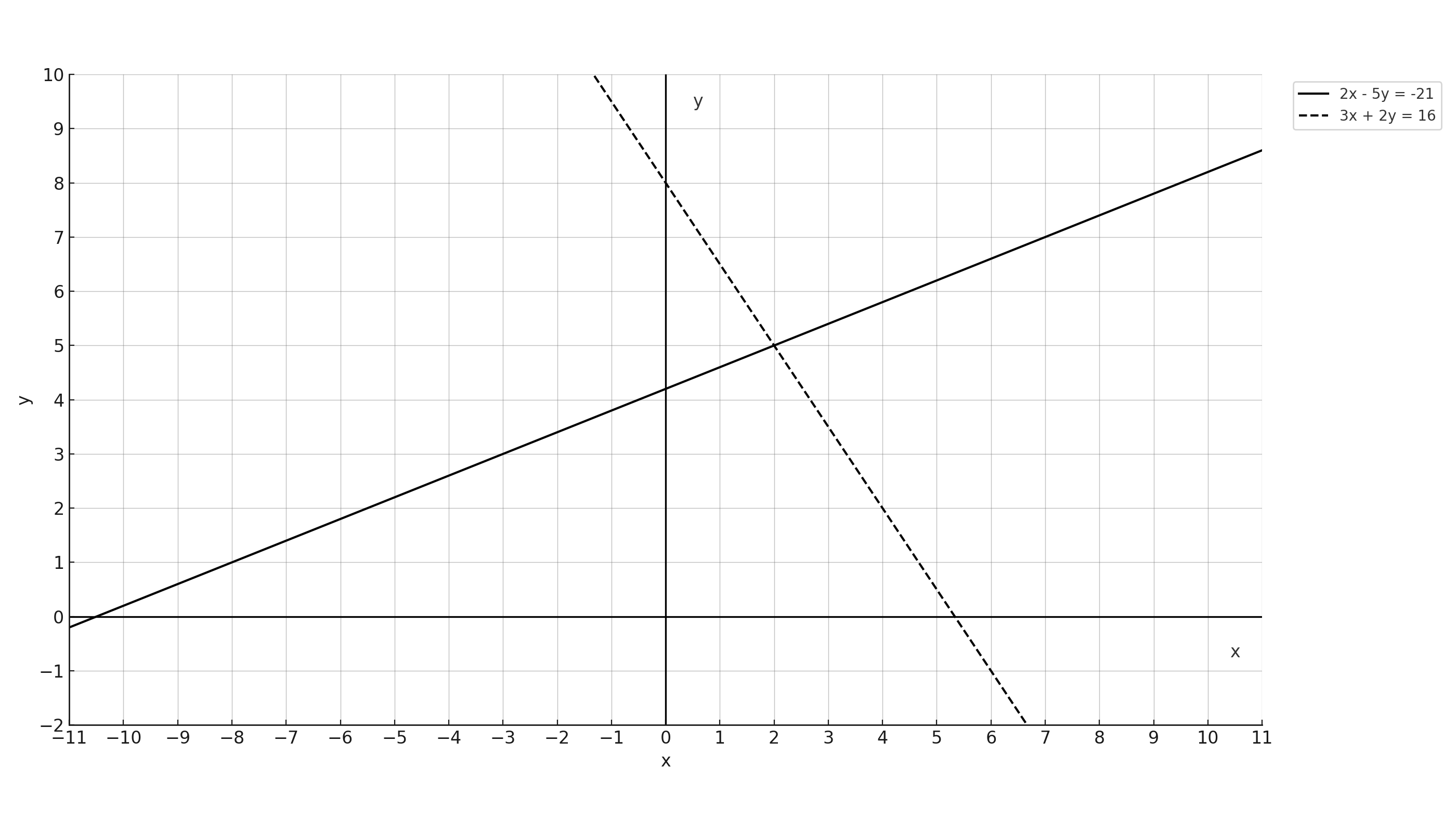
The figure above shows a system of two linear equations in the \(\mathrm{xy}\)-plane.
The equation of each line can be written in the standard form \(\mathrm{Ax + By = C}\), where \(\mathrm{A, B,\ and\ C}\) are integers.
For the line with the positive slope, if \(\mathrm{A \gt 0}\) and the greatest common divisor of \(\mathrm{A, B,\ and\ C}\) is 1, what is the value of \(\mathrm{A + B}\)?
\(\mathrm{-3}\)
\(\mathrm{3}\)
\(\mathrm{5}\)
\(\mathrm{7}\)
1. TRANSLATE the graph to identify the target line
The problem asks about "the line with the positive slope."
- TRANSLATE what "positive slope" means visually:
- Positive slope: line rises as you move from left to right
- Negative slope: line falls as you move from left to right
- Looking at the graph:
- The solid line (2x - 5y = -21) goes upward → positive slope ✓
- The dashed line (3x + 2y = 16) goes downward → negative slope
Target: The solid line with positive slope
2. TRANSLATE coordinate points from the graph
We need two clear points with integer coordinates on this line.
- TRANSLATE from the graph:
- Point 1: x = -3, y = 3 → (-3, 3)
- Point 2: x = 2, y = 5 → (2, 5)
(This second point appears to be where the two lines intersect)
3. Calculate the slope
Using the slope formula:
\(\mathrm{m = \frac{y_2 - y_1}{x_2 - x_1}}\)
\(\mathrm{m = \frac{5 - 3}{2 - (-3)}}\)
\(\mathrm{m = \frac{2}{5}}\)
4. Write the equation in point-slope form
Using point (2, 5) and slope m = 2/5:
\(\mathrm{y - 5 = \frac{2}{5}(x - 2)}\)
5. SIMPLIFY to convert to standard form
We need the form Ax + By = C where A, B, and C are all integers.
- First, clear the fraction by multiplying both sides by 5:
\(\mathrm{5(y - 5) = 5 \cdot \frac{2}{5}(x - 2)}\)
\(\mathrm{5(y - 5) = 2(x - 2)}\)
- Distribute on both sides:
\(\mathrm{5y - 25 = 2x - 4}\)
- Rearrange to get all variables on the left:
\(\mathrm{-2x + 5y = -4 + 25}\)
\(\mathrm{-2x + 5y = 21}\)
- INFER that we need A > 0, so multiply the entire equation by -1:
\(\mathrm{2x - 5y = -21}\)
This gives us: A = 2, B = -5, C = -21
6. Verify the given conditions
- Is A > 0? Yes, 2 > 0 ✓
- Is gcd(A, B, C) = 1?
\(\mathrm{gcd(2, 5, 21) = 1}\) ✓
(These three numbers share no common factor greater than 1)
7. Calculate the final answer
\(\mathrm{A + B = 2 + (-5)}\)
\(\mathrm{A + B = 2 - 5}\)
\(\mathrm{A + B = -3}\)
Answer: A. -3
Why Students Usually Falter on This Problem
Most Common Error Path:
Weak SIMPLIFY skill combined with sign tracking error: When converting from point-slope to standard form, students correctly clear the fraction and distribute, getting 5y - 25 = 2x - 4. However, when rearranging terms, they make a sign error and write:
\(\mathrm{2x - 5y = 25 - 4}\)
\(\mathrm{2x - 5y = 21}\)
This gives them B = -5 incorrectly as C = 21 instead of C = -21. Even worse, some students might then think B = +5 by not properly accounting for the negative sign in "-5y". This confusion leads them to calculate A + B = 2 + 5 = 7.
This may lead them to select Choice D (7).
Second Most Common Error:
Inadequate INFER reasoning about negative coefficients: Students successfully derive the correct equation 2x - 5y = -21 with A = 2 and B = -5, but when calculating A + B, they incorrectly assume that B must refer to the absolute value or they mishandle the negative sign. They might compute A + B = 2 + 5 = 7 instead of 2 + (-5) = -3, not recognizing that the coefficient B itself is negative in the standard form.
This may lead them to select Choice D (7).
Third Error Path:
Misidentifying the target line: Students might confuse which line has the positive slope, mistakenly analyzing the dashed line (3x + 2y = 16) instead. This line actually has a negative slope of -3/2, but students might proceed with its equation anyway. If they calculate A + B for this equation: A + B = 3 + 2 = 5.
This may lead them to select Choice C (5).
The Bottom Line:
This problem combines visual interpretation (identifying the correct line from a graph), coordinate extraction, algebraic manipulation with fractions, and careful sign tracking through multiple steps. The real challenge is maintaining accuracy with negative values—both in the algebraic rearrangement and in the final arithmetic. Students who rush or aren't meticulous with signs will likely select an incorrect answer that matches their computational error.
\(\mathrm{-3}\)
\(\mathrm{3}\)
\(\mathrm{5}\)
\(\mathrm{7}\)