
The graph of the function h is shown in the xy-plane. For what positive value of x is \(\mathrm{h(x) =...
GMAT Advanced Math : (Adv_Math) Questions
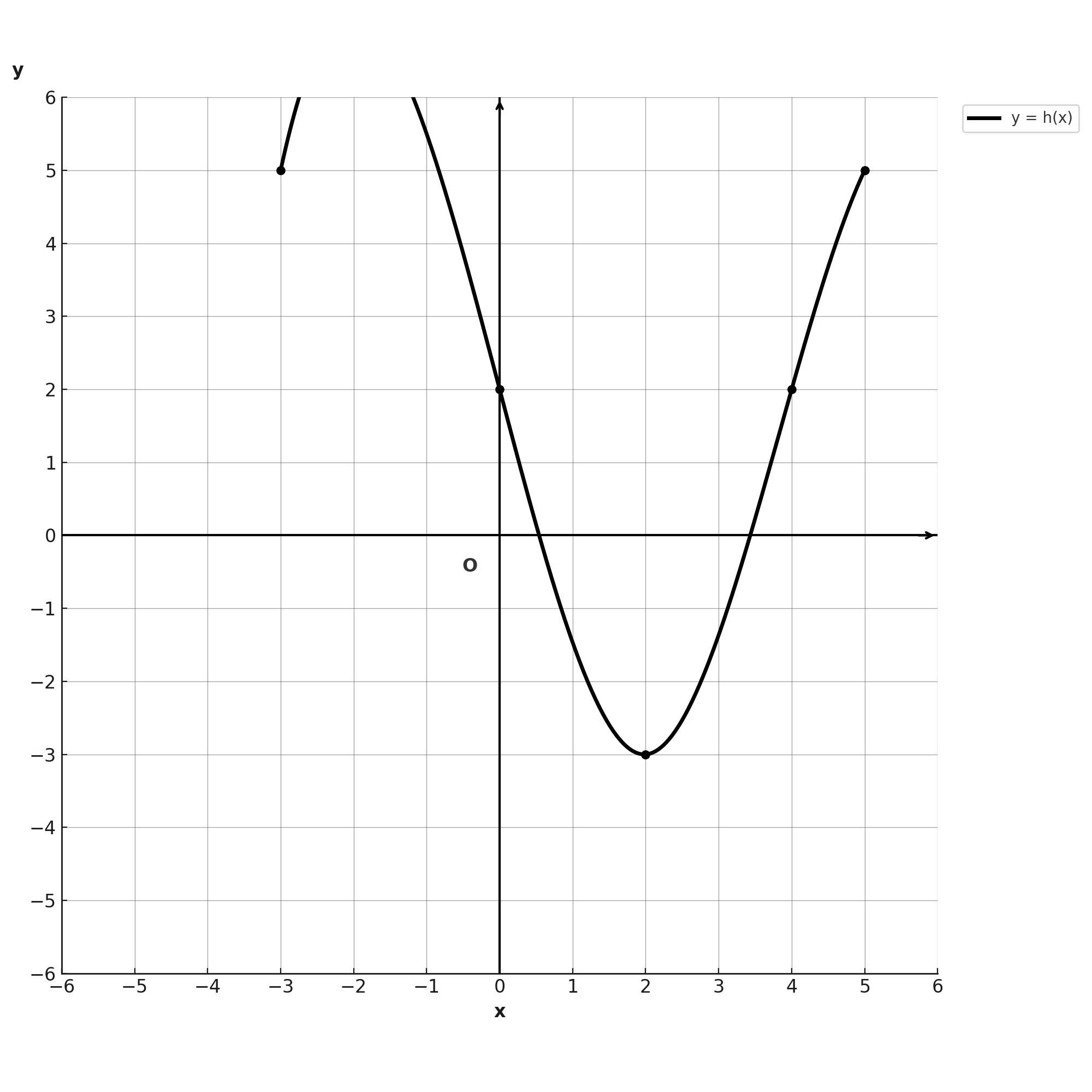
The graph of the function h is shown in the xy-plane. For what positive value of x is \(\mathrm{h(x) = 2}\)?
1. TRANSLATE the function notation
The question asks: 'For what positive value of x is h(x) = 2?'
- TRANSLATE this from function language to graph language:
- \(\mathrm{h(x) = 2}\) means 'the y-value of the function is 2'
- We need to find the x-coordinate(s) where the graph reaches a height of \(\mathrm{y = 2}\)
2. VISUALIZE the search strategy
- VISUALIZE a horizontal line at \(\mathrm{y = 2}\):
- Locate \(\mathrm{y = 2}\) on the vertical axis
- Imagine (or mentally draw) a horizontal line across the graph at this height
- Find where this line intersects the curve
3. Identify intersection points
Looking at the graph:
- The horizontal line \(\mathrm{y = 2}\) crosses the curve at two points:
- First intersection: at \(\mathrm{x = 0}\), where \(\mathrm{y = 2}\) → point \(\mathrm{(0, 2)}\)
- Second intersection: at \(\mathrm{x = 4}\), where \(\mathrm{y = 2}\) → point \(\mathrm{(4, 2)}\)
So we have two x-values where \(\mathrm{h(x) = 2}\): \(\mathrm{x = 0}\) and \(\mathrm{x = 4}\)
4. APPLY CONSTRAINTS to select the answer
- The question specifically asks for the positive value of x
- APPLY CONSTRAINTS about what 'positive' means:
- Positive numbers are greater than zero
- Zero is neither positive nor negative
- Therefore \(\mathrm{x = 0}\) does not qualify
- Only \(\mathrm{x = 4}\) is positive
Answer: 4
Why Students Usually Falter on This Problem
Most Common Error Path:
Weak TRANSLATE skill: Student doesn't fully connect \(\mathrm{h(x) = 2}\) to \(\mathrm{y = 2}\)
Some students see '\(\mathrm{h(x) = 2}\)' and aren't sure how to work with it graphically. They might look for the number 2 on the x-axis instead of the y-axis, or they might look for where the graph crosses \(\mathrm{x = 2}\) (which gives a y-value around -3 in this graph).
This confusion leads to guessing among plausible-looking x-values on the graph.
Second Most Common Error:
Missing conceptual knowledge: Student incorrectly identifies zero as positive
Students might correctly identify both intersection points at \(\mathrm{x = 0}\) and \(\mathrm{x = 4}\), but then incorrectly believe that zero counts as positive (or forget the constraint entirely). Some students think 'non-negative' and 'positive' mean the same thing.
This may lead them to select 0 as their answer (though this would typically not be among multiple choice options, it represents a conceptual gap that needs addressing).
The Bottom Line:
This problem tests whether students can bridge the gap between algebraic function notation and graphical representation. The key insight is that h(x) is just another name for y, so finding \(\mathrm{h(x) = 2}\) is the same as finding where the graph reaches a height of 2. The additional constraint about 'positive' adds a layer of precision that tests whether students remember that zero occupies a special middle ground—neither positive nor negative.