
The graph of a quadratic function is shown in the xy-plane. The graph has a minimum at the point \(\mathrm{(h,...
GMAT Advanced Math : (Adv_Math) Questions
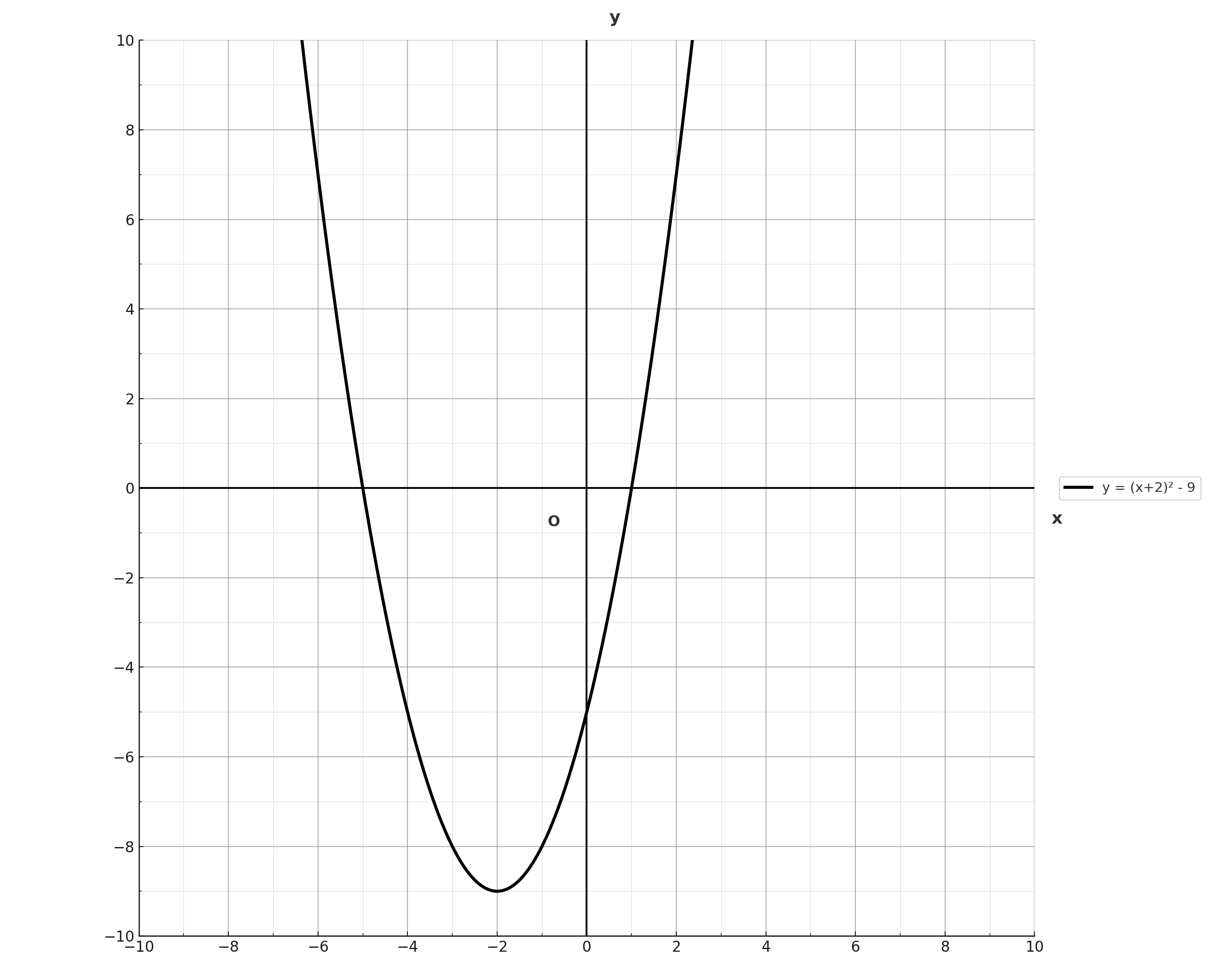
The graph of a quadratic function is shown in the xy-plane. The graph has a minimum at the point \(\mathrm{(h, k)}\). What is the value of \(\mathrm{h}\)?
1. INFER what the problem is asking
- The problem asks for the value of h, where \(\mathrm{(h, k)}\) is the minimum point of the parabola
- The minimum point of a parabola is called the vertex
- So we need to find the x-coordinate of the vertex
2. TRANSLATE the equation to identify the vertex
- The given equation is: \(\mathrm{y = (x+2)^2 - 9}\)
- This is in vertex form: \(\mathrm{y = (x-h)^2 + k}\), where \(\mathrm{(h,k)}\) is the vertex
- SIMPLIFY to match the forms:
- We have: \(\mathrm{y = (x+2)^2 - 9}\)
- Vertex form: \(\mathrm{y = (x-h)^2 + k}\)
- Notice that \(\mathrm{(x+2)^2 = (x-(-2))^2}\)
- This means \(\mathrm{h = -2}\) and \(\mathrm{k = -9}\)
3. INFER the vertex location and verify with the graph
- From the equation analysis: vertex is at \(\mathrm{(-2, -9)}\)
- Looking at the graph confirms this: the lowest point is at \(\mathrm{x = -2, y = -9}\)
- The problem asks for h, which is the x-coordinate
Answer: h = -2
Why Students Usually Falter on This Problem
Most Common Error Path:
Weak SIMPLIFY skill / Sign error: Students see \(\mathrm{(x+2)^2}\) and incorrectly conclude that \(\mathrm{h = +2}\), not recognizing that the vertex form requires \(\mathrm{(x-h)^2}\), so \(\mathrm{(x+2)^2 = (x-(-2))^2}\) means \(\mathrm{h = -2}\).
This leads them to answer +2 instead of -2, completely missing the sign convention of vertex form.
Second Most Common Error:
Poor INFER reasoning: Students may confuse which coordinate is being asked for. They correctly identify the vertex as \(\mathrm{(-2, -9)}\) but then provide \(\mathrm{k = -9}\) as their answer instead of \(\mathrm{h = -2}\), not carefully reading what the question asks for.
This causes them to answer -9 when the question specifically asks for h.
The Bottom Line:
This problem tests whether students understand the relationship between the algebraic form of a quadratic (specifically vertex form) and the geometric location of the vertex. The most critical skill is recognizing the sign convention: in \(\mathrm{y = (x-h)^2 + k}\), if you see \(\mathrm{(x+2)^2}\), that means \(\mathrm{h = -2}\), not +2. Students who rely only on visual inspection of the graph can get the right answer, but understanding the algebraic connection is more powerful for problems where graphs might be imprecise or unavailable.