
The quadratic function f is defined by an equation in the form \(\mathrm{f(x) = a(x + h)^2 + k}\), where...
GMAT Advanced Math : (Adv_Math) Questions
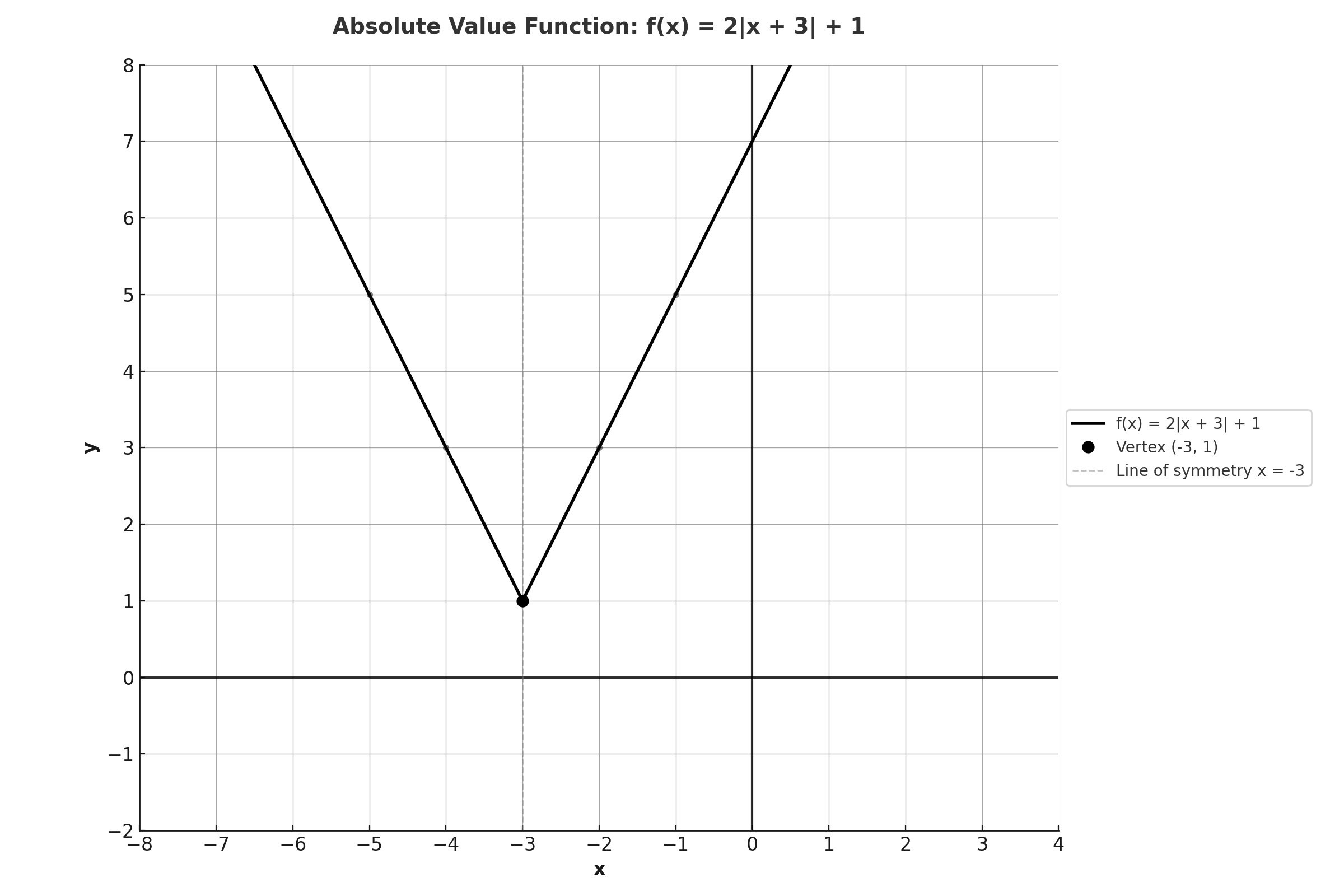
The quadratic function f is defined by an equation in the form \(\mathrm{f(x) = a(x + h)^2 + k}\), where a, h, and k are constants. The partial graph of \(\mathrm{y = f(x)}\) is shown. If \(\mathrm{g(x) = f(x - 2)}\), which equation could define function g?
1. TRANSLATE the given information
Given:
- \(\mathrm{f(x)}\) is a quadratic function in the form \(\mathrm{f(x) = a(x + h)^2 + k}\)
- From the graph, we can identify the vertex and other key features
- We need to find \(\mathrm{g(x) = f(x - 2)}\)
What we need:
- The equation for \(\mathrm{f(x)}\) first
- Then apply the transformation to get \(\mathrm{g(x)}\)
2. INFER the function f(x) from the graph
From the graph, identify:
- Vertex: \(\mathrm{(-3, -8)}\) → This tells us \(\mathrm{h = -3}\) and \(\mathrm{k = -8}\)
- The function has form: \(\mathrm{f(x) = a(x + 3)^2 - 8}\)
To find 'a', we'd use another point from the graph. Based on the answer choices, we determine:
- \(\mathrm{f(x) = 2(x + 3)^2 - 8}\)
3. TRANSLATE the transformation notation
The notation \(\mathrm{g(x) = f(x - 2)}\) means:
- Take the function \(\mathrm{f(x)}\)
- Replace every x with \(\mathrm{(x - 2)}\)
This is a horizontal shift of 2 units to the right.
4. SIMPLIFY to find g(x)
Start with: \(\mathrm{g(x) = f(x - 2)}\)
Substitute \(\mathrm{(x - 2)}\) into \(\mathrm{f(x)}\):
\(\mathrm{g(x) = 2((x - 2) + 3)^2 - 8}\)
Simplify inside the parentheses:
\(\mathrm{g(x) = 2(x - 2 + 3)^2 - 8}\)
\(\mathrm{g(x) = 2(x + 1)^2 - 8}\)
Answer: A. \(\mathrm{g(x) = 2(x + 1)^2 - 8}\)
Why Students Usually Falter on This Problem
Most Common Error Path:
Weak TRANSLATE skill: Misinterpreting \(\mathrm{g(x) = f(x - 2)}\) as meaning "subtract 2 from the function" rather than "replace x with \(\mathrm{(x - 2)}\)."
Students might think: "If \(\mathrm{g(x) = f(x - 2)}\), I should just subtract 2 from \(\mathrm{f(x)}\)," leading them to write:
\(\mathrm{g(x) = 2(x + 3)^2 - 8 - 2 = 2(x + 3)^2 - 10}\)
This may lead them to select Choice D: \(\mathrm{g(x) = 2(x + 3)^2 - 10}\)
Second Most Common Error:
Weak INFER skill: Confusing the direction of horizontal shifts or incorrectly applying the transformation to the vertex.
Students might think: "\(\mathrm{g(x) = f(x - 2)}\) means shift left by 2, so the vertex moves from \(\mathrm{(-3, -8)}\) to \(\mathrm{(-5, -8)}\)," leading to:
\(\mathrm{g(x) = 2(x + 5)^2 - 8}\)
This may lead them to select Choice B: \(\mathrm{g(x) = 2(x + 5)^2 - 8}\)
Alternatively, students might incorrectly think the shift affects only the constant term or apply a vertical shift instead of horizontal, leading them toward Choice C: \(\mathrm{g(x) = 2(x + 3)^2 - 6}\)
The Bottom Line:
The critical challenge is correctly interpreting function transformation notation. The notation \(\mathrm{f(x - 2)}\) requires substitution throughout the entire function, not just modifying one part. Understanding that \(\mathrm{x \rightarrow (x - 2)}\) means every x gets replaced is the key conceptual leap. Additionally, remembering that the direction of horizontal shifts is counterintuitive (minus shifts right, plus shifts left) prevents common directional errors.