
A rain barrel is partially filled at noon and then water flows into it at a constant rate for the...
GMAT Algebra : (Alg) Questions
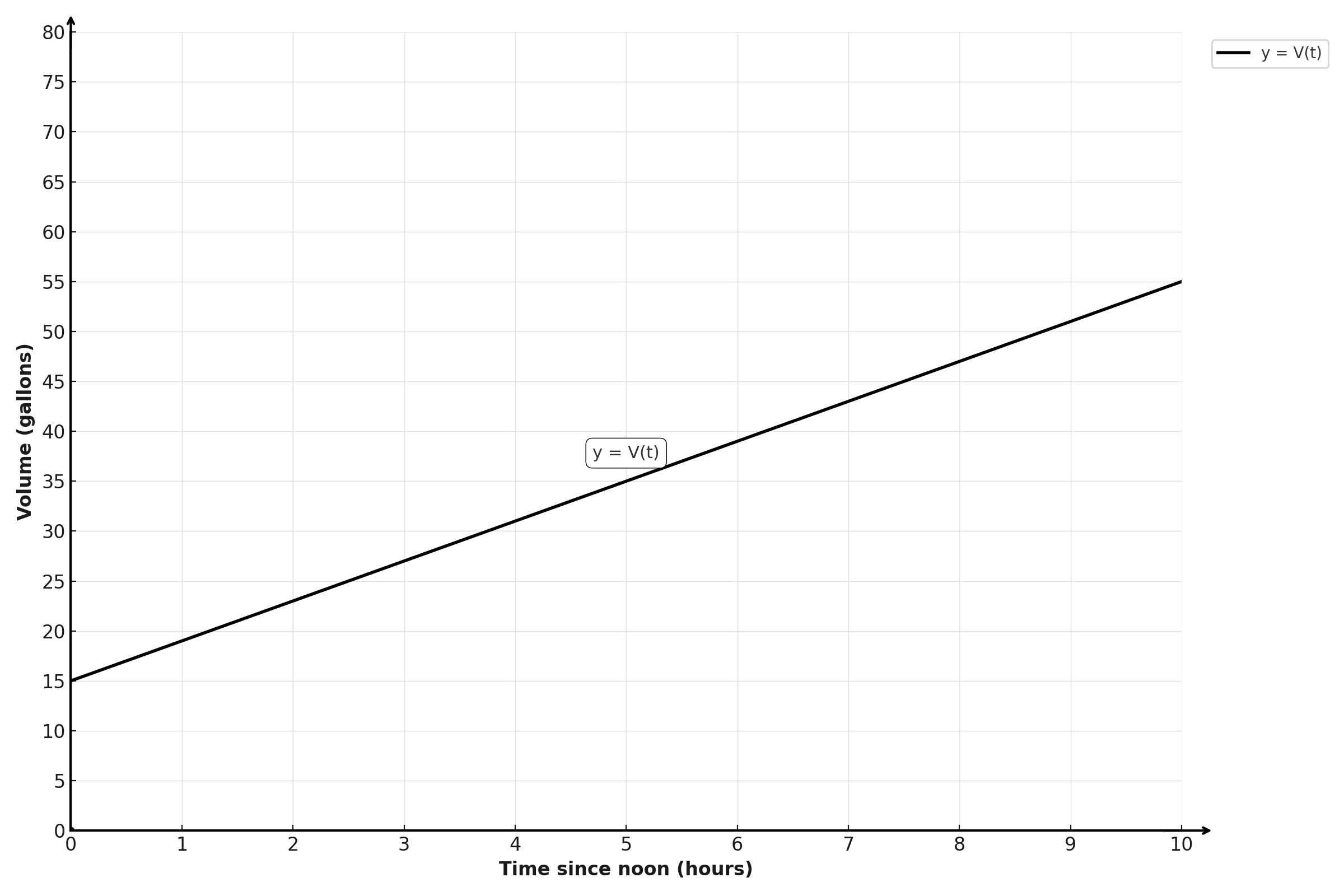
- A rain barrel is partially filled at noon and then water flows into it at a constant rate for the next several hours with no water removed.
- The figure shows the graph of \(\mathrm{y = V(t)}\), where \(\mathrm{V(t)}\) is the volume of water in the barrel, in gallons, \(\mathrm{t}\) hours after noon.
- To the nearest whole gallon, what is the initial volume of water in the barrel at noon?
1. TRANSLATE the problem information
The problem gives us:
- \(\mathrm{V(t)}\) = volume of water (in gallons) in the barrel
- \(\mathrm{t}\) = time in hours after noon
- We need the 'initial volume at noon'
Key translation: Since t measures hours after noon, then noon itself is when \(\mathrm{t = 0}\).
So 'initial volume at noon' translates to: Find \(\mathrm{V(0)}\)
2. INFER where to find \(\mathrm{V(0)}\) on the graph
To find \(\mathrm{V(0)}\), we need to determine what V equals when t equals 0.
On a graph:
- The horizontal axis shows t values
- The vertical axis shows V values
- When \(\mathrm{t = 0}\), we're at the y-axis
Strategic insight: \(\mathrm{V(0)}\) is the y-intercept—the point where the graph crosses the vertical axis.
3. TRANSLATE (read) the y-intercept from the graph
Looking at the graph where \(\mathrm{t = 0}\) (the y-axis):
- The line intersects the y-axis at the gridline marked 15
- Therefore, \(\mathrm{V(0) = 15}\) gallons
Answer: 15 gallons
Why Students Usually Falter on This Problem
Most Common Error Path:
Weak TRANSLATE skill: Not recognizing that 'initial volume at noon' means \(\mathrm{V(0)}\) because t represents 'hours after noon'
Some students may think:
- 'Initial' might mean some other special time value
- They might look for a labeled point on the graph
- They might try to use the slope or other point on the line
This leads to confusion and guessing among various values visible on the graph.
Second Most Common Error:
Poor TRANSLATE reasoning (graph reading): Misreading the y-intercept value
Students might:
- Read the value imprecisely, estimating it as 14 or 16
- Confuse the y-intercept with another nearby value
- Not align their reading properly with the gridlines
This may lead them to select an answer close to but not exactly 15.
The Bottom Line:
This problem tests whether students can connect real-world language ('initial,' 'at noon') to mathematical representations (\(\mathrm{t = 0}\), y-intercept). The key insight is understanding the domain of the function: since t counts hours after noon, noon itself is \(\mathrm{t = 0}\). Once that translation is made, the rest is straightforward graph reading.