
The function f is a rational function of the form \(\mathrm{f(x) = \frac{a}{x - c}}\), where a and c are...
GMAT Advanced Math : (Adv_Math) Questions
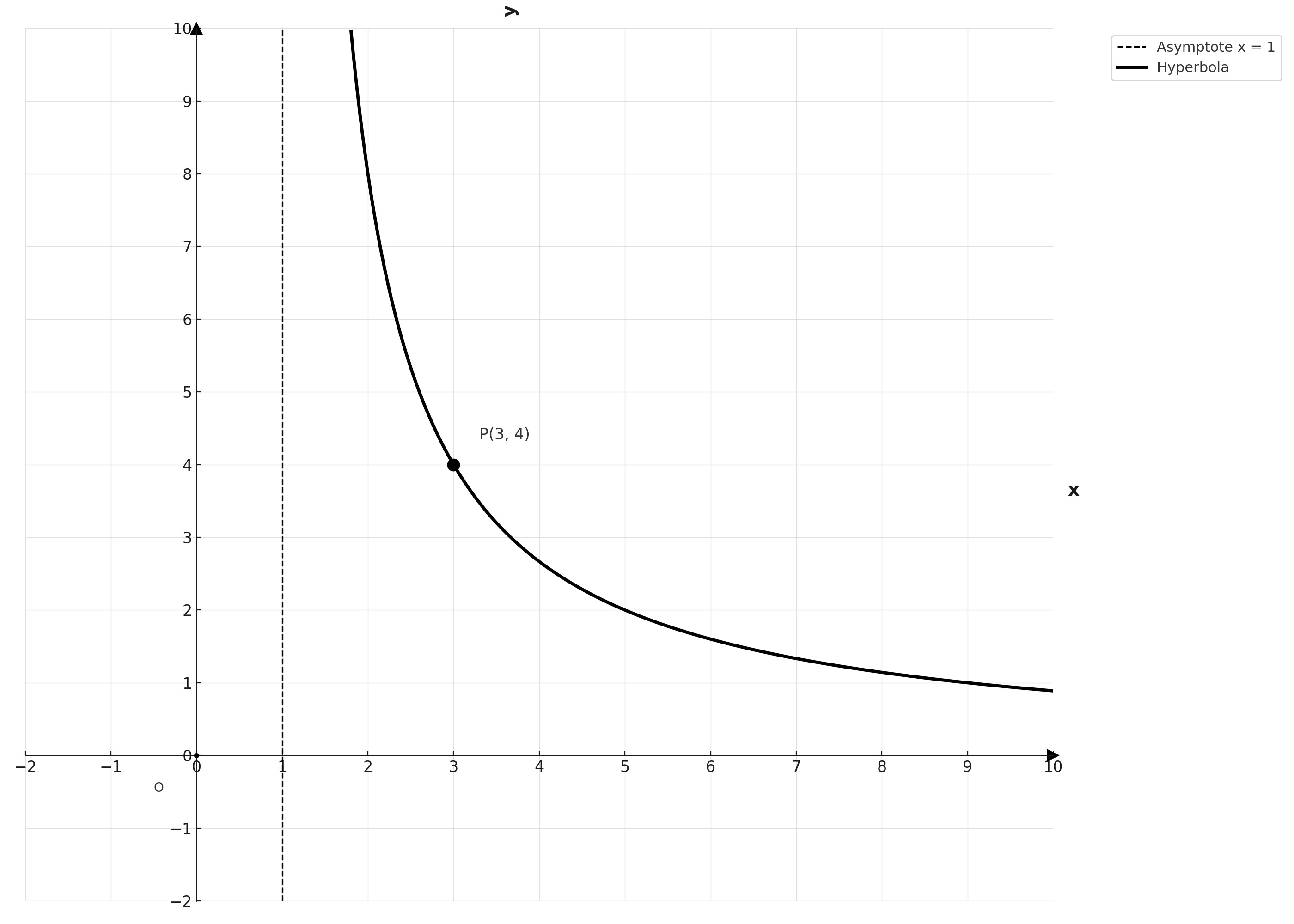
- The function \(\mathrm{f}\) is a rational function of the form \(\mathrm{f(x) = \frac{a}{x - c}}\), where \(\mathrm{a}\) and \(\mathrm{c}\) are real constants.
- The graph of \(\mathrm{y = f(x)}\) is shown on the coordinate plane. A vertical asymptote occurs at \(\mathrm{x = 1}\), and the graph passes through the labeled point \(\mathrm{P(3, 4)}\).
- Define \(\mathrm{g}\) by \(\mathrm{g(x) = f(x - 3)}\). Which equation could define \(\mathrm{g}\)?
1. TRANSLATE the problem information
From the graph and problem description:
- The function has the form \(\mathrm{f(x) = \frac{a}{x - c}}\)
- There's a vertical asymptote at \(\mathrm{x = 1}\) (shown as dashed line on graph)
- The graph passes through point \(\mathrm{P(3, 4)}\)
- We need to find \(\mathrm{g(x) = f(x - 3)}\)
2. INFER the value of c from the vertical asymptote
A vertical asymptote occurs where the denominator of a rational function equals zero.
For \(\mathrm{f(x) = \frac{a}{x - c}}\), the denominator \(\mathrm{(x - c)}\) equals zero when \(\mathrm{x = c}\).
Since we see the vertical asymptote at \(\mathrm{x = 1}\), we can INFER that:
- \(\mathrm{x - c = 0}\) when \(\mathrm{x = 1}\)
- Therefore, \(\mathrm{c = 1}\)
Now we know: \(\mathrm{f(x) = \frac{a}{x - 1}}\)
3. INFER the value of a using the given point
The graph passes through \(\mathrm{P(3, 4)}\), which means when \(\mathrm{x = 3}\), \(\mathrm{y = 4}\).
So \(\mathrm{f(3) = 4}\):
- \(\mathrm{\frac{a}{3 - 1} = 4}\)
- \(\mathrm{\frac{a}{2} = 4}\)
- \(\mathrm{a = 8}\)
Now we have the complete function: \(\mathrm{f(x) = \frac{8}{x - 1}}\)
4. TRANSLATE and SIMPLIFY to find g(x)
The problem states \(\mathrm{g(x) = f(x - 3)}\).
TRANSLATE this instruction: Replace every x in f(x) with (x - 3):
- \(\mathrm{g(x) = \frac{8}{(x - 3) - 1}}\)
SIMPLIFY the denominator:
- \(\mathrm{g(x) = \frac{8}{x - 3 - 1}}\)
- \(\mathrm{g(x) = \frac{8}{x - 4}}\)
5. Verify (optional but helpful)
The transformation \(\mathrm{x \rightarrow (x - 3)}\) shifts the graph 3 units to the right.
- Original vertical asymptote: \(\mathrm{x = 1}\)
- New vertical asymptote: \(\mathrm{x = 1 + 3 = 4}\) ✓
This matches our denominator \(\mathrm{(x - 4)}\), which equals zero at \(\mathrm{x = 4}\).
Answer: (C) \(\mathrm{g(x) = \frac{8}{x - 4}}\)
Why Students Usually Falter on This Problem
Most Common Error Path:
Weak INFER skill: Students may not connect the vertical asymptote location to the denominator structure. They might:
- Not realize that the asymptote at \(\mathrm{x = 1}\) means \(\mathrm{c = 1}\)
- Confuse the asymptote location with the value of a
- Try to work backward from the answer choices without understanding the underlying structure
This leads to confusion and guessing among the answer choices.
Second Most Common Error:
Poor SIMPLIFY execution: When finding \(\mathrm{g(x) = f(x - 3)}\), students might incorrectly simplify the denominator:
- They might write \(\mathrm{(x - 3) - 1 = x - 2}\) (forgetting to combine -3 and -1)
- Or they might write \(\mathrm{(x - 3) - 1 = x - 3 - 1}\) but then simplify to \(\mathrm{x - 3}\) instead of \(\mathrm{x - 4}\)
Getting \(\mathrm{x - 2}\) doesn't match any answer choice, leading to confusion. Getting \(\mathrm{x - 3}\) might lead them to examine Choice (D), which has \(\mathrm{(x - 3)}\) in it, even though it's the wrong form.
Third Error Path:
Misunderstanding transformation direction: Students might think \(\mathrm{g(x) = f(x - 3)}\) means subtracting 3 from the result or shifting left instead of right, leading them to:
- Incorrectly calculate the new asymptote location
- Select Choice (B) \(\mathrm{g(x) = \frac{8}{x - 1}}\), thinking the asymptote stays at \(\mathrm{x = 1}\)
The Bottom Line:
This problem requires connecting abstract concepts (vertical asymptotes and their relationship to denominators) with concrete function transformation rules. Students need both strong inference skills to decode the graph's information and careful algebraic simplification to execute the transformation correctly.