
The graph in the xy-plane models the possible combinations of length x, in meters (m), and width y, in meters,...
GMAT Algebra : (Alg) Questions
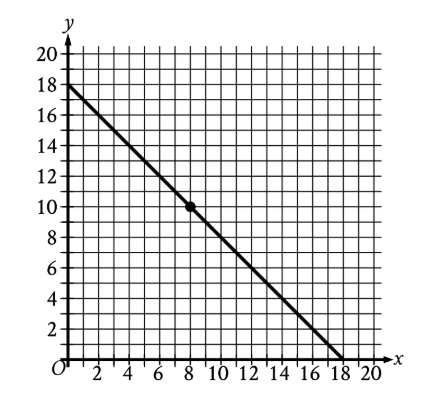
The graph in the xy-plane models the possible combinations of length \(\mathrm{x}\), in meters (m), and width \(\mathrm{y}\), in meters, for a rectangle with a perimeter of 36 m. Which statement is the best interpretation of the point \(\mathrm{(8, 10)}\) in this context?
The length is 10 m less than the perimeter, and the width is 8 m less than the perimeter.
The length is 10 m, and the width is 8 m.
The length is 8 m, and the width is 10 m.
The length is 8 m less than the perimeter, and the width is 10 m less than the perimeter.
1. TRANSLATE the problem setup
Given information:
- The graph models combinations of length \(\mathrm{(x)}\) and width \(\mathrm{(y)}\) for a rectangle
- \(\mathrm{x} =\) length in meters
- \(\mathrm{y} =\) width in meters
- Perimeter \(= 36\) m
- We need to interpret the point \(\mathrm{(8, 10)}\)
2. TRANSLATE the coordinate point
Apply coordinate notation:
- Any point in the xy-plane is written as \(\mathrm{(x, y)}\)
- The first number is always the x-coordinate
- The second number is always the y-coordinate
For the point (8, 10):
- x-coordinate \(= 8\)
- y-coordinate \(= 10\)
3. INFER the real-world meaning
Connect the coordinates to the context:
- Since \(\mathrm{x}\) represents length: length \(= 8\) m
- Since \(\mathrm{y}\) represents width: width \(= 10\) m
The point \(\mathrm{(8, 10)}\) tells us this particular rectangle has a length of 8 meters and a width of 10 meters.
Answer: C - The length is 8 m, and the width is 10 m.
Why Students Usually Falter on This Problem
Most Common Error Path:
TRANSLATE - Coordinate confusion: Students reverse the coordinate order in their interpretation. They might think "I see the numbers 8 and 10" without carefully tracking which coordinate position corresponds to which variable. Some students may read left-to-right through the answer choices and match the first variable (length) with the first number they see in the options (10), rather than with the first coordinate in the point (8).
This leads them to select Choice B (The length is 10 m, and the width is 8 m).
Second Most Common Error Path:
TRANSLATE - Overcomplicating the problem: Students see the perimeter value (36 m) prominently mentioned and assume they need to perform calculations with it. They might think the coordinates represent "how much less than the perimeter" each dimension is, calculating \(36 - 8 = 28\) and \(36 - 10 = 26\), then trying to match this to answer choices.
This leads to confusion and may cause them to select Choice D or Choice A, depending on which coordinate they associate with which dimension.
The Bottom Line:
This problem tests the fundamental skill of translating coordinate notation into context-specific meaning. The key is remembering that \(\mathrm{(x, y)}\) always means the first number is \(\mathrm{x}\) and the second is \(\mathrm{y}\)—then simply applying the given definitions of what \(\mathrm{x}\) and \(\mathrm{y}\) represent. Don't overthink it by trying to incorporate every piece of given information (like the perimeter value) when the question only asks for a direct interpretation of the point.
The length is 10 m less than the perimeter, and the width is 8 m less than the perimeter.
The length is 10 m, and the width is 8 m.
The length is 8 m, and the width is 10 m.
The length is 8 m less than the perimeter, and the width is 10 m less than the perimeter.