
In the figure above, regular octagon ABCDEFGH is inscribed in a circle with center O. The vertices are labeled consecutively...
GMAT Geometry & Trigonometry : (Geo_Trig) Questions
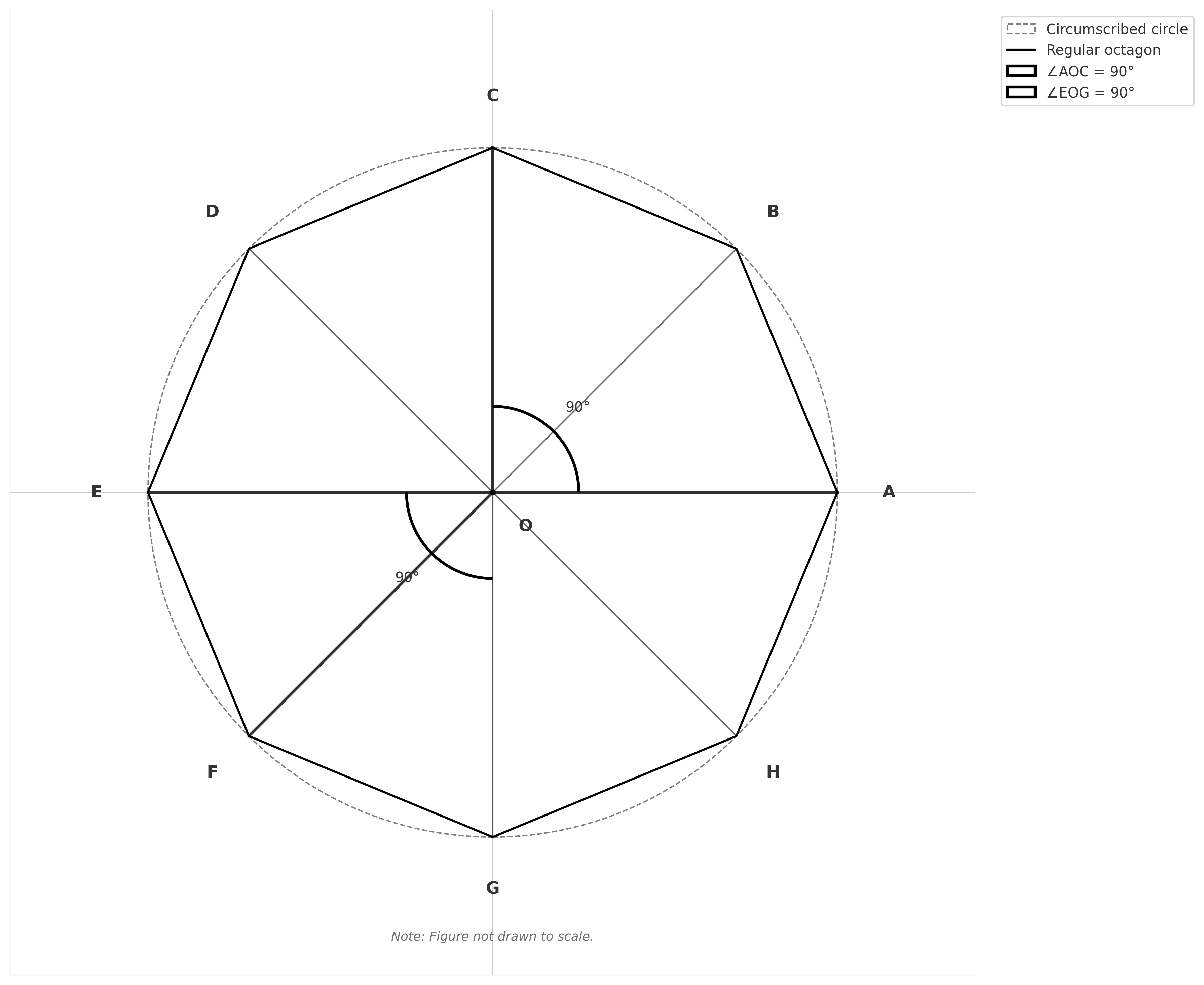
In the figure above, regular octagon ABCDEFGH is inscribed in a circle with center O. The vertices are labeled consecutively in counterclockwise order, starting with vertex A. If central angles \(\mathrm{AOC}\) and \(\mathrm{EOF}\) each measure \(\mathrm{90°}\), what is the radian measure of central angle \(\mathrm{COF}\)?
\(\frac{\pi}{4}\)
\(\frac{\pi}{2}\)
\(\frac{3\pi}{4}\)
\(\pi\)
1. INFER the key property of regular octagons
When a regular polygon is inscribed in a circle, its vertices divide the circle into equal parts.
- For a regular octagon (8 sides):
- The 8 vertices divide the full 360° circle into 8 equal parts
- Central angle between consecutive vertices = \(360° \div 8 = 45°\)
This is the foundation for finding any central angle in the octagon.
2. TRANSLATE the vertex labels into positions
The problem tells us vertices are labeled "consecutively in counterclockwise order, starting with vertex A."
- This means:
- A is at position 0 (starting point)
- B is at position 1 (one step counterclockwise)
- C is at position 2 (two steps counterclockwise)
- And so on...
3. INFER the angular positions using the consecutive spacing
Since each step is 45°, we can find each vertex's angle from A:
- Vertex C: \(2 \times 45° = 90°\)
- This confirms the given information that \(\angle \mathrm{AOC} = 90°\) ✓
- Vertex E: \(4 \times 45° = 180°\)
- Vertex F: \(5 \times 45° = 225°\)
4. SIMPLIFY to find ∠COF
The central angle COF spans from C to F:
- \(\angle \mathrm{COF} = \text{(position of F)} - \text{(position of C)}\)
- \(\angle \mathrm{COF} = 225° - 90° = 135°\)
5. TRANSLATE degrees to radians
The answer choices are in radians, so we need to convert:
- Use the conversion: \(\text{degrees} \times (\pi/180°) = \text{radians}\)
- \(135° \times (\pi/180°) = 135\pi/180\)
- SIMPLIFY: Reduce the fraction by dividing both numerator and denominator by 45
- \(135\pi/180 = 3\pi/4\)
Answer: \(3\pi/4\) or Choice (C)
Why Students Usually Falter on This Problem
Most Common Error Path:
Weak INFER skill: Not recognizing that vertex spacing gives the angular positions
Many students understand that consecutive vertices are 45° apart, but they fail to realize this means they can calculate the position of ANY vertex by counting steps from A.
Instead, they might:
- Try to measure angles from the diagram (which is stated as "not to scale")
- Attempt to use properties of octagon interior angles (135°) which aren't relevant to central angles
- Get confused about which angles to add or subtract
This leads to confusion and guessing among the answer choices.
Second Most Common Error:
Poor SIMPLIFY execution: Making errors in the degree-to-radian conversion
Students might:
- Correctly find \(\angle \mathrm{COF} = 135°\)
- Start the conversion: \(135° \times \pi/180°\)
- Incorrectly simplify \(135/180\), perhaps getting:
- \(135/180 = 27/36 = 9/12 = 3/4\), then incorrectly write as \(\pi/4\)
- Or fail to reduce completely and leave it as \(27\pi/36\)
This may lead them to select Choice (A) (\(\pi/4\)) if they drop a factor during simplification.
The Bottom Line:
This problem requires spatial reasoning about how regular polygons divide circles. The key breakthrough is realizing that "consecutively labeled vertices" means you can multiply \(\text{(number of steps)} \times 45°\) to find any vertex's angular position. Without this insight, students resort to guessing or trying to extract information from an unlabeled, not-to-scale diagram.
\(\frac{\pi}{4}\)
\(\frac{\pi}{2}\)
\(\frac{3\pi}{4}\)
\(\pi\)