
The figure above shows rhombus PQRS in the xy-plane. The vertices of the rhombus are on the x- and y-axes....
GMAT Geometry & Trigonometry : (Geo_Trig) Questions
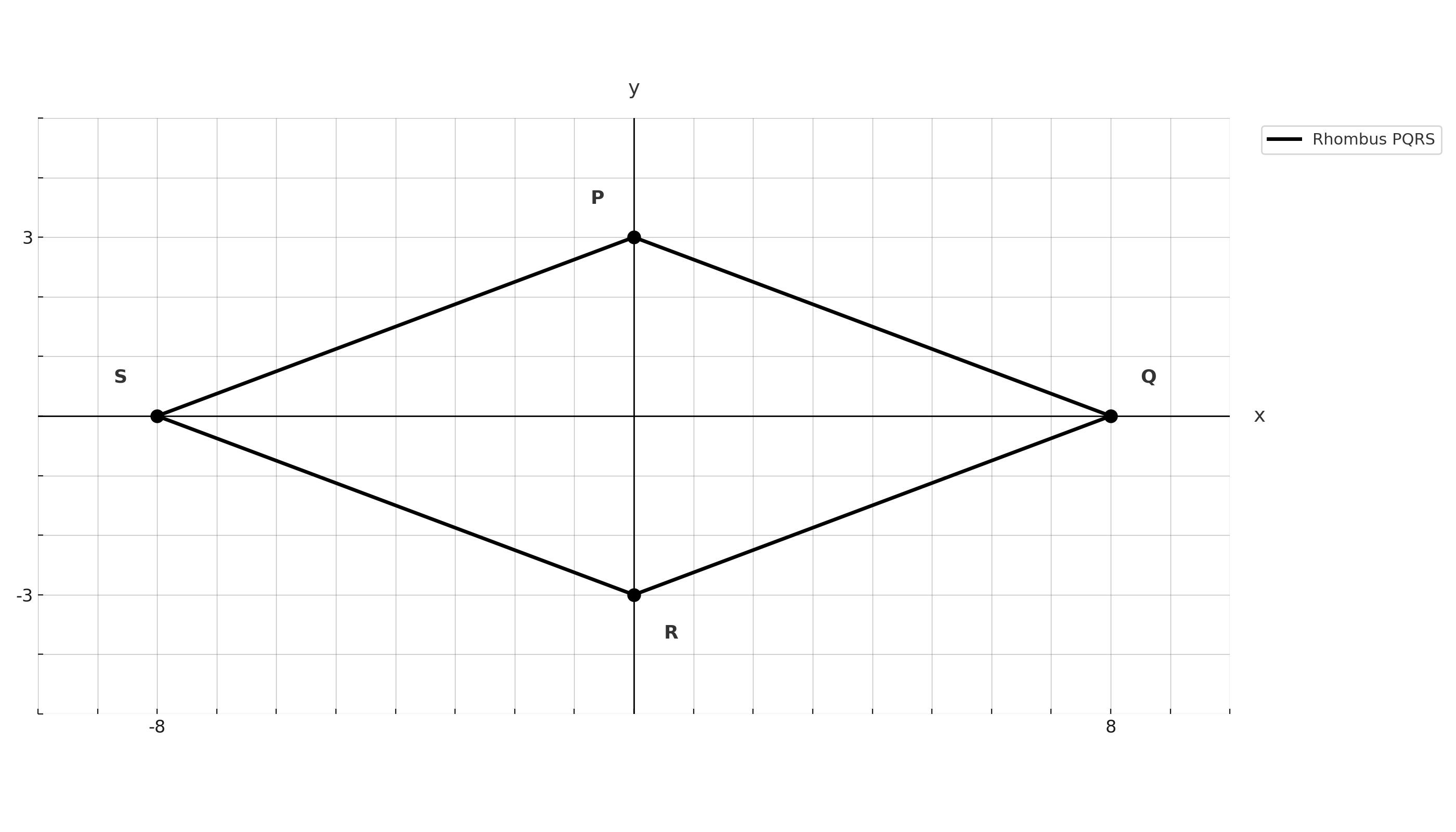
The figure above shows rhombus PQRS in the xy-plane. The vertices of the rhombus are on the x- and y-axes. What is the area, in square units, of the rhombus?
1. TRANSLATE the graph information
- TRANSLATE the vertex coordinates from the graph:
- P is at \(\mathrm{(0, 3)}\) - on the positive y-axis
- Q is at \(\mathrm{(8, 0)}\) - on the positive x-axis
- R is at \(\mathrm{(0, -3)}\) - on the negative y-axis
- S is at \(\mathrm{(-8, 0)}\) - on the negative x-axis
2. INFER the structure of the rhombus
- Notice that the diagonals of the rhombus lie exactly on the coordinate axes:
- Diagonal PR runs vertically along the y-axis
- Diagonal QS runs horizontally along the x-axis
- Since we know the area formula for a rhombus uses diagonal lengths, our strategy is to:
- Find the length of each diagonal
- Apply the area formula
3. SIMPLIFY to find the diagonal lengths
- For diagonal PR (vertical):
- Goes from \(\mathrm{y = 3}\) to \(\mathrm{y = -3}\)
- Length = \(\mathrm{3 - (-3) = 3 + 3 = 6}\) units
- For diagonal QS (horizontal):
- Goes from \(\mathrm{x = -8}\) to \(\mathrm{x = 8}\)
- Length = \(\mathrm{8 - (-8) = 8 + 8 = 16}\) units
4. APPLY the rhombus area formula
- The area formula is: \(\mathrm{A = \frac{d_1 \times d_2}{2}}\)
- Substituting our values:
- \(\mathrm{A = \frac{6 \times 16}{2}}\)
- \(\mathrm{A = \frac{96}{2}}\)
- \(\mathrm{A = 48}\)
Answer: 48 square units
Why Students Usually Falter on This Problem
Most Common Error Path:
Weak TRANSLATE skill: Students misread coordinates, especially when dealing with negative values. For example, they might read R as \(\mathrm{(0, 3)}\) instead of \(\mathrm{(0, -3)}\), or they might count grid squares incorrectly.
When calculating diagonal PR, they might get: \(\mathrm{3 - 3 = 0}\) (if they thought both P and R were at \(\mathrm{y = 3}\)), which makes no sense. Or they might get just 3 units instead of 6 units (by not accounting for the distance below the x-axis). Similarly for diagonal QS, they might calculate only half the length (8 units instead of 16).
Using incorrect diagonal lengths like \(\mathrm{d_1 = 3}\) and \(\mathrm{d_2 = 8}\) would give: \(\mathrm{A = \frac{3 \times 8}{2} = 12}\) square units, which is significantly off. This leads to confusion when they don't see this answer matching any expectation, causing them to guess.
Second Most Common Error:
Missing conceptual knowledge: Students don't remember or don't recognize the area formula for a rhombus using diagonals. They might try to find the side length instead or attempt to use base × height without identifying what the "height" is.
Without knowing \(\mathrm{A = \frac{d_1 \times d_2}{2}}\), students might attempt to calculate the distance from S to P using the distance formula: \(\mathrm{\sqrt{(0-(-8))^2 + (3-0)^2} = \sqrt{64 + 9} = \sqrt{73} \approx 8.54}\). Then they get stuck trying to figure out how to use this to find area, leading to abandoned calculations and guessing.
The Bottom Line:
This problem requires both careful graph reading (especially with negative coordinates) and knowing the specific area formula for a rhombus. The symmetric position on the axes makes the diagonal lengths easy to calculate if you recognize what you're looking for, but students who try to force the problem into a "base times height" approach will struggle.