
In the figure, two roads ST and UV intersect at point W. Road segments SU and TV run parallel to...
GMAT Geometry & Trigonometry : (Geo_Trig) Questions
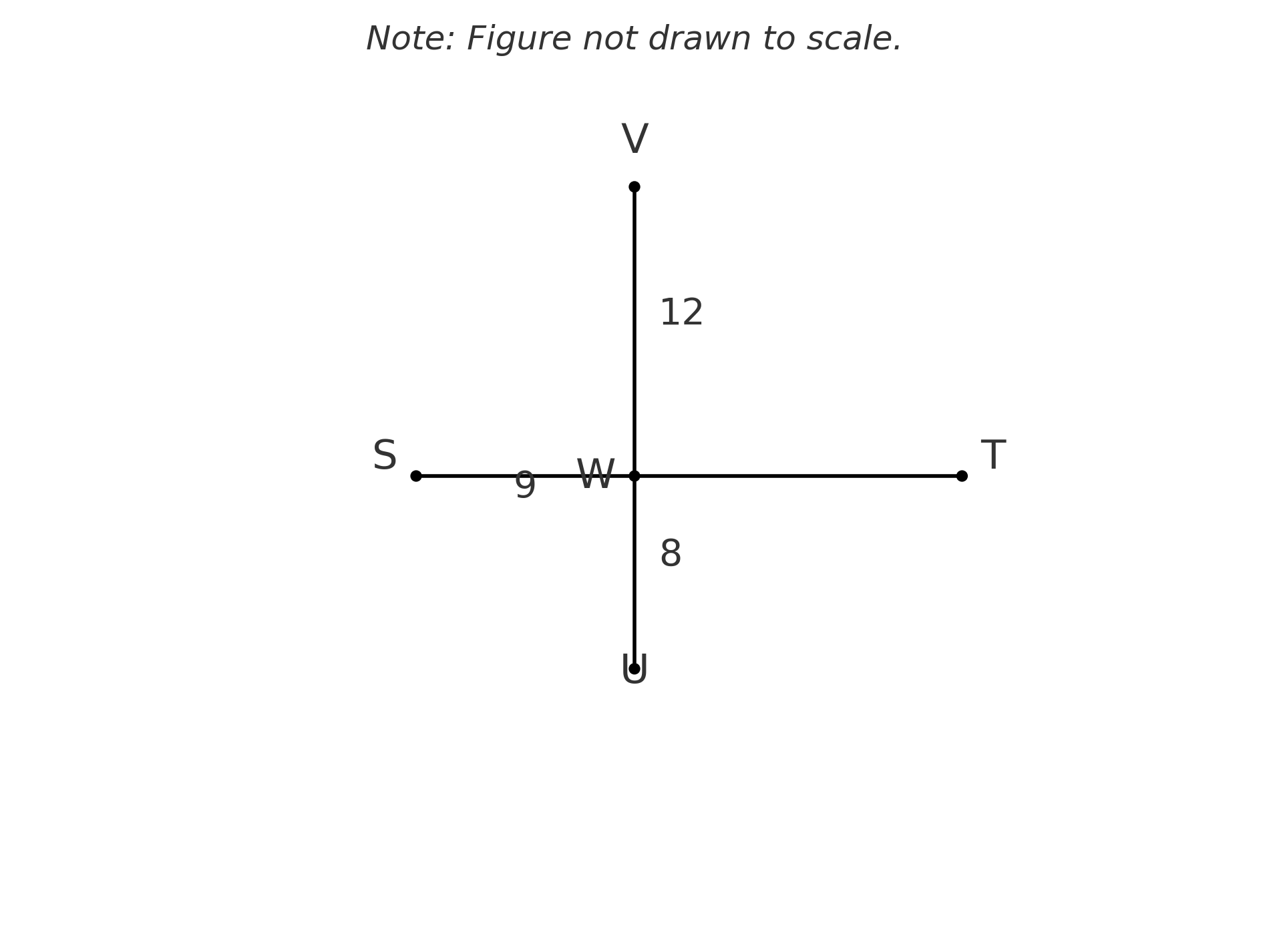
In the figure, two roads ST and UV intersect at point W. Road segments SU and TV run parallel to each other. The distances are \(\mathrm{SW = 9}\) miles, \(\mathrm{UW = 8}\) miles, and \(\mathrm{WV = 12}\) miles. What is the total length of road ST in miles?
\(\frac{21}{2}\)
\(\frac{45}{2}\)
\(\frac{51}{2}\)
\(\frac{27}{2}\)
1. TRANSLATE the problem information
- Given information:
- Roads ST and UV intersect at point W
- SU || TV (parallel segments)
- SW = 9 miles
- UW = 8 miles
- WV = 12 miles
- What we need to find:
- Total length of road ST (which equals SW + TW)
2. INFER the geometric relationships
- Key insight: When parallel segments SU and TV are connected by intersecting lines (the roads), they form similar triangles.
- Looking at the figure, we can identify:
- Triangle SWU (with vertices S, W, U)
- Triangle TWV (with vertices T, W, V)
- These triangles are similar because:
- They share vertical angles at W (these angles are equal)
- Because SU || TV, corresponding angles are equal when cut by the transversals
- This is AA (Angle-Angle) similarity!
3. TRANSLATE similarity into proportions
- Since triangles SWU and TWV are similar, their corresponding sides must be proportional.
- The sides correspond as follows:
- SW corresponds to TW
- UW corresponds to VW
- SU corresponds to TV
- This gives us the proportion:
\(\frac{\mathrm{SW}}{\mathrm{TW}} = \frac{\mathrm{UW}}{\mathrm{VW}}\)
4. SIMPLIFY to find TW
- Substitute the known values:
\(\frac{9}{\mathrm{TW}} = \frac{8}{12}\)
- Simplify the right side:
\(\frac{9}{\mathrm{TW}} = \frac{2}{3}\)
- Cross-multiply:
\(9 \times 3 = 2 \times \mathrm{TW}\)
\(27 = 2 \times \mathrm{TW}\)
- Solve for TW:
\(\mathrm{TW} = \frac{27}{2}\) miles
5. INFER what we need for the final answer
- The question asks for the total length of road ST, not just TW.
- Road ST consists of two segments: SW and TW
- Total length: \(\mathrm{ST} = \mathrm{SW} + \mathrm{TW}\)
6. SIMPLIFY the final calculation
- \(\mathrm{ST} = 9 + \frac{27}{2}\)
- Convert 9 to halves: \(9 = \frac{18}{2}\)
- Add: \(\mathrm{ST} = \frac{18}{2} + \frac{27}{2} = \frac{45}{2}\) miles
Answer: (B) \(\frac{45}{2}\) miles
Why Students Usually Falter on This Problem
Most Common Error Path:
Weak INFER skill: Students fail to recognize that the parallel segments create similar triangles, or they identify the wrong pair of triangles as similar.
Some students might think they should use the Pythagorean theorem to find distances, or try to set up proportions using the wrong triangle pairs. Without recognizing the similar triangles SWU and TWV, students cannot set up the correct proportion and get stuck, leading to confusion and guessing.
Second Most Common Error:
Poor SIMPLIFY execution: Students correctly set up the proportion \(\frac{9}{\mathrm{TW}} = \frac{8}{12}\) but make errors in solving it, or they correctly find \(\mathrm{TW} = \frac{27}{2}\) but forget to add SW to get the total length.
For example, a student might incorrectly cross-multiply as \(9 \times 12 = 8 \times \mathrm{TW}\), getting \(\mathrm{TW} = \frac{108}{8} = \frac{27}{2}\) (which happens to be correct by coincidence), but then forget to add the 9 miles of SW. They would answer \(\frac{27}{2}\), which equals Choice (D) \(\left(\frac{27}{2}\right)\).
Alternatively, students might make arithmetic errors when adding fractions: instead of converting 9 to \(\frac{18}{2}\), they might incorrectly compute \(9 + \frac{27}{2}\) as \(\frac{36}{2}\) or \(\frac{51}{2}\), leading them to select Choice (C) \(\left(\frac{51}{2}\right)\).
The Bottom Line:
This problem tests whether students can recognize similar triangles formed by parallel lines in a real-world context (intersecting roads) and whether they can carefully execute the multi-step solution involving proportions and fraction arithmetic. The key challenge is the initial geometric insight—once you see the similar triangles, the rest follows systematically.
\(\frac{21}{2}\)
\(\frac{45}{2}\)
\(\frac{51}{2}\)
\(\frac{27}{2}\)