
In the figure, a rectangle has side lengths m = 6 and n = 8.A diagonal of the rectangle is...
GMAT Geometry & Trigonometry : (Geo_Trig) Questions
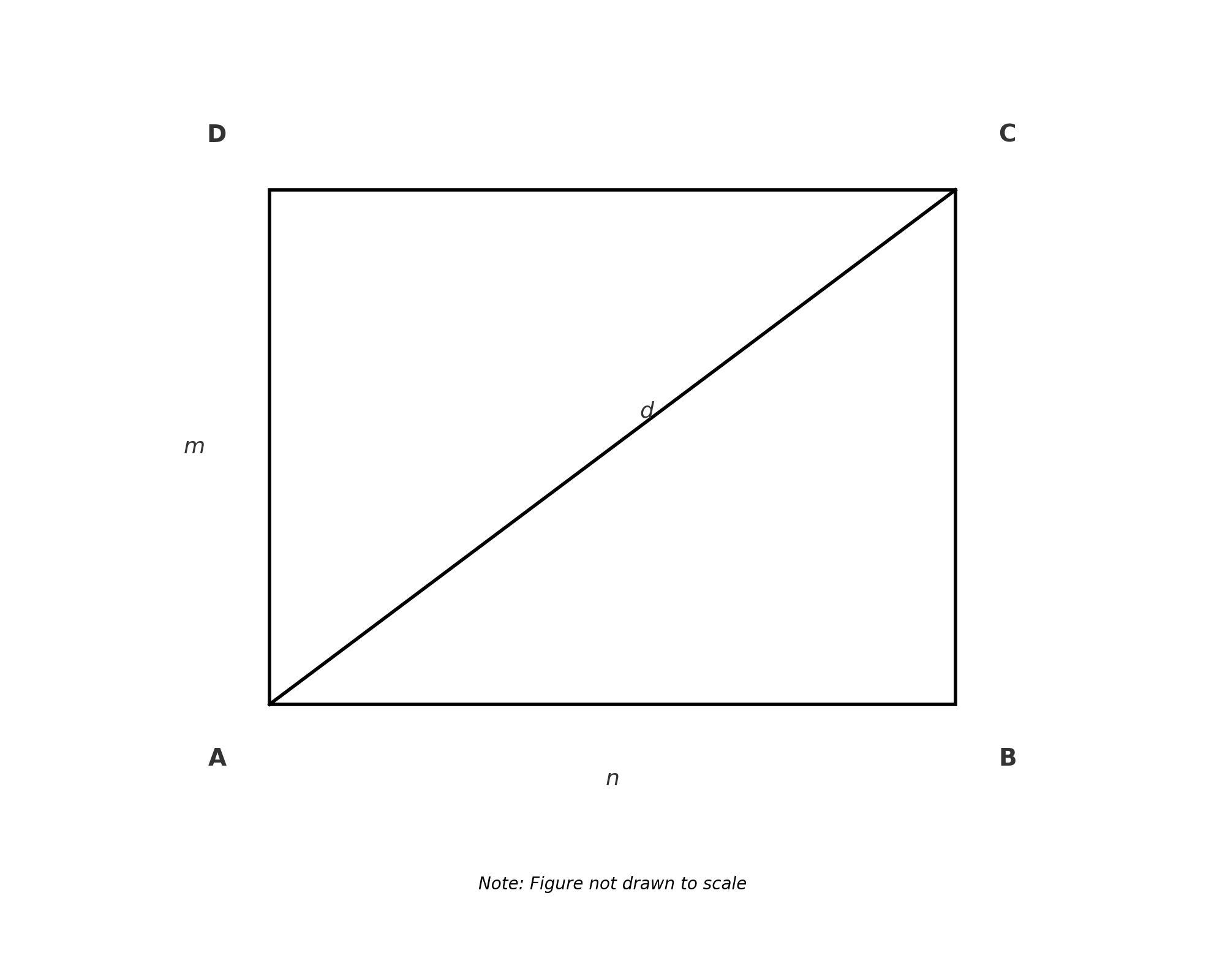
- In the figure, a rectangle has side lengths \(\mathrm{m = 6}\) and \(\mathrm{n = 8}\).
- A diagonal of the rectangle is drawn and labeled \(\mathrm{d}\).
- Which expression gives the exact value of \(\mathrm{d}\)?
1. TRANSLATE the problem information
Looking at the diagram and problem:
- Given information:
- Rectangle ABCD with vertices labeled
- Horizontal side (AB): \(\mathrm{n = 8}\)
- Vertical side (AD): \(\mathrm{m = 6}\)
- Diagonal from A to C is labeled \(\mathrm{d}\)
- What we need: An expression that gives the exact value of \(\mathrm{d}\) (not a numerical answer, but the expression itself)
2. INFER the geometric relationship
Here's the key insight: When you draw a diagonal across a rectangle, it creates a right triangle.
Why? Because all angles in a rectangle are \(\mathrm{90°}\). So:
- The diagonal AC becomes the hypotenuse
- The two sides of the rectangle (AB and BC) become the legs of the right triangle
Since we have a right triangle with:
- One leg = \(\mathrm{m = 6}\)
- Other leg = \(\mathrm{n = 8}\)
- Hypotenuse = \(\mathrm{d}\)
We can use the Pythagorean theorem!
3. TRANSLATE the Pythagorean theorem
For a right triangle: \(\mathrm{(leg_1)^2 + (leg_2)^2 = (hypotenuse)^2}\)
Substituting our values:
\(\mathrm{m^2 + n^2 = d^2}\)
\(\mathrm{6^2 + 8^2 = d^2}\)
4. Solve for d
To find \(\mathrm{d}\), take the square root of both sides:
\(\mathrm{d = \sqrt{m^2 + n^2}}\)
\(\mathrm{d = \sqrt{6^2 + 8^2}}\)
5. TRANSLATE to match answer choices
Looking at the options, we need the expression exactly as written:
Choice (D): \(\mathrm{\sqrt{6^2 + 8^2}}\)
This matches our expression exactly!
Answer: D
Why Students Usually Falter on This Problem
Most Common Error Path:
Weak INFER skill: Students don't recognize that the diagonal creates a right triangle, so they don't see that the Pythagorean theorem applies. Instead, they think about the problem as "two sides combine to make a diagonal" and simply add the lengths together.
Their reasoning: "The diagonal goes across both dimensions, so I should add them: \(\mathrm{6 + 8}\)"
This leads them to select Choice A (\(\mathrm{6 + 8}\)).
Second Most Common Error:
Incomplete conceptual knowledge of Pythagorean theorem: Students remember that the Pythagorean theorem involves squares and square roots, but don't recall the exact form. They might think:
- "I need to multiply the sides somehow and take a square root"
- Or they confuse it with the geometric mean formula
This confusion may lead them to select Choice B (\(\mathrm{\sqrt{6 \cdot 8}}\)), which looks mathematical but uses multiplication instead of the sum of squares.
The Bottom Line:
This problem tests whether students can recognize a familiar formula (Pythagorean theorem) hidden in a geometric context (rectangle diagonal). The key breakthrough is INFERRING that a rectangle's diagonal forms a right triangle—without this insight, students resort to simpler but incorrect operations like addition or multiplication.