
In the figure, triangle ACE is a right triangle with a right angle at C. Point B is on side...
GMAT Geometry & Trigonometry : (Geo_Trig) Questions
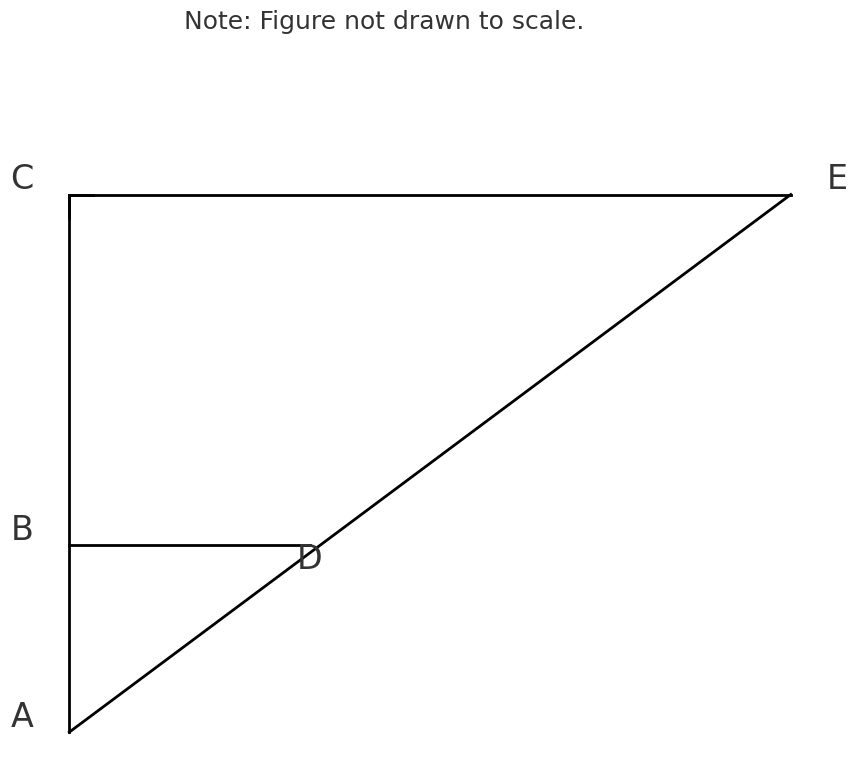
In the figure, triangle \(\mathrm{ACE}\) is a right triangle with a right angle at \(\mathrm{C}\). Point \(\mathrm{B}\) is on side \(\mathrm{AC}\) and point \(\mathrm{D}\) is on side \(\mathrm{AE}\) such that segment \(\mathrm{BD}\) is parallel to segment \(\mathrm{CE}\). If the length of \(\mathrm{AB}\) is \(\mathrm{5}\), the length of \(\mathrm{AD}\) is \(\mathrm{7}\), and the length of \(\mathrm{DE}\) is \(\mathrm{9}\), what is the length of \(\mathrm{BC}\)?
1. TRANSLATE the problem information
- Given information:
- Triangle ACE with right angle at C
- B is on segment AC, D is on segment AE
- BD || CE (parallel segments)
- AB = 5
- AD = 7
- DE = 9
- What we need to find: BC (the remaining part of side AC)
2. INFER the geometric relationship
This is the crucial insight: When BD is parallel to CE, and both are intersected by the sides of triangle ACE, we create two triangles that share angle A.
- Key recognition: Triangle ABD and triangle ACE are similar triangles
- Why they're similar:
- Angle A is common to both triangles
- Since BD || CE, corresponding angles are equal:
- Angle ADB = Angle AEC (corresponding angles with transversal AE)
- Angle ABD = Angle ACE (corresponding angles with transversal AC)
By the AA similarity criterion (two angles equal means all three angles equal), we have:
Triangle ABD ~ Triangle ACE
3. TRANSLATE similarity into proportions
Similar triangles have a powerful property: all corresponding sides are proportional.
From triangle ABD ~ triangle ACE, we can write:
\(\frac{\mathrm{AB}}{\mathrm{AC}} = \frac{\mathrm{AD}}{\mathrm{AE}} = \frac{\mathrm{BD}}{\mathrm{CE}}\)
We'll use the first two ratios since we have information about those sides.
4. TRANSLATE unknowns into algebraic expressions
Before we can use our proportion, we need to express everything in terms of what we know:
- Find AE: Since D is on segment AE between A and E:
AE = AD + DE = 7 + 9 = 16
- Express AC: Since B is on segment AC between A and C:
AC = AB + BC = 5 + BC
Now our proportion becomes:
\(\frac{5}{5 + \mathrm{BC}} = \frac{7}{16}\)
5. SIMPLIFY to solve for BC
Cross-multiply:
\(5 \times 16 = 7 \times (5 + \mathrm{BC})\)
\(80 = 35 + 7\mathrm{BC}\)
Subtract 35 from both sides:
\(45 = 7\mathrm{BC}\)
Divide by 7:
\(\mathrm{BC} = \frac{45}{7}\)
Answer: 45/7 (Choice C)
Why Students Usually Falter on This Problem
Most Common Error Path:
Weak INFER skill: Not recognizing that BD || CE creates similar triangles
Many students see the parallel lines but don't make the connection that this creates similar triangles. They might try to use the parallel lines in other ways (like setting up equal ratios directly from the parallel segments) or attempt to use the right angle at C without the similarity relationship. Without identifying triangle ABD ~ triangle ACE, students have no systematic approach and may resort to guessing or trying arithmetic combinations of the given numbers.
This leads to confusion and guessing among the answer choices.
Second Most Common Error:
Poor TRANSLATE reasoning: Setting up an incorrect proportion
Some students recognize the similar triangles but set up the wrong proportion. Common mistakes include:
- Using AB/AD = BC/DE (matching parts that aren't actually corresponding sides)
- Writing 5/7 = BC/9 (treating segments as if they correspond when they don't)
- Using AB/AE = AD/AC (reversing which triangle each measurement belongs to)
For example, if a student incorrectly reasons that AB/AD = BC/DE, they get:
5/7 = BC/9 → BC = 45/7... which happens to be correct! But using 5/7 = AC/AE leads to 5/7 = (5+BC)/16 → 80 = 35 + 7BC would also work.
However, other incorrect proportions like AB/AD = BC/CE or similar mistakes lead to wrong values that might match Choice A (35/9) or Choice B (10/7) depending on the specific error.
Third Common Error:
SIMPLIFY execution error: Algebraic mistakes when solving the proportion
Even with the correct proportion 5/(5 + BC) = 7/16, students can make errors:
- Wrong cross-multiplication: Writing 5 × 7 = 16 × (5 + BC), leading to 35 = 80 + 16BC → BC = -45/16 (doesn't match any choice, causes confusion)
- Arithmetic errors: Computing 5 × 16 = 70 instead of 80, or 7 × 5 = 40 instead of 35
- Isolation errors: After getting 80 = 35 + 7BC, computing BC = 80/7 by dividing incorrectly
The error of getting 80/7 (forgetting to subtract 35 first) would lead them to select Choice D (80/7).
The Bottom Line:
This problem tests whether students can recognize geometric similarity created by parallel lines and then accurately translate that relationship into algebraic proportions. The multi-step nature (identify similarity → set up proportion → solve equation) means errors can occur at any stage, but the most critical skill is the initial geometric insight that unlocks the entire solution.