
The figure shown is a right circular cylinder with a radius of r and height of h. The lateral surface...
GMAT Geometry & Trigonometry : (Geo_Trig) Questions
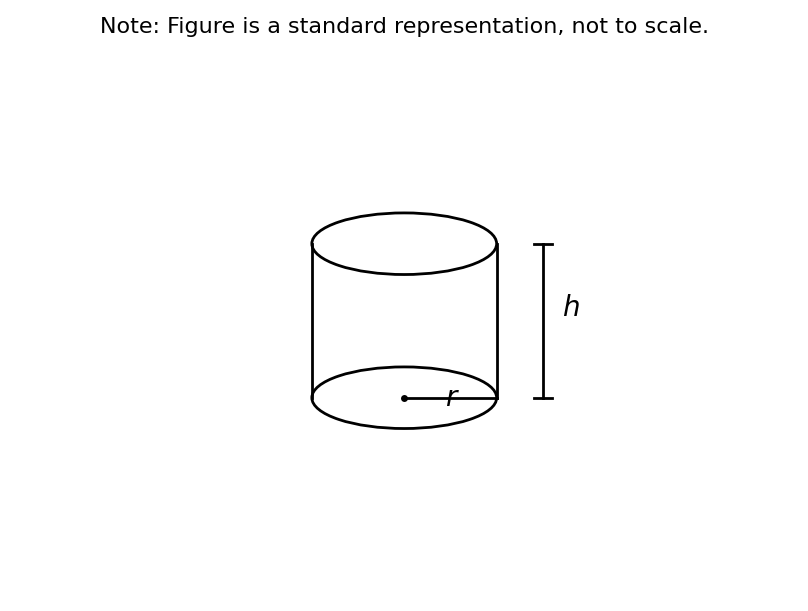
The figure shown is a right circular cylinder with a radius of \(\mathrm{r}\) and height of \(\mathrm{h}\). The lateral surface area of a cylinder is the area of its curved surface and is given by the formula \(\mathrm{A = 2\pi rh}\). A second right circular cylinder (not shown) has a lateral surface area that is 180 times as large as the lateral surface area of the cylinder shown. Which of the following could represent the radius \(\mathrm{R}\), in terms of \(\mathrm{r}\), and the height \(\mathrm{H}\), in terms of \(\mathrm{h}\), of the second cylinder?
1. TRANSLATE the problem information
- Given information:
- Original cylinder has radius r and height h
- Lateral surface area formula: \(\mathrm{A = 2\pi rh}\)
- Second cylinder has lateral surface area "180 times as large"
- What "180 times as large" means:
- If the second cylinder's area is \(\mathrm{A_2}\) and the first is \(\mathrm{A_1}\), then \(\mathrm{A_2 = 180 \times A_1}\)
2. TRANSLATE the areas into formulas
- Original cylinder:
- \(\mathrm{A_1 = 2\pi rh}\)
- Second cylinder (with radius R and height H):
- \(\mathrm{A_2 = 2\pi RH}\)
3. Set up the relationship equation
Since \(\mathrm{A_2 = 180 \times A_1}\):
\(\mathrm{2\pi RH = 180 \times (2\pi rh)}\)
4. SIMPLIFY the equation
- Divide both sides by \(\mathrm{2\pi}\) (the common factor):
\(\mathrm{RH = 180rh}\)
- Divide both sides by rh to isolate the scaling factors:
\(\mathrm{\frac{RH}{rh} = 180}\)
\(\mathrm{\frac{R}{r} \times \frac{H}{h} = 180}\)
5. INFER what this means
The product of the radius scaling factor \(\mathrm{\frac{R}{r}}\) and the height scaling factor \(\mathrm{\frac{H}{h}}\) must equal 180.
6. Test each answer choice
- Choice A: \(\mathrm{R = 9r}\) and \(\mathrm{H = 10h}\)
- Scaling factors: 9 and 10
- Product: \(\mathrm{9 \times 10 = 90}\) ✗
- Choice B: \(\mathrm{R = 12r}\) and \(\mathrm{H = 12h}\)
- Scaling factors: 12 and 12
- Product: \(\mathrm{12 \times 12 = 144}\) ✗
- Choice C: \(\mathrm{R = 10r}\) and \(\mathrm{H = 18h}\)
- Scaling factors: 10 and 18
- Product: \(\mathrm{10 \times 18 = 180}\) ✓
- Choice D: \(\mathrm{R = 15r}\) and \(\mathrm{H = 15h}\)
- Scaling factors: 15 and 15
- Product: \(\mathrm{15 \times 15 = 225}\) ✗
Answer: C (\(\mathrm{R = 10r}\) and \(\mathrm{H = 18h}\))
Why Students Usually Falter on This Problem
Most Common Error Path:
Weak TRANSLATE skill: Students misinterpret "180 times as large" as meaning either the radius OR the height (but not both) must be scaled by 180, or that the sum of the scaling factors equals 180.
For example, they might look for \(\mathrm{\frac{R}{r} + \frac{H}{h} = 180}\), or think that either \(\mathrm{R = 180r}\) or \(\mathrm{H = 180h}\). Since no answer choice shows scaling factors that add to 180 or individual factors of 180, this leads to confusion and guessing.
Second Most Common Error:
Inadequate SIMPLIFY execution: Students set up the equation \(\mathrm{2\pi RH = 180(2\pi rh)}\) correctly but fail to cancel the \(\mathrm{2\pi}\) term, leaving them with a more complex equation. They might then try to substitute answer choices directly into \(\mathrm{2\pi RH = 180(2\pi rh)}\) rather than the simplified form \(\mathrm{(\frac{R}{r})(\frac{H}{h}) = 180}\), making the testing process more error-prone and potentially leading to arithmetic mistakes that cause selection of Choice B (\(\mathrm{R = 12r}\) and \(\mathrm{H = 12h}\)) or Choice D (\(\mathrm{R = 15r}\) and \(\mathrm{H = 15h}\)) which have "nice" equal scaling factors.
The Bottom Line:
This problem tests whether students can translate multiplicative language ("times as large") into correct equations and recognize that when a formula has two variables multiplied together, the scaling factors of those variables also multiply. The algebraic simplification is straightforward, but missing this conceptual understanding of how scaling works makes the problem unsolvable.