
In the figure above, triangle ABC is a right triangle with the right angle at B. Segment BD is the...
GMAT Geometry & Trigonometry : (Geo_Trig) Questions
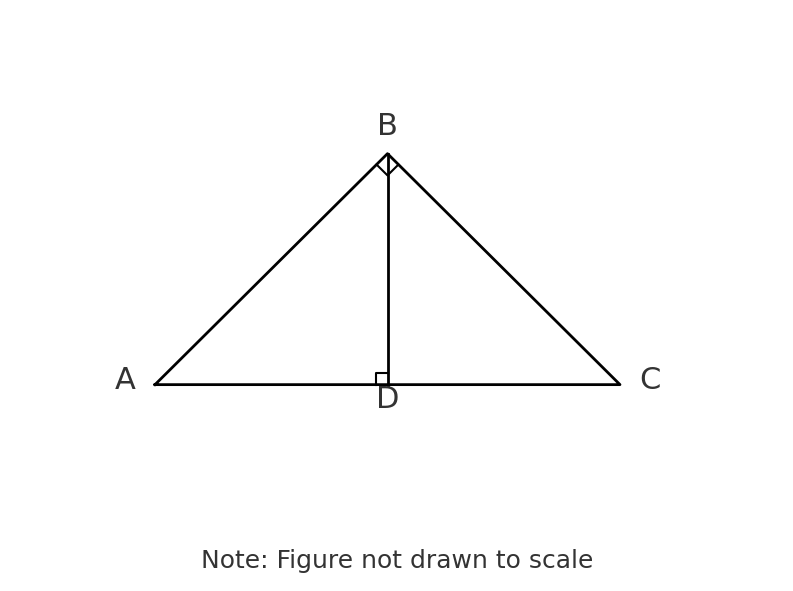
In the figure above, triangle \(\mathrm{ABC}\) is a right triangle with the right angle at \(\mathrm{B}\). Segment \(\mathrm{BD}\) is the altitude to the hypotenuse \(\mathrm{AC}\). If the measure of angle \(\mathrm{C}\) is \(38\) degrees, what is the measure of angle \(\mathrm{ABD}\), in degrees?
1. TRANSLATE the problem information
Looking at the diagram and problem statement:
Given:
- Triangle ABC has a right angle at vertex B (so \(\text{angle ABC} = 90°\))
- BD is an altitude to hypotenuse AC (meaning \(\text{BD} \perp \text{AC}\))
- \(\text{Angle C} = 38°\)
Find: Angle ABD
What this tells us:
- Since BD is an altitude, \(\text{angle BDA} = 90°\) and \(\text{angle BDC} = 90°\)
- We have two smaller right triangles: ABD and CBD
2. INFER the strategic approach
To find angle ABD, we need to analyze triangle ABD. This triangle has:
- \(\text{Angle ADB} = 90°\) (we know this)
- Angle BAD = ? (we don't know this yet)
- Angle ABD = ? (this is what we're looking for)
Key insight: We can find angle BAD because it's the same as angle A in the original triangle ABC, and we can calculate angle A using the angle sum property.
3. Find angle A in triangle ABC
Using the angle sum property:
\(\text{Angle A} + \text{Angle B} + \text{Angle C} = 180°\)
\(\text{Angle A} + 90° + 38° = 180°\)
\(\text{Angle A} + 128° = 180°\)
\(\text{Angle A} = 52°\)
4. INFER what we now know about triangle ABD
Now in triangle ABD:
- \(\text{Angle BAD} = 52°\) (this is angle A)
- \(\text{Angle ADB} = 90°\) (BD is perpendicular to AC)
- Angle ABD = ?
5. Calculate angle ABD
Using the angle sum property again:
\(\text{Angle BAD} + \text{Angle ABD} + \text{Angle ADB} = 180°\)
\(52° + \text{Angle ABD} + 90° = 180°\)
\(\text{Angle ABD} + 142° = 180°\)
\(\text{Angle ABD} = 38°\)
Answer: 38 degrees
Alternative Method Using Similar Triangles
There's an elegant property here worth knowing: When you draw an altitude from the right angle to the hypotenuse of a right triangle, you create two smaller triangles that are similar to the original triangle and to each other.
This means: \(\triangle \text{ABC} \sim \triangle \text{DBA} \sim \triangle \text{DBC}\)
From this similarity:
- Angle C in triangle ABC corresponds to angle ABD in triangle DBA
- Therefore, \(\text{angle ABD} = \text{angle C} = 38°\)
This gives the same answer much more quickly!
Why Students Usually Falter on This Problem
Most Common Error Path:
Weak INFER skill: Not recognizing that angle A needs to be found first before analyzing triangle ABD.
Students might look at triangle ABD and try to work directly with the given information (angle C = 38°), not realizing that angle C is not an angle in triangle ABD. They might incorrectly assume that \(\text{angle ABD} = 90° - 38° = 52°\), thinking they can use angle C directly in some calculation.
This leads to confusion and incorrect calculations, potentially causing them to guess or calculate 52° as their answer.
Second Most Common Error:
Conceptual confusion: Misunderstanding what the altitude creates geometrically.
Students might not recognize that BD being an altitude means it creates right angles at D (\(\text{angle BDA} = 90°\) and \(\text{angle BDC} = 90°\)). Without this understanding, they cannot properly analyze triangle ABD and may try to use incorrect angle relationships.
This causes them to get stuck and guess randomly.
The Bottom Line:
This problem tests whether students can work systematically with multiple triangles in a single figure. The key is recognizing that you need information from the larger triangle ABC to solve for angles in the smaller triangle ABD. Students who jump directly to triangle ABD without first finding angle A will struggle. Those who know the similar triangle property have a much faster route to the answer.