
In the xy-plane, the bold line segment shown represents one leg of a right triangle. The area of the triangle...
GMAT Geometry & Trigonometry : (Geo_Trig) Questions
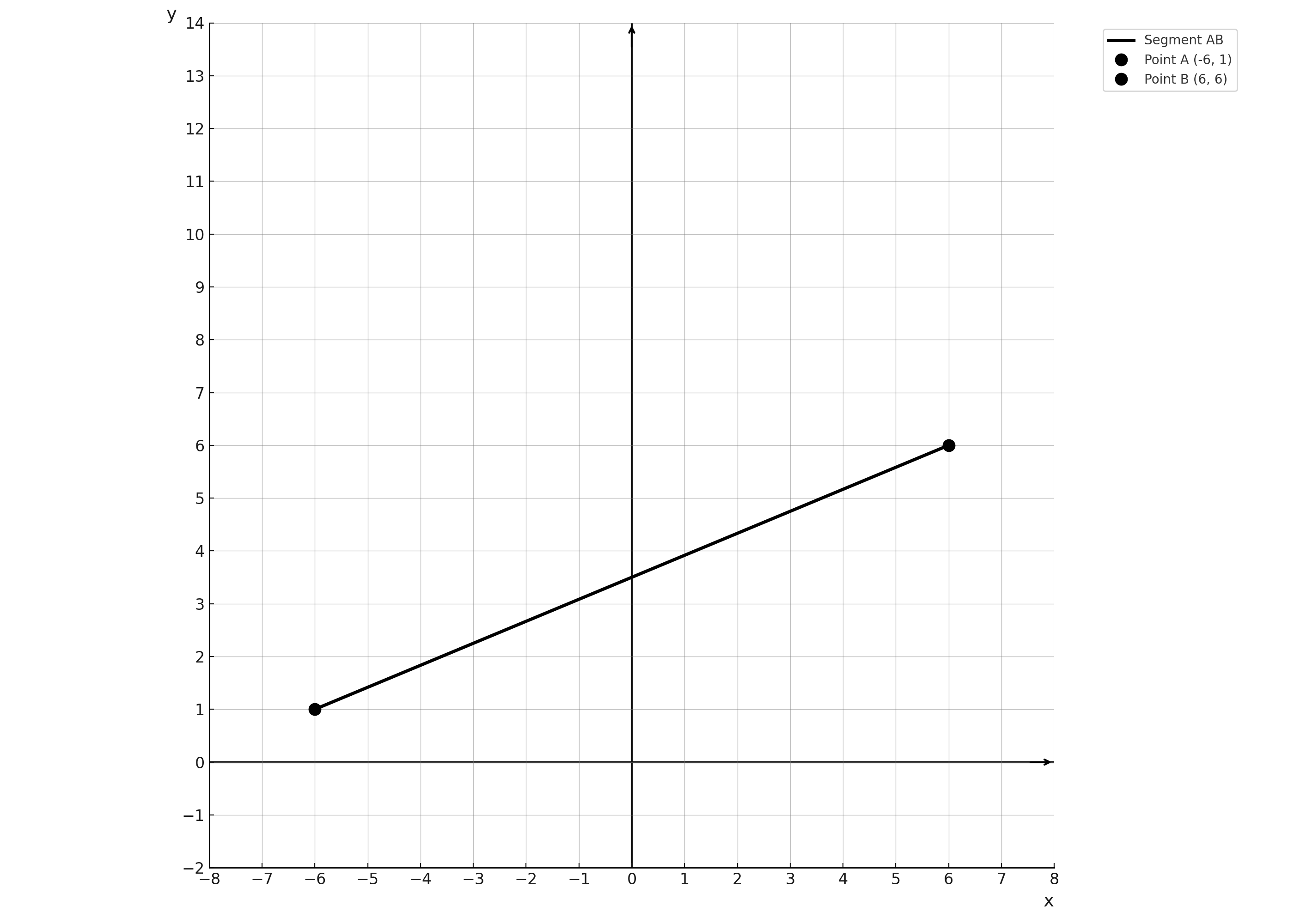
- In the xy-plane, the bold line segment shown represents one leg of a right triangle.
- The area of the triangle is \(78\sqrt{3}\) square units.
- What is the length, in units, of the other leg of this triangle?
- Use the figure to read exact coordinates of the segment's endpoints.
\(\mathrm{13}\)
\(\mathrm{12}\)
\(\mathrm{12\sqrt{3}}\)
\(\mathrm{6\sqrt{13}}\)
1. TRANSLATE the problem information
First, TRANSLATE the visual information from the graph into precise coordinates:
- Given information:
- Point A (left endpoint): \((-6, 1)\)
- Point B (right endpoint): \((6, 6)\)
- Segment AB is one leg of a right triangle
- Area of the triangle = \(78\sqrt{3}\) square units
- What we need to find:
- The length of the other leg
2. Calculate the length of the given leg (segment AB)
Use the distance formula to find the length of segment AB:
- Horizontal change: \(\Delta x = 6 - (-6) = 6 + 6 = 12\)
- Vertical change: \(\Delta y = 6 - 1 = 5\)
- Distance = \(\sqrt{(\Delta x)^2 + (\Delta y)^2}\)
\(= \sqrt{(12)^2 + (5)^2}\)
\(= \sqrt{144 + 25}\)
\(= \sqrt{169}\)
\(= 13\) units
3. INFER the relationship between the legs and area
Here's the key insight: INFER that since segment AB is described as "one leg" of a right triangle, there must be another leg perpendicular to it.
For a right triangle, the area formula uses the two perpendicular legs (not the hypotenuse):
Area = \(\frac{1}{2} \times \mathrm{leg}_1 \times \mathrm{leg}_2\)
We have:
- \(\mathrm{leg}_1 = 13\) (the segment we just calculated)
- \(\mathrm{leg}_2 = L\) (unknown)
- Area = \(78\sqrt{3}\)
4. TRANSLATE the area relationship into an equation
Set up the equation:
\(\frac{1}{2} \times 13 \times L = 78\sqrt{3}\)
5. SIMPLIFY to solve for L
Now SIMPLIFY through algebraic steps:
- \(\frac{1}{2} \times 13 \times L = 78\sqrt{3}\)
- \(\frac{13L}{2} = 78\sqrt{3}\)
Multiply both sides by 2:
- \(13L = 156\sqrt{3}\)
Divide both sides by 13 (use calculator):
- \(L = \frac{156\sqrt{3}}{13}\)
- \(L = \frac{156}{13}\sqrt{3}\)
- \(L = 12\sqrt{3}\)
Answer: C (\(12\sqrt{3}\))
Why Students Usually Falter on This Problem
Most Common Error Path:
Process Skill Gap (INFER): Misunderstanding which sides of the triangle are legs vs. hypotenuse
Some students might assume that the segment AB shown is the hypotenuse of the right triangle rather than one of the legs. If they make this error, they might try to use the Pythagorean theorem incorrectly or set up a different area relationship altogether. Since the problem explicitly states "one leg," this misreading leads to confusion about how to set up the area equation properly.
This leads to confusion and abandonment of the systematic approach, causing them to guess among the answer choices.
Second Most Common Error:
Process Skill Gap (SIMPLIFY): Algebraic errors when solving for L
Students might correctly set up the equation \(\frac{1}{2} \times 13 \times L = 78\sqrt{3}\) but then make errors in the algebraic manipulation:
- Forgetting to multiply by 2 to clear the fraction
- Making division errors when computing \(156 \div 13\)
- Incorrectly "combining" the radical with the coefficient
For example, a student might compute \(156/13 = 13\) instead of 12, leading them to think the answer is \(13\sqrt{3}\). However, this isn't among the choices, which might cause them to select Choice A (\(13\)), dropping the radical entirely in confusion.
The Bottom Line:
This problem requires carefully TRANSLATING graph information, INFERRING the geometric relationship between legs and area in a right triangle, and SIMPLIFYING through multi-step algebra involving radicals. The combination of coordinate geometry, right triangle properties, and radical arithmetic creates multiple opportunities for error.
\(\mathrm{13}\)
\(\mathrm{12}\)
\(\mathrm{12\sqrt{3}}\)
\(\mathrm{6\sqrt{13}}\)