
The circle shown has center O and circumference 108pi. Points A, B, and C are on the circle such that...
GMAT Geometry & Trigonometry : (Geo_Trig) Questions
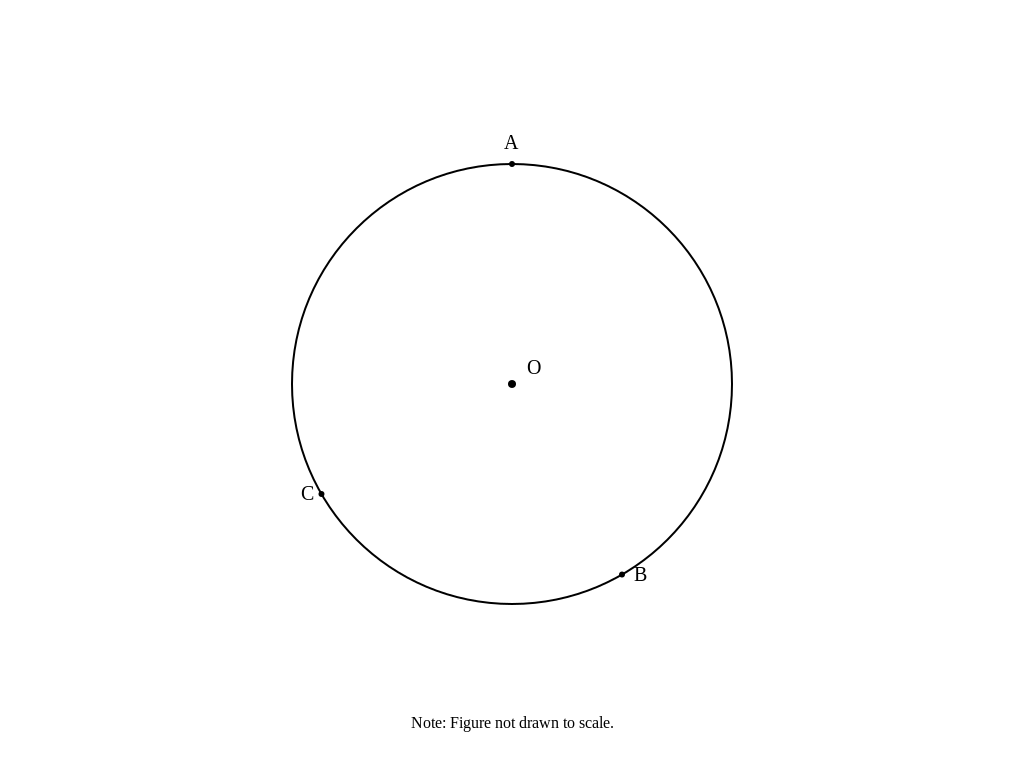
The circle shown has center O and circumference \(108\pi\). Points A, B, and C are on the circle such that arc AB is twice the length of arc BC. Additionally, arc CA is three times the length of arc BC. What is the length of arc AB?
Express your answer in terms of \(\pi\).
1. TRANSLATE the problem information
- Given information:
- Circle has circumference \(108\pi\)
- Three points A, B, C on the circle create three arcs
- Arc AB = twice arc BC
- Arc CA = three times arc BC
- What we need to find: The length of arc AB
2. TRANSLATE the relationships into algebra
Let's use a variable for the smallest arc mentioned. Let arc BC = \(x\)
Now we can express the other arcs:
- Arc AB = \(2x\) (twice arc BC)
- Arc CA = \(3x\) (three times arc BC)
3. INFER the key relationship
Here's the crucial insight: Points A, B, and C divide the circle into exactly three arcs (AB, BC, and CA). These three arcs must completely cover the circle, so they must add up to the total circumference.
This gives us:
\(\mathrm{Arc\ AB} + \mathrm{Arc\ BC} + \mathrm{Arc\ CA} = 108\pi\)
4. SIMPLIFY by substitution and solving
Substitute our expressions:
\(2x + x + 3x = 108\pi\)
Combine like terms:
\(6x = 108\pi\)
Divide both sides by 6:
\(x = 18\pi\)
5. Find arc AB
Now that we know \(x = 18\pi\), we can find:
\(\mathrm{Arc\ AB} = 2x = 2(18\pi) = 36\pi\)
Answer: \(36\pi\)
Why Students Usually Falter on This Problem
Most Common Error Path:
Weak TRANSLATE skill: Students may struggle to set up the relationships algebraically. A common mistake is to confuse which arc is being compared to which. For example, they might write:
- Arc BC = \(2x\) (incorrectly thinking BC is twice something else)
- Arc AB = \(x\)
This reversal leads to setting up: \(x + 2x + 3x = 108\pi\), giving \(6x = 108\pi\), so \(x = 18\pi\). But now they think arc AB = \(x = 18\pi\) instead of \(36\pi\). This would lead them to an incorrect answer of \(18\pi\).
Second Most Common Error:
Weak SIMPLIFY execution: Students correctly set up \(2x + x + 3x = 108\pi\) but make an arithmetic error when combining like terms. For instance, they might miscalculate and get \(5x = 108\pi\) instead of \(6x = 108\pi\). This gives \(x = 108\pi/5 = 21.6\pi\), leading to arc AB = \(2x = 43.2\pi\). This causes them to arrive at an incorrect final answer.
The Bottom Line:
This problem tests whether students can translate multiple verbal relationships into a coherent algebraic system and recognize that the parts must sum to the whole. The key challenge is maintaining clear variable definitions throughout the solution—staying organized about which arc is which, and which arc is the base variable.