
Triangles KLM and PQR are right triangles with right angles at K and P, respectively.The triangles are similar, with K,...
GMAT Geometry & Trigonometry : (Geo_Trig) Questions
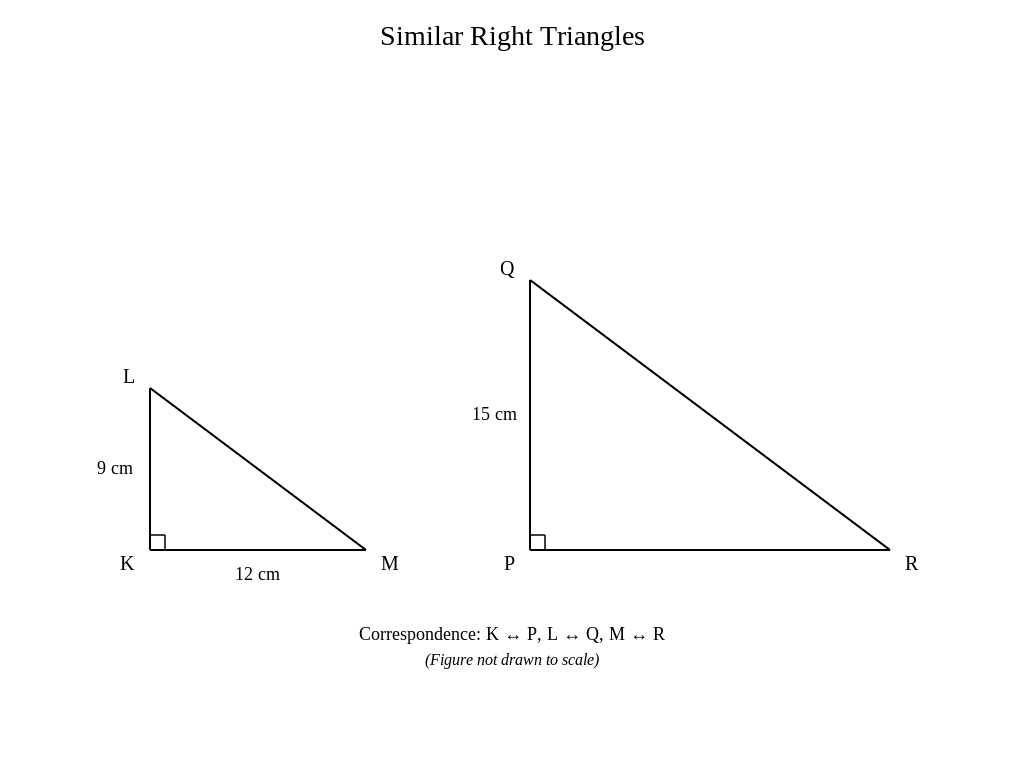
- Triangles \(\mathrm{KLM}\) and \(\mathrm{PQR}\) are right triangles with right angles at \(\mathrm{K}\) and \(\mathrm{P}\), respectively.
- The triangles are similar, with \(\mathrm{K, L, M}\) corresponding to \(\mathrm{P, Q, R}\), respectively, as shown in the figure.
- In triangle \(\mathrm{KLM}\), \(\mathrm{KL = 9}\) centimeters and \(\mathrm{LM = 12}\) centimeters; in triangle \(\mathrm{PQR}\), \(\mathrm{PQ = 15}\) centimeters.
What is the length, in centimeters, of \(\mathrm{QR}\)?
1. TRANSLATE the problem information
Given information:
- Triangle KLM: right angle at K, KL = 9 cm, LM = 12 cm
- Triangle PQR: right angle at P, PQ = 15 cm
- The triangles are similar
- Correspondence: K ↔ P, L ↔ Q, M ↔ R
What we need to find: Length of QR
2. TRANSLATE the correspondence into side relationships
The vertex correspondence K ↔ P, L ↔ Q, M ↔ R tells us which sides correspond:
- Side KL (connecting K and L) corresponds to side PQ (connecting P and Q)
- Side LM (connecting L and M) corresponds to side QR (connecting Q and R)
- Side KM (connecting K and M) corresponds to side PR (connecting P and R)
3. INFER the solution approach
Since the triangles are similar, corresponding sides are proportional. We know:
- KL = 9 cm and its corresponding side PQ = 15 cm
- LM = 12 cm and we need to find its corresponding side QR
We can set up a proportion: KL/PQ = LM/QR
4. Set up and SIMPLIFY the proportion
Write the proportion:
\(\frac{\mathrm{KL}}{\mathrm{PQ}} = \frac{\mathrm{LM}}{\mathrm{QR}}\)
Substitute the known values:
\(\frac{9}{15} = \frac{12}{\mathrm{QR}}\)
Cross-multiply:
\(9 \times \mathrm{QR} = 15 \times 12\)
\(9 \times \mathrm{QR} = 180\)
Divide both sides by 9:
\(\mathrm{QR} = \frac{180}{9} = 20\)
Answer: 20 centimeters (Choice B)
Why Students Usually Falter on This Problem
Most Common Error Path:
Weak TRANSLATE skill: Misinterpreting the correspondence notation and incorrectly matching sides
Students may see that KL = 9 and PQ = 15, correctly identifying these as corresponding sides. However, they might then incorrectly assume that the given side KM (or mistakenly reading it as 12 cm from the diagram) corresponds to QR, rather than recognizing that LM corresponds to QR.
For example, if a student thinks KM = 12 corresponds to QR, they might set up:
- KL/PQ = KM/QR → \(\frac{9}{15} = \frac{12}{\mathrm{QR}}\)
This gives the same answer by coincidence, but reflects a conceptual misunderstanding.
Alternatively, students might confuse which measurement is which (mixing up KL, KM, and LM), leading to incorrect proportion setups that yield wrong values.
Second Most Common Error:
Inadequate SIMPLIFY execution: Setting up the correct proportion but making arithmetic errors
A student might correctly write 9/15 = 12/QR, but then make an error when cross-multiplying or dividing:
- Incorrectly calculating 15 × 12 = 150 instead of 180
- Or dividing 180/9 incorrectly
This leads to confusion and potentially selecting Choice D (10) if they get 90/9, or getting stuck and guessing among the choices.
The Bottom Line:
This problem tests whether students can translate the abstract correspondence notation into concrete relationships between specific sides, then apply the proportionality property of similar triangles. The key is carefully tracking which sides correspond to which, then setting up the proportion correctly.