
Right triangles ABC and LMN are similar. Vertex A corresponds to vertex L, and both triangles have right angles at...
GMAT Geometry & Trigonometry : (Geo_Trig) Questions
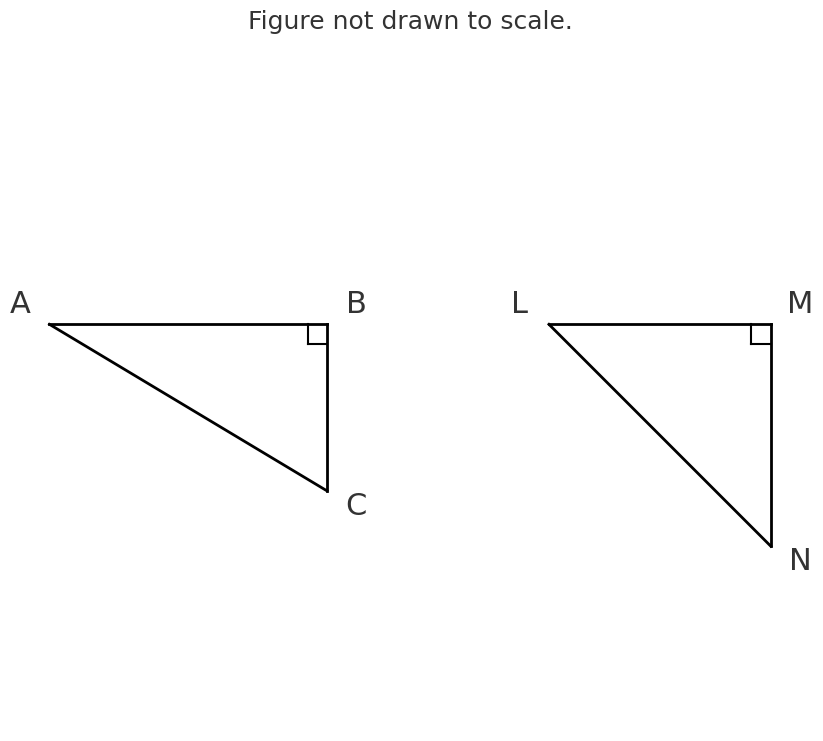
Right triangles ABC and LMN are similar. Vertex A corresponds to vertex L, and both triangles have right angles at B and M, respectively. If the measure of angle C is 21°, what is the measure of angle L?
1. TRANSLATE the problem information
Let's carefully extract what the problem tells us:
- Given information:
- Triangle ABC has a right angle at B (so \(\angle\mathrm{B} = 90°\))
- Triangle LMN has a right angle at M (so \(\angle\mathrm{M} = 90°\))
- The two triangles are similar
- Vertex A corresponds to vertex L (this is crucial!)
- \(\angle\mathrm{C} = 21°\)
- What we need to find:
- The measure of angle L
2. INFER the solution strategy
Here's the key insight: Since the triangles are similar and A corresponds to L, we know that \(\angle\mathrm{L} = \angle\mathrm{A}\) (corresponding angles in similar triangles are equal).
But we don't know \(\angle\mathrm{A}\) yet! So our strategy is:
- First: Find \(\angle\mathrm{A}\) using what we know about triangle ABC
- Then: Use the correspondence to determine \(\angle\mathrm{L}\)
3. SIMPLIFY to find angle A
In triangle ABC, we know two of the three angles:
- \(\angle\mathrm{B} = 90°\) (right angle)
- \(\angle\mathrm{C} = 21°\) (given)
- \(\angle\mathrm{A} = ?\)
Using the angle sum property:
\(\angle\mathrm{A} + \angle\mathrm{B} + \angle\mathrm{C} = 180°\)
\(\angle\mathrm{A} + 90° + 21° = 180°\)
\(\angle\mathrm{A} + 111° = 180°\)
\(\angle\mathrm{A} = 69°\)
4. INFER the final answer using correspondence
Since triangles ABC and LMN are similar, and vertex A corresponds to vertex L:
\(\angle\mathrm{L} = \angle\mathrm{A} = 69°\)
Answer: B (69°)
Why Students Usually Falter on This Problem
Most Common Error Path:
Weak TRANSLATE skill: Students misidentify the correspondence between vertices. They might see that \(\angle\mathrm{C} = 21°\) and think that since we're looking for \(\angle\mathrm{L}\), maybe L corresponds to C (after all, both are at the "end" position in the triangle names ABC and LMN).
If they make this error, they conclude that \(\angle\mathrm{L} = \angle\mathrm{C} = 21°\).
This may lead them to select Choice A (21°).
Second Most Common Error:
Incomplete INFER reasoning: Students might recognize they need to work with angles in triangle ABC, but get confused about which angles to use. They might incorrectly add angles together (like 90° + 21° = 111°) or subtract only one angle from 180° (like 180° - 21° = 159°) without properly applying the angle sum property.
This may lead them to select Choice C (111°) or Choice D (159°).
The Bottom Line:
This problem tests whether students can carefully track correspondence relationships in similar figures. The word "corresponds" is easy to misread or misinterpret, especially under time pressure. Success requires precise translation of which vertex pairs match, then systematic application of angle relationships.