
Right triangle PQR and right triangle STU are shown in the figure. The relationship between the side lengths of the...
GMAT Geometry & Trigonometry : (Geo_Trig) Questions
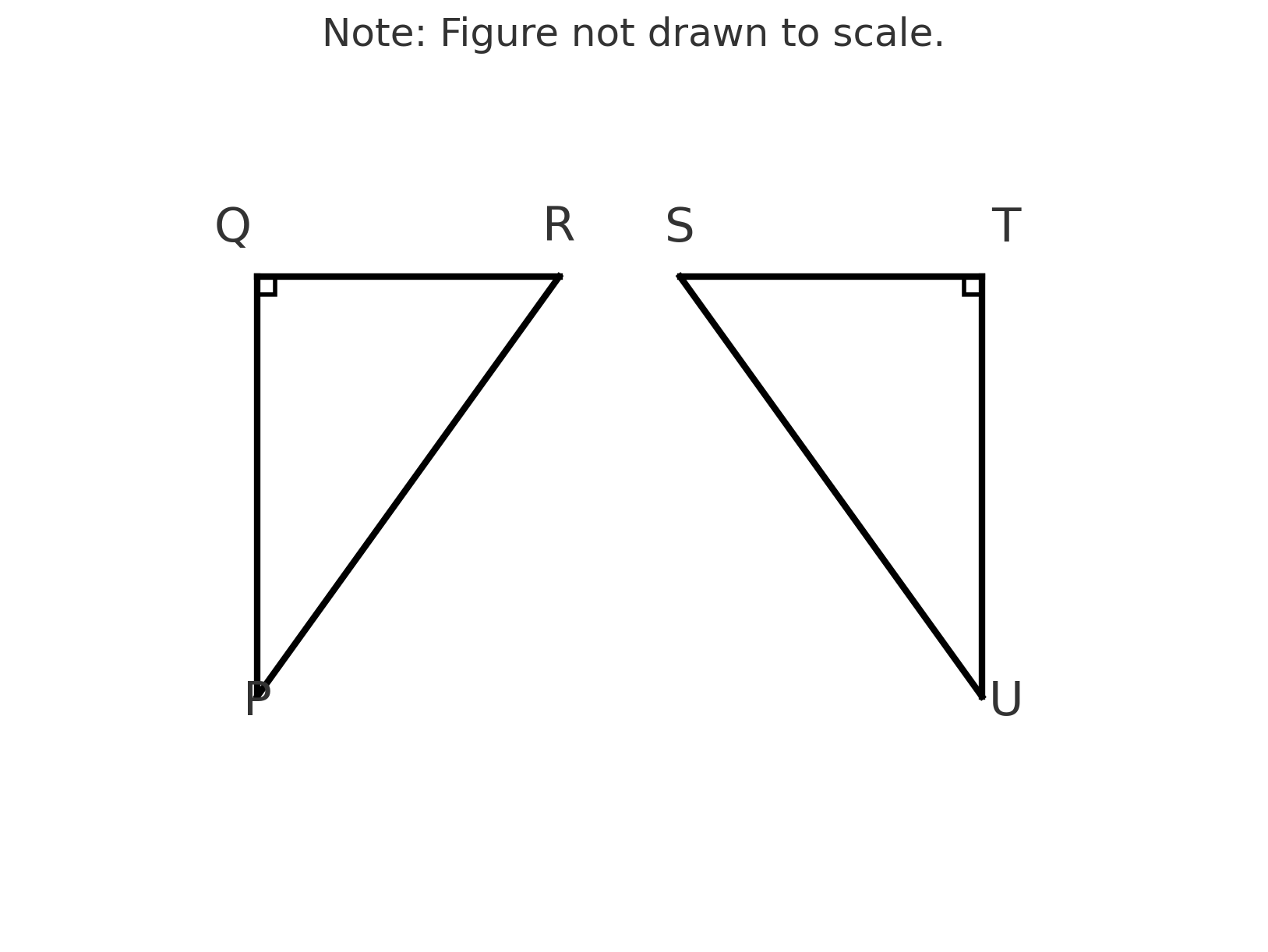
Right triangle PQR and right triangle STU are shown in the figure. The relationship between the side lengths of the two triangles is such that \(\frac{\mathrm{PQ}}{\mathrm{ST}} = \frac{\mathrm{QR}}{\mathrm{TU}} = \frac{\mathrm{PR}}{\mathrm{SU}} = 4\). If the measure of angle RPQ is \(35°\), what is the measure, in degrees, of angle UST? (Disregard the degree symbol when gridding your answer.)
1. INFER what the proportional relationships tell us
- Given information:
- \(\frac{\mathrm{PQ}}{\mathrm{ST}} = \frac{\mathrm{QR}}{\mathrm{TU}} = \frac{\mathrm{PR}}{\mathrm{SU}} = 4\)
- All three ratios are equal
- Key insight: When all corresponding sides of two triangles are proportional with the same ratio, the triangles are similar by the Side-Side-Side (SSS) Similarity Theorem.
Therefore: Triangle PQR ~ Triangle STU
2. INFER the correspondence between vertices
- From the side ratios, we can establish which vertices correspond:
- \(\frac{\mathrm{PQ}}{\mathrm{ST}}\) → side PQ corresponds to side ST
- \(\frac{\mathrm{QR}}{\mathrm{TU}}\) → side QR corresponds to side TU
- \(\frac{\mathrm{PR}}{\mathrm{SU}}\) → side PR corresponds to side SU
- Matching up the vertices from these correspondences:
- \(\mathrm{P} \leftrightarrow \mathrm{S}\)
- \(\mathrm{Q} \leftrightarrow \mathrm{T}\)
- \(\mathrm{R} \leftrightarrow \mathrm{U}\)
3. INFER which angles correspond
- Angle RPQ is the angle at vertex P, formed by sides PR and PQ
- Since P corresponds to S, the corresponding angle in triangle STU is the angle at vertex S
- Using our vertex correspondence (\(\mathrm{R} \leftrightarrow \mathrm{U}\), \(\mathrm{P} \leftrightarrow \mathrm{S}\), \(\mathrm{Q} \leftrightarrow \mathrm{T}\)), the angle at S formed by sides SU and ST is angle UST
4. Apply the property of similar triangles
- In similar triangles, corresponding angles are equal
- Since angle RPQ corresponds to angle UST:
- \(\angle \mathrm{UST} = \angle \mathrm{RPQ} = 35°\)
Answer: 35
Why Students Usually Falter on This Problem
Most Common Error Path:
Weak INFER skill: Not recognizing that equal ratios of all three pairs of corresponding sides means the triangles are similar.
Students might see the ratios and think they need to calculate something with the ratio value of 4, or they might not make the connection to triangle similarity. Without recognizing similarity, they cannot access the property that corresponding angles are equal, leaving them stuck without a clear path forward.
This leads to confusion and guessing.
Second Most Common Error:
Weak INFER skill: Incorrectly determining which angle in triangle STU corresponds to angle RPQ.
Even if students recognize the triangles are similar, they might misinterpret the angle notation or incorrectly match vertices. For example, they might think angle RPQ corresponds to angle TSU or angle SUT instead of angle UST. The three-letter angle notation can be confusing—students might not remember that the middle letter indicates the vertex where the angle is located.
This causes them to get stuck or potentially select an incorrect angle measure if they try to use properties of triangles (like complementary angles in a right triangle) with the wrong angle.
The Bottom Line:
This problem requires strong geometric reasoning rather than calculation. The key challenge is making the logical leap from "equal side ratios" to "similar triangles" to "corresponding angles are equal." Students who treat this as a numerical computation problem rather than a geometric reasoning problem will struggle to find the solution path.