
A ball is thrown upward from an initial height. The scatterplot below shows the height h, in meters, of the...
GMAT Problem-Solving and Data Analysis : (PS_DA) Questions
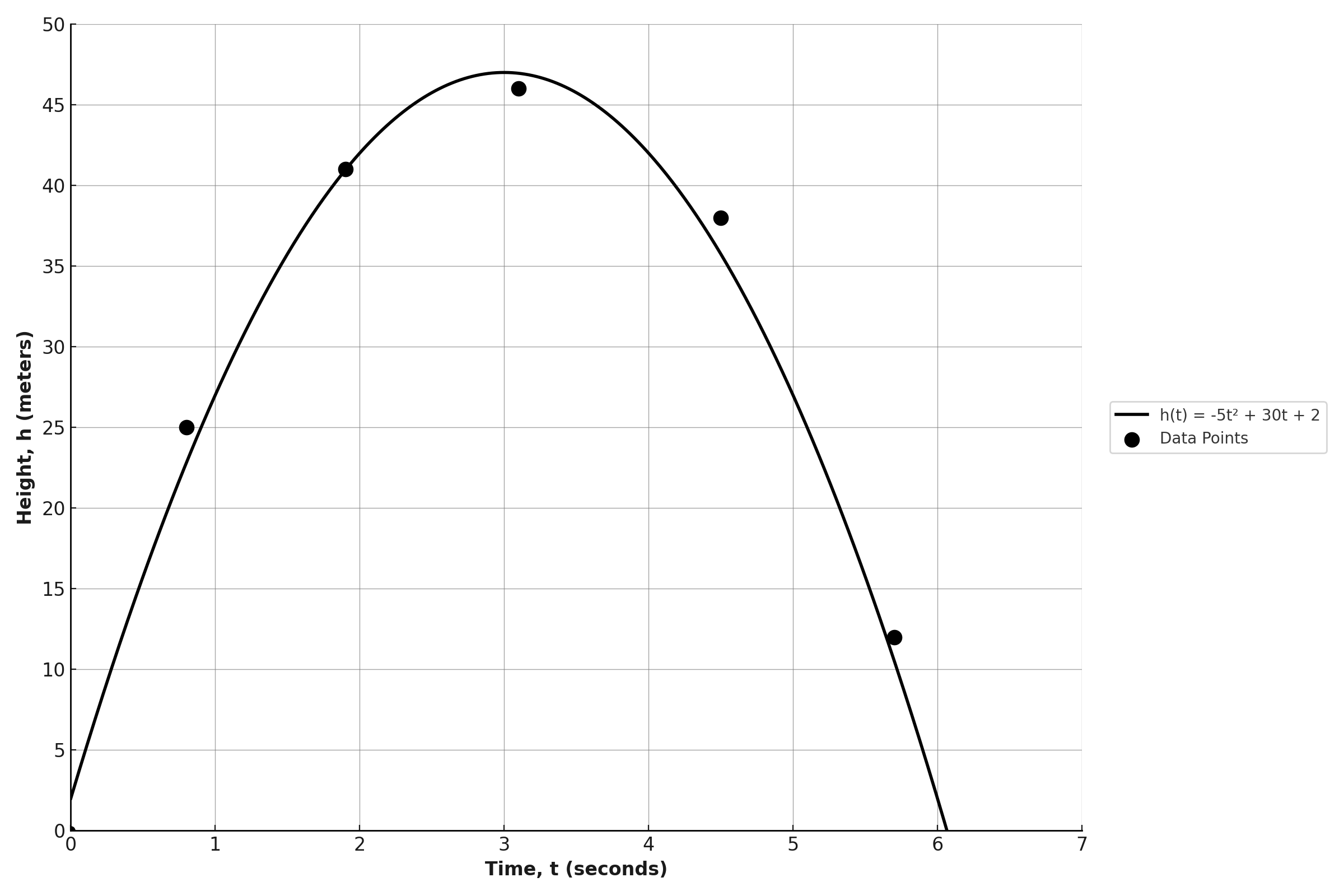
A ball is thrown upward from an initial height. The scatterplot below shows the height \(\mathrm{h}\), in meters, of the ball \(\mathrm{t}\) seconds after it is thrown, along with a smooth curve representing a quadratic model for the data. The function \(\mathrm{h(t) = -5t^2 + v_0t + h_0}\), where \(\mathrm{v_0}\) and \(\mathrm{h_0}\) are constants, can be used to model the height of the ball. In this model, \(\mathrm{v_0}\) represents the initial upward velocity in meters per second, and \(\mathrm{h_0}\) represents the initial height in meters. Based on the model represented by the smooth curve, what is the value of \(\mathrm{v_0}\)?
25
30
35
40
1. TRANSLATE the graph information to find the initial height
Look at where the smooth curve intersects the y-axis (when t = 0):
- Given from graph: At t = 0, h = 2
- What this tells us: The initial height \(\mathrm{h_0 = 2}\)
This is the height when the ball was released (at time zero).
2. Update the equation with known information
Now that we know \(\mathrm{h_0 = 2}\), substitute it into the model:
- Original model: \(\mathrm{h(t) = -5t^2 + v_0t + h_0}\)
- Updated model: \(\mathrm{h(t) = -5t^2 + v_0t + 2}\)
We still need to find \(\mathrm{v_0}\) (the initial upward velocity).
3. INFER which point to use for finding v₀
To find the remaining unknown \(\mathrm{v_0}\), we need another point from the smooth curve.
- Strategic choice: Use the vertex (the highest point of the parabola)
- Why the vertex? It's the most clearly defined feature on the curve—the obvious maximum point
- TRANSLATE the vertex coordinates from the graph: \(\mathrm{(t, h) = (3, 47)}\)
This means at t = 3 seconds, the height is 47 meters.
4. Substitute the vertex point into the equation
Plug in t = 3 and h = 47 into our updated model:
\(\mathrm{47 = -5(3)^2 + v_0(3) + 2}\)
5. SIMPLIFY to solve for v₀
Work through the algebra step by step:
- Calculate \(\mathrm{3^2 = 9}\)
\(\mathrm{47 = -5(9) + 3v_0 + 2}\)
- Multiply: \(\mathrm{-5(9) = -45}\)
\(\mathrm{47 = -45 + 3v_0 + 2}\)
- Combine constants: \(\mathrm{-45 + 2 = -43}\)
\(\mathrm{47 = -43 + 3v_0}\)
- Add 43 to both sides:
\(\mathrm{47 + 43 = 3v_0}\)
\(\mathrm{90 = 3v_0}\)
- Divide both sides by 3:
\(\mathrm{v_0 = 30}\)
Answer: B) 30
The initial upward velocity is 30 meters per second.
Why Students Usually Falter on This Problem
Most Common Error Path:
Weak TRANSLATE skill: Misreading the vertex coordinates from the graph
Students may misidentify the vertex location, perhaps reading it as (3, 46) instead of (3, 47) due to the nearby data point, or estimating the t-coordinate as 2.5 or 3.5 instead of exactly 3.
If a student reads the vertex as occurring at t = 2 with h = 41 (using the data point instead of the smooth curve):
\(\mathrm{41 = -5(2)^2 + v_0(2) + 2}\)
\(\mathrm{41 = -20 + 2v_0 + 2}\)
\(\mathrm{41 = -18 + 2v_0}\)
\(\mathrm{59 = 2v_0}\)
\(\mathrm{v_0 = 29.5}\)
This doesn't match any answer choice exactly, leading to confusion and possible selection of Choice A (25) or Choice B (30) based on rounding or guessing.
Second Most Common Error:
Weak INFER skill: Not recognizing that \(\mathrm{h_0}\) can be found from the y-intercept
Students may attempt to use two data points (excluding t = 0) to create a system of two equations with two unknowns (\(\mathrm{v_0}\) and \(\mathrm{h_0}\)). While this approach works in principle, it's more complex and increases the chance of arithmetic errors.
Alternatively, some students might assume \(\mathrm{h_0 = 0}\) (starting from ground level) without checking the graph, leading to:
\(\mathrm{h(t) = -5t^2 + v_0t + 0}\)
Using (3, 47):
\(\mathrm{47 = -45 + 3v_0}\)
\(\mathrm{92 = 3v_0}\)
\(\mathrm{v_0 \approx 30.67}\)
This might lead them to select Choice C (35) as the closest "reasonable" answer.
Third Most Common Error:
Execution error in SIMPLIFY: Sign errors when combining negative and positive terms
When solving \(\mathrm{47 = -45 + 3v_0 + 2}\), students might:
- Incorrectly combine -45 + 2 as -47 instead of -43
- Make errors like: \(\mathrm{47 = -47 + 3v_0}\), leading to \(\mathrm{94 = 3v_0}\) and \(\mathrm{v_0 \approx 31.3}\)
Or they might incorrectly handle the equation as:
\(\mathrm{47 + 45 = 3v_0 + 2}\), leading to \(\mathrm{92 = 3v_0 + 2}\), then \(\mathrm{90 = 3v_0}\)... which coincidentally gives the right answer despite the error!
This type of error is more likely to cause confusion and guessing rather than selecting a specific wrong answer.
The Bottom Line:
This problem tests your ability to extract precise information from a graph and strategically use it in a partially-known equation. The key is carefully reading the smooth curve (not just the data points), especially identifying the y-intercept and the vertex, then methodically working through the algebra without sign errors.
25
30
35
40