
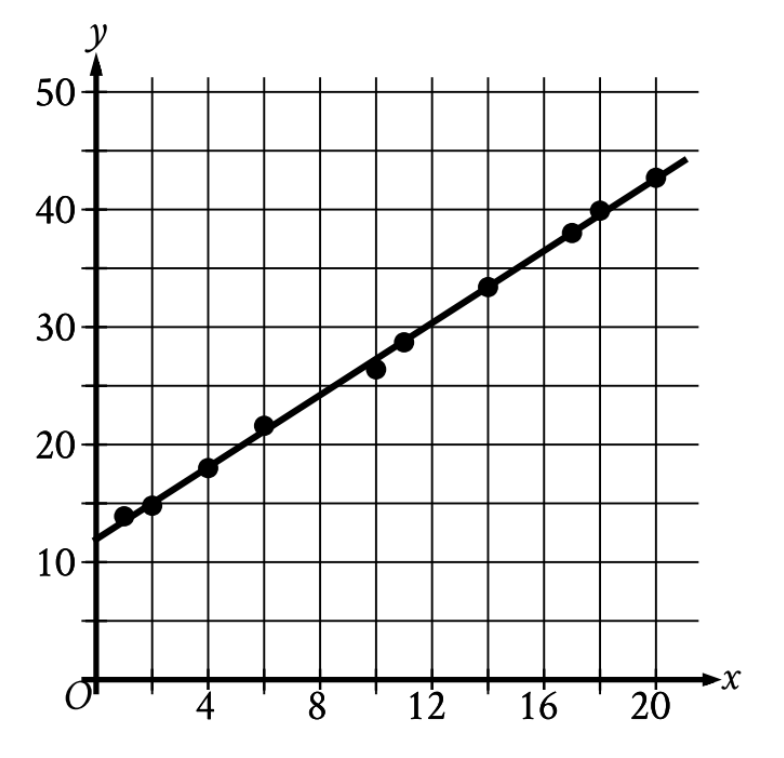
The scatterplot shows the relationship between two variables, x and y, for data set E. A line of best fit...
GMAT Problem-Solving and Data Analysis : (PS_DA) Questions
The scatterplot shows the relationship between two variables, \(\mathrm{x}\) and \(\mathrm{y}\), for data set \(\mathrm{E}\). A line of best fit is shown. Data set \(\mathrm{F}\) is created by multiplying the \(\mathrm{y}\)-coordinate of each data point from data set \(\mathrm{E}\) by \(3.9\). Which of the following could be an equation of a line of best fit for data set \(\mathrm{F}\)?
\(\mathrm{Y=46.8+5.9x}\)
\(\mathrm{Y=46.8+1.5x}\)
\(\mathrm{Y=12+5.9x}\)
\(\mathrm{Y=12+1.5x}\)
1. TRANSLATE the graph information
Looking at the scatterplot for data set E:
- The line of best fit crosses the y-axis at approximately \((0, 12)\)
- The line also passes through approximately \((12, 30)\)
- These two points will help us find the equation
2. SIMPLIFY to find the equation for data set E
Using the slope formula with our two points \((0, 12)\) and \((12, 30)\):
- Slope = \(\frac{30 - 12}{12 - 0}\)
- \(= \frac{18}{12}\)
- \(= 1.5\)
So the equation for data set E is:
- \(\mathrm{y} = 12 + 1.5\mathrm{x}\)
3. INFER how the transformation affects the line equation
Here's the key insight: Data set F is created by multiplying each y-coordinate by 3.9.
When you multiply ALL y-values in a dataset by a constant, something important happens to the line of best fit:
- The y-intercept gets multiplied by that constant
- The slope also gets multiplied by that constant
This is because the line must still pass through transformed versions of the original points. If point \((\mathrm{x}, \mathrm{y})\) becomes \((\mathrm{x}, 3.9\mathrm{y})\), then the entire linear relationship scales by the same factor.
4. SIMPLIFY to find the new parameters for data set F
Apply the multiplication by 3.9:
- New y-intercept: \(12 \times 3.9 = 46.8\)
- New slope: \(1.5 \times 3.9 = 5.85\)
Since 5.85 rounds to 5.9, the equation for data set F is:
- \(\mathrm{y} = 46.8 + 5.9\mathrm{x}\)
Answer: A. y = 46.8 + 5.9x
Why Students Usually Falter on This Problem
Most Common Error Path:
Weak INFER skill: Not understanding that multiplying all y-coordinates by a constant multiplies BOTH the y-intercept AND the slope by that constant.
Students might correctly identify that the y-intercept changes from 12 to 46.8 (since \(12 \times 3.9 = 46.8\)), but fail to realize that the slope must also be multiplied by 3.9. They might think the slope stays at 1.5 because "only the y-values changed, not the x-values."
This error leads them to select Choice B (\(\mathrm{y} = 46.8 + 1.5\mathrm{x}\)).
Second Most Common Error:
Poor TRANSLATE reasoning: Misreading the graph and incorrectly identifying the y-intercept or slope of the original line for data set E.
If a student looks at the graph too quickly, they might think they should just use the parameters they see directly without recognizing they need to transform them. Or they might confuse which line they're finding - E or F.
This leads to confusion and potentially selecting Choice D (\(\mathrm{y} = 12 + 1.5\mathrm{x}\)), which is actually the equation for data set E, not F.
The Bottom Line:
This problem tests whether students understand how linear transformations work. It's not enough to just read the graph - you need to grasp that scaling all y-values by a factor scales the entire linear relationship by that same factor. The algebraic connection between the transformation and its effect on both parameters (intercept and slope) is what makes this problem challenging.
\(\mathrm{Y=46.8+5.9x}\)
\(\mathrm{Y=46.8+1.5x}\)
\(\mathrm{Y=12+5.9x}\)
\(\mathrm{Y=12+1.5x}\)