
The scatterplot shows the relationship between two variables, x and y. An equation for the exponential model shown can be...
GMAT Problem-Solving and Data Analysis : (PS_DA) Questions
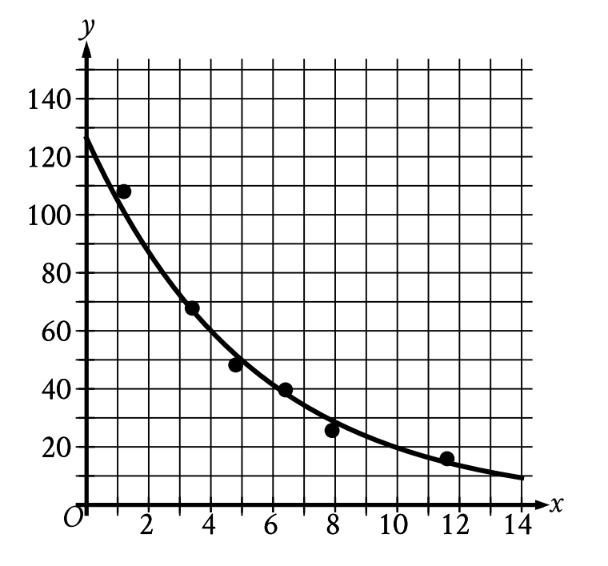
The scatterplot shows the relationship between two variables, \(\mathrm{x}\) and \(\mathrm{y}\). An equation for the exponential model shown can be written as \(\mathrm{y = a(b)^x}\), where \(\mathrm{a}\) and \(\mathrm{b}\) are positive constants. Which of the following is closest to the value of \(\mathrm{b}\)?
1. TRANSLATE the problem information
- Given information:
- A scatterplot showing the relationship between x and y
- The exponential model has the form \(\mathrm{y = a(b)^x}\)
- Both a and b are positive constants
- We need to find the value of b
- TRANSLATE the visual pattern:
- Looking at the scatterplot, as x increases (moving right), y decreases (moving down)
- The curve is decreasing throughout
2. INFER the key constraint
- For exponential functions of the form \(\mathrm{y = a(b)^x}\), the behavior depends entirely on the value of b:
- If \(\mathrm{b \gt 1}\): the function increases (exponential growth)
- If \(\mathrm{0 \lt b \lt 1}\): the function decreases (exponential decay)
- Since our scatterplot shows a decreasing pattern, we can INFER that b must be between 0 and 1.
3. APPLY CONSTRAINTS to eliminate wrong answers
- Examine each answer choice against the constraint \(\mathrm{0 \lt b \lt 1}\):
- A. 0.83 → This IS between 0 and 1 ✓
- B. 1.83 → This is greater than 1 (would show growth) ✗
- C. 18.36 → This is greater than 1 (would show growth) ✗
- D. 126.35 → This is greater than 1 (would show growth) ✗
- Only one choice represents exponential decay!
Answer: A. 0.83
Optional Verification
If you want to verify that 0.83 is reasonable, you can use actual data points:
TRANSLATE coordinates from the graph:
- At \(\mathrm{x = 0}\): \(\mathrm{y ≈ 120}\)
- At \(\mathrm{x = 8}\): \(\mathrm{y ≈ 25}\)
SIMPLIFY to find b:
- Since \(\mathrm{y = a(b)^x}\) and at \(\mathrm{x = 0}\) we have \(\mathrm{y = 120}\): \(\mathrm{a ≈ 120}\)
- At \(\mathrm{x = 8}\): \(\mathrm{25 = 120(b)^8}\)
- Dividing both sides by 120: \(\mathrm{b^8 = 25/120 ≈ 0.208}\)
- Taking the 8th root: \(\mathrm{b ≈ 0.83}\) (use calculator)
This confirms our answer!
Why Students Usually Falter on This Problem
Most Common Error Path:
Conceptual confusion: Reversing the growth/decay conditions
Many students confuse which values of b correspond to which behavior. They might think:
- "Bigger number = bigger y values = b should be large like 126.35"
- Or they misremember: "b > 1 means decay"
This misconception leads them to select Choice B (1.83), Choice C (18.36), or Choice D (126.35) - all representing exponential growth when the problem clearly shows decay.
Second Most Common Error:
Weak TRANSLATE skill: Misreading the trend in the scatterplot
Some students might misinterpret the scatterplot direction, especially if they:
- Read the graph from right to left instead of left to right
- Focus on individual points rather than the overall trend
- Confuse steep decline with some other property
This causes confusion about whether they need growth or decay, leading to random guessing among answer choices.
The Bottom Line:
The key insight is that this problem can be solved entirely through conceptual reasoning about exponential behavior. You don't need to calculate anything if you remember: decreasing exponential = b between 0 and 1. Since only one answer choice satisfies this constraint, you've found your answer. The numerical appearance of the answer choices is specifically designed to test whether you understand the fundamental behavior of exponential functions.