
The scatterplot shows measured pairs \(\mathrm{(x, y)}\) and a smooth curve modeling the data. The model is exponential and can...
GMAT Problem-Solving and Data Analysis : (PS_DA) Questions
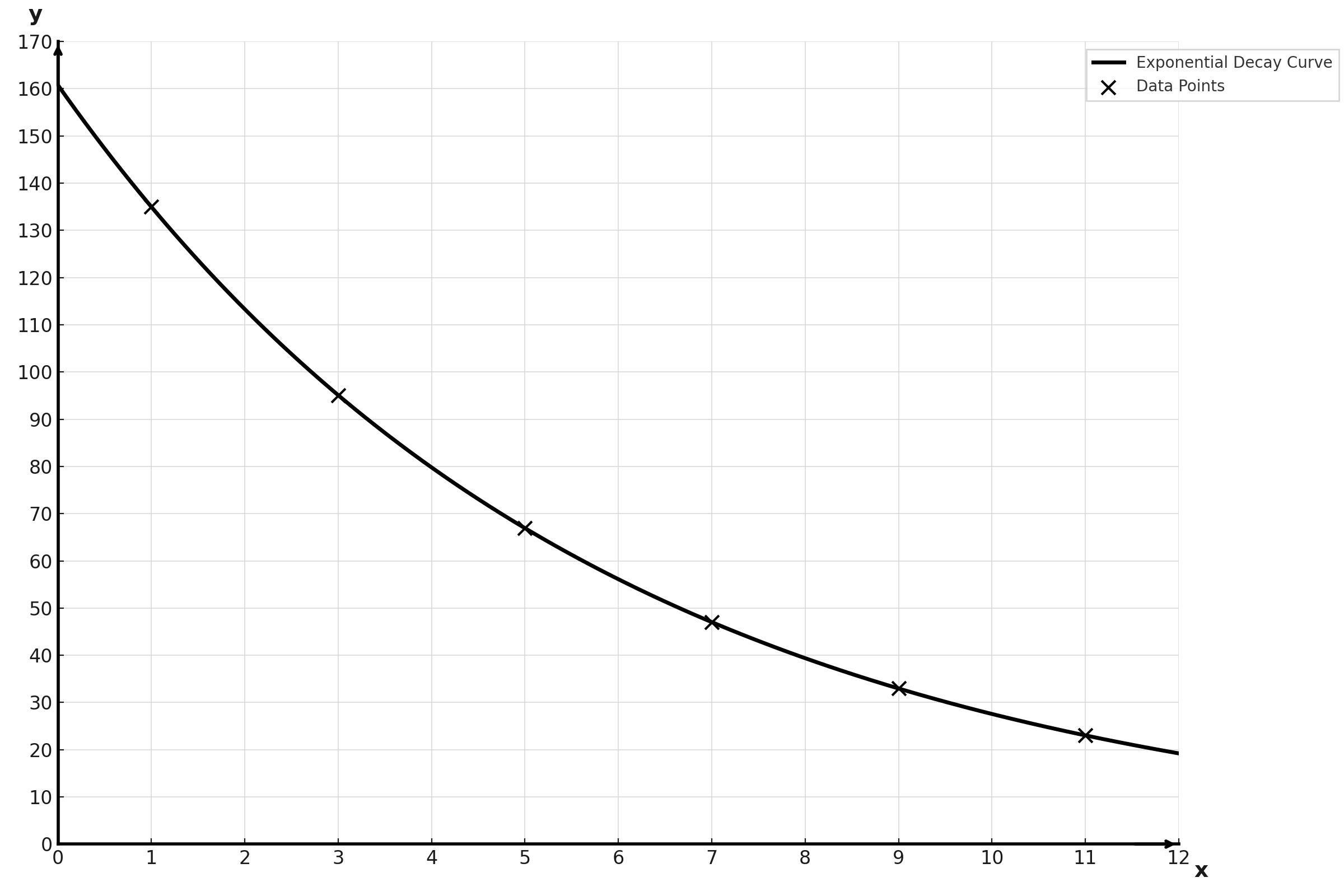
The scatterplot shows measured pairs \(\mathrm{(x, y)}\) and a smooth curve modeling the data. The model is exponential and can be written as \(\mathrm{y = a(b)^x}\), where a and b are positive constants. Based on the graph, which of the following is closest to the value of b?
1. TRANSLATE the graph information into data points
Looking at the scatterplot, I need to identify clear, readable data points (where the X marks are):
- Given data points:
- \(\mathrm{(0, 160)}\) - the y-intercept
- \(\mathrm{(1, 135)}\)
- \(\mathrm{(3, 95)}\)
- \(\mathrm{(5, 67)}\)
- \(\mathrm{(7, 47)}\)
- \(\mathrm{(9, 33)}\)
- \(\mathrm{(11, 23)}\)
- What we're looking for: The value of \(\mathrm{b}\) in the model \(\mathrm{y = a(b)^x}\)
2. INFER the best strategy to find b
Since we have an exponential model \(\mathrm{y = a(b)^x}\), I need to recognize:
- The parameter \(\mathrm{a}\) is the y-value when \(\mathrm{x = 0}\), so \(\mathrm{a = 160}\)
- To find \(\mathrm{b}\), I can use two points and substitute them into the equation
- The easiest approach is to use \(\mathrm{x = 0}\) and \(\mathrm{x = 1}\) since they're consecutive
3. Set up equations using two points
Using \(\mathrm{(0, 160)}\) and \(\mathrm{(1, 135)}\):
- At \(\mathrm{x = 0}\): \(\mathrm{y = a(b)^0 = a(1) = a = 160}\)
- At \(\mathrm{x = 1}\): \(\mathrm{y = a(b)^1 = ab = 160b = 135}\)
4. SIMPLIFY to solve for b
From \(\mathrm{160b = 135}\):
- \(\mathrm{b = \frac{135}{160}}\)
- \(\mathrm{b = 0.84375}\)
5. Verify using the ratio property (optional but recommended)
Let me INFER another approach to check my answer:
- For exponential functions, \(\mathrm{b^{(x_2-x_1)} = \frac{y_2}{y_1}}\)
- Using points \(\mathrm{(1, 135)}\) and \(\mathrm{(3, 95)}\):
- \(\mathrm{b^{(3-1)} = \frac{95}{135}}\)
- \(\mathrm{b^2 = 0.7037}\) (use calculator)
- \(\mathrm{b = \sqrt{0.7037} \approx 0.839}\) (use calculator)
Both methods give \(\mathrm{b \approx 0.84}\)!
6. APPLY CONSTRAINTS to select the answer
Looking at the choices:
- (A) 0.84 ✓ Matches our calculation
- (B) 0.94 - Too large (would indicate slower decay)
- (C) 1.34 - Greater than 1 (would indicate growth, not decay)
- (D) 134 - Way too large (likely a misinterpretation)
Answer: (A) 0.84
Why Students Usually Falter on This Problem
Most Common Error Path:
Weak TRANSLATE skill: Students misread the data points from the graph, particularly confusing which coordinate belongs to which axis or misreading values between gridlines.
For example, reading \(\mathrm{(1, 135)}\) as \(\mathrm{(1, 140)}\) or \(\mathrm{(3, 95)}\) as \(\mathrm{(3, 100)}\) leads to incorrect calculations:
- If using 140 instead of 135: \(\mathrm{b = \frac{140}{160} = 0.875}\)
- If using 100 instead of 95: \(\mathrm{b^2 = \frac{100}{135} = 0.741}\), so \(\mathrm{b \approx 0.86}\)
These reading errors lead to values that don't match any answer choice exactly, causing confusion and guessing, or might lead students toward Choice (B) (0.94) if multiple reading errors compound.
Second Most Common Error:
Weak INFER skill combined with conceptual confusion: Students confuse which parameter to solve for or misunderstand what \(\mathrm{b}\) represents in the exponential model.
Some students might:
- Calculate \(\mathrm{a}\) instead of \(\mathrm{b}\) and look for 160 in the choices
- Try to find the slope like in a linear model
- Divide the wrong values: computing \(\mathrm{\frac{160}{135} \approx 1.185}\) instead of \(\mathrm{\frac{135}{160}}\)
If students compute \(\mathrm{\frac{160}{135}}\), they get approximately 1.19, which might lead them to guess Choice (C) (1.34) as the "closest" value greater than 1, not recognizing that \(\mathrm{b}\) must be less than 1 for a decay model.
Third Most Common Error:
Poor SIMPLIFY execution: Students correctly set up the problem but make arithmetic errors when computing ratios or taking square roots.
For example, when using the ratio method with \(\mathrm{b^2 = \frac{95}{135}}\):
- Forgetting to take the square root, leaving \(\mathrm{b^2 \approx 0.70}\) and selecting Choice (A) (0.84) by chance
- Taking the square root incorrectly, perhaps computing \(\mathrm{\frac{\sqrt{95}}{\sqrt{135}}}\) separately and making errors
The Bottom Line:
This problem tests your ability to accurately extract information from a graph and apply exponential function properties. The key is recognizing that for decay models (where y decreases as x increases), \(\mathrm{b}\) must be between 0 and 1, which immediately eliminates choices (C) and (D). Careful reading of coordinates and precise calculation of ratios are essential to distinguish between the remaining close choices (A) and (B).