
In the given scatterplot, a line of best fit for the data is shown. Which of the following is closest...
GMAT Problem-Solving and Data Analysis : (PS_DA) Questions
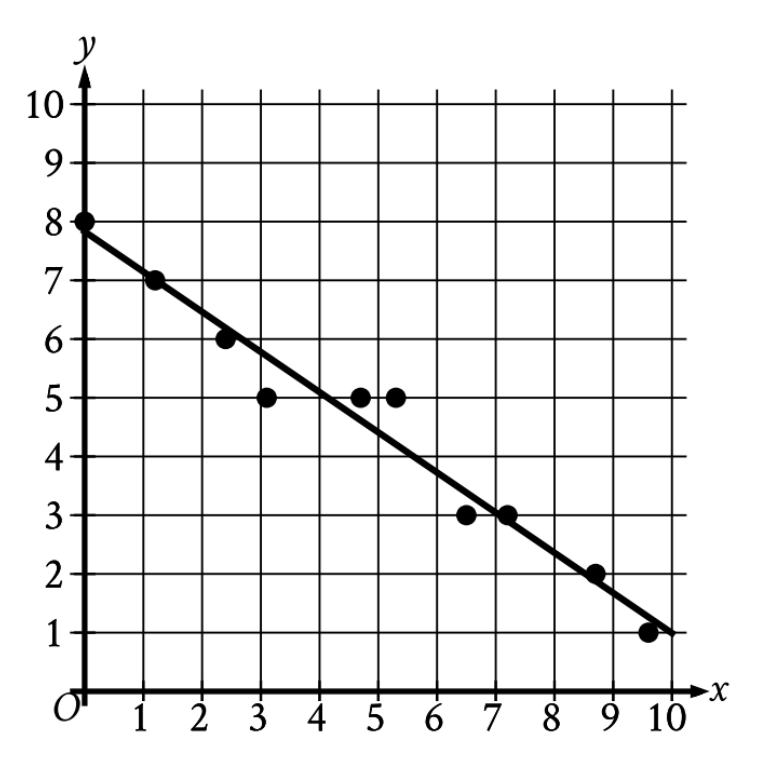
In the given scatterplot, a line of best fit for the data is shown. Which of the following is closest to the slope of this line of best fit?
\(7\)
\(0.7\)
\(-0.7\)
\(-7\)
1. TRANSLATE the visual information from the graph
- Observe the line of best fit shown in the scatterplot
- Notice the line goes downward from left to right
- Identify two clear points that the line passes through (or nearly passes through):
- Point 1: \((0, 8)\) — where the line appears to intersect the y-axis
- Point 2: \((10, 1)\) — where the line appears to be near the bottom right
Tip: Choose points that fall on or very close to grid intersections for easier reading.
2. INFER what the slope's sign must be
- Since the line decreases as x increases (goes down from left to right), the slope must be negative
- This immediately eliminates Choice A (7) and Choice B (0.7) since they are positive
- We're now choosing between Choice C (−0.7) and Choice D (−7)
3. APPLY the slope formula with your points
- Use the slope formula: \(\mathrm{slope} = \frac{\mathrm{y_2 - y_1}}{\mathrm{x_2 - x_1}}\)
- Substitute the coordinates from points \((0, 8)\) and \((10, 1)\):
\(\mathrm{slope} = \frac{1 - 8}{10 - 0}\)
\(\mathrm{slope} = \frac{-7}{10}\)
4. SIMPLIFY the fraction to decimal form
- Convert \(\frac{-7}{10}\) to decimal:
\(\frac{-7}{10} = -0.7\)
5. Match with answer choices
- Our calculated slope is -0.7
- This exactly matches Choice C
Answer: C. −0.7
Why Students Usually Falter on This Problem
Most Common Error Path:
Weak TRANSLATE skill: Students misread the coordinates from the graph. They might choose points that don't clearly lie on grid intersections, leading to poor estimates. For instance, choosing \((3, 6)\) and \((7, 3)\) might give approximately \(\frac{-3}{4} = -0.75\), which is close to -0.7 but could cause doubt. More problematically, if students miscount grid lines or misidentify coordinates, they could get significantly different values.
Some students might also confuse the slope formula and calculate \(\frac{\mathrm{x_2 - x_1}}{\mathrm{y_2 - y_1}}\) instead, giving \(\frac{-10}{7} \approx -1.43\). This doesn't match any answer choice, leading to confusion and guessing.
Second Most Common Error:
Poor SIMPLIFY execution: Students correctly set up the calculation as \(\frac{-7}{10}\) but then make an arithmetic error. The most common mistake is dropping the negative sign, calculating \(7 \div 10 = 0.7\) and forgetting to include the negative. This leads them to select Choice B (0.7).
Another error occurs when students don't divide at all — they see -7 in the numerator and 10 in the denominator, but mistakenly think the slope is -7, leading them to select Choice D (−7).
Third Error Path:
Conceptual confusion about slope steepness: Some students understand the slope is negative but don't have a good sense of what -0.7 versus -7 means visually. A slope of -7 would be extremely steep (dropping 7 units for every 1 unit right), while -0.7 is more gradual. Looking at the graph, the line drops about 7 units over 10 units horizontally, which is gradual. Students who don't INFER this relationship might select Choice D (−7) by seeing the "7" in their calculation without completing the division.
The Bottom Line:
This problem tests whether students can accurately read coordinates from a graph and correctly apply the slope formula. The key is to eliminate obviously wrong answers first by observing the line's direction, then carefully select two clear points and execute the calculation properly, being mindful of negative signs and completing the division to convert to decimal form.
\(7\)
\(0.7\)
\(-0.7\)
\(-7\)