
During a study, the temperature, in degrees Celsius (°C), of the air in a chamber was recorded to the nearest...
GMAT Problem-Solving and Data Analysis : (PS_DA) Questions
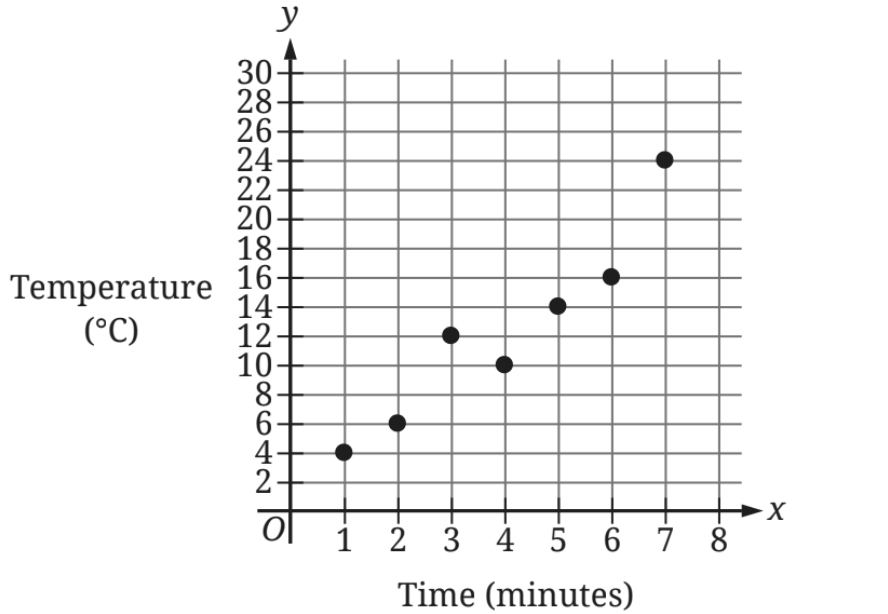
During a study, the temperature, in degrees Celsius (\(\mathrm{°C}\)), of the air in a chamber was recorded to the nearest integer at certain times. The scatterplot shows the recorded temperature \(\mathrm{y}\), in \(\mathrm{°C}\), of the air in the chamber \(\mathrm{x}\) minutes after the start of the study. What was the average rate of change, in \(\mathrm{°C}\) per minute, of the recorded temperature of the air in the chamber from \(\mathrm{x = 5}\) to \(\mathrm{x = 7}\)?
1. TRANSLATE the problem requirements
The question asks for 'the average rate of change, in °C per minute, from x = 5 to x = 7'
This tells us:
- We need to find how temperature changes per minute
- We're focusing on the interval from x = 5 to x = 7
- We need to find two specific points on the scatterplot
2. TRANSLATE the graph information into coordinates
Look carefully at the scatterplot to identify the exact coordinates:
- At x = 5 minutes: The point is at y = 14°C → coordinate (5, 14)
- At x = 7 minutes: The point is at y = 24°C → coordinate (7, 24)
Take your time reading these values - the grid lines help you count accurately.
3. Apply the average rate of change formula
The average rate of change between two points is:
\(\frac{\mathrm{y_2} - \mathrm{y_1}}{\mathrm{x_2} - \mathrm{x_1}}\)
Substituting our values:
\(\frac{24 - 14}{7 - 5}\)
4. SIMPLIFY the calculation
\(\frac{24 - 14}{7 - 5} = \frac{10}{2} = 5\)
Since temperature is measured in °C and time in minutes, the rate is 5 °C per minute.
Answer: 5 (or 5.0, or 5 °C per minute)
Why Students Usually Falter on This Problem
Most Common Error Path:
Weak TRANSLATE skill: Misreading the y-coordinate at x = 7
Some students might read the point at x = 7 as (7, 22) instead of (7, 24) because they miscount the grid lines or confuse it with a nearby value.
If they use (7, 22) instead of (7, 24):
- Calculation becomes: \((22 - 14)/(7 - 5) = 8/2 = 4\)
- This leads to an incorrect answer of 4
Second Most Common Error:
Weak TRANSLATE skill: Reading coordinates but using the wrong pair of points
A student might accidentally read values from x = 5 and x = 6 (which is (6, 16)) instead of x = 5 and x = 7:
- Calculation becomes: \((16 - 14)/(6 - 5) = 2/1 = 2\)
- This leads to an incorrect answer of 2
Alternatively, some might use x = 6 and x = 7:
- Calculation becomes: \((24 - 16)/(7 - 6) = 8/1 = 8\)
- This leads to an incorrect answer of 8
The Bottom Line:
This problem tests your ability to carefully extract precise information from a visual display. The mathematics (using the rate of change formula) is straightforward once you have the correct coordinates. The challenge is in the careful, accurate reading of the scatterplot - take your time to locate each point exactly using the grid lines as guides.