
The scatterplot shows the relationship between the age of a vehicle (in years) and its market value (in thousands of...
GMAT Problem-Solving and Data Analysis : (PS_DA) Questions
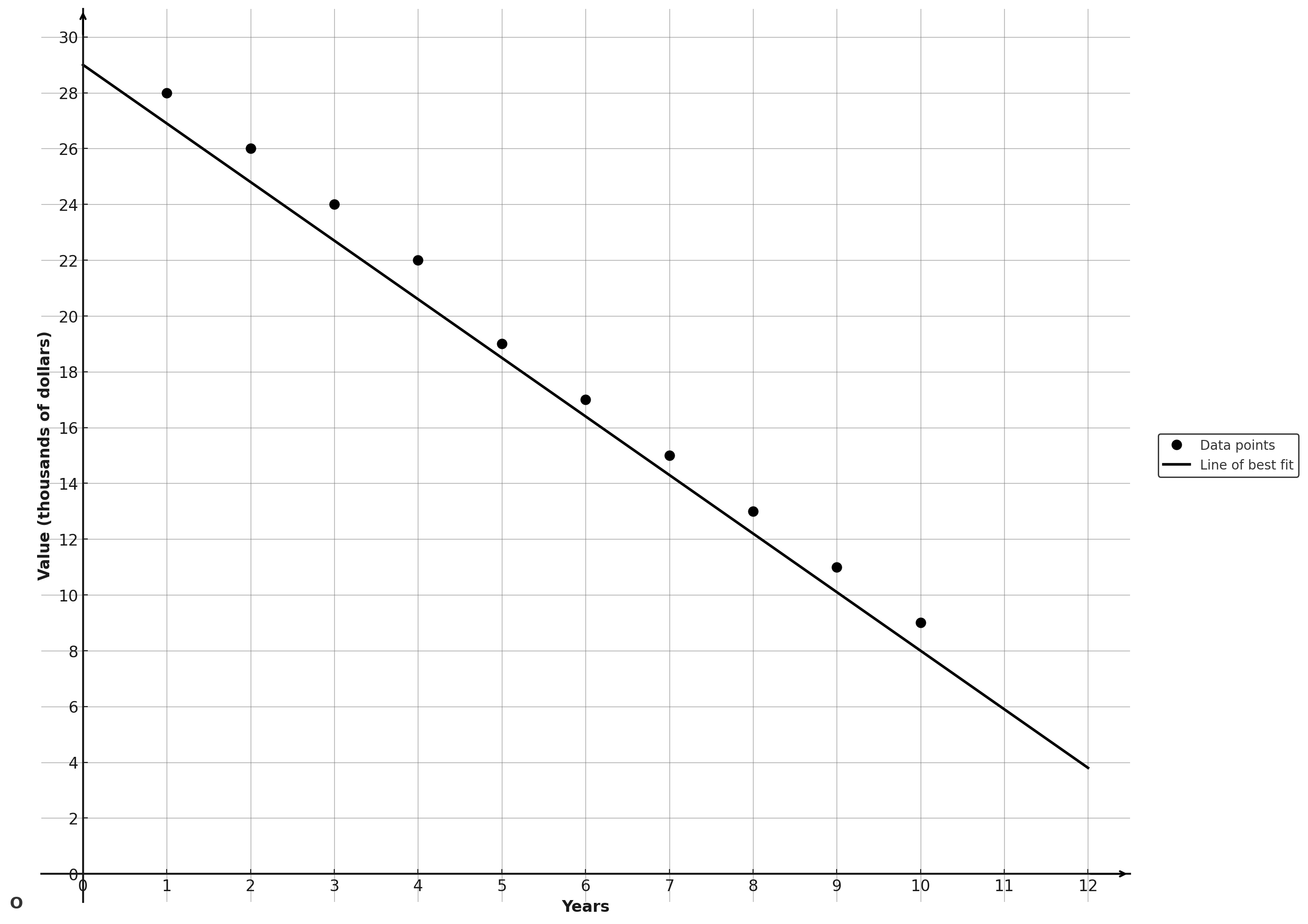
The scatterplot shows the relationship between the age of a vehicle (in years) and its market value (in thousands of dollars). A line of best fit is also shown. Which of the following equations best represents the line of best fit shown?
In the equations below, \(\mathrm{v}\) represents the value in thousands of dollars and \(\mathrm{t}\) represents the age in years.
1. TRANSLATE the graph information
Looking at the scatterplot, you need to extract two key pieces of information:
- Y-intercept: Where does the line cross the v-axis?
- Follow the line to where \(\mathrm{t = 0}\)
- The line crosses at \(\mathrm{v = 29}\)
- Direction of the line: Does it go up or down?
- Moving from left to right, the line goes downward
- This tells us the slope will be negative
2. TRANSLATE two points from the line
To calculate slope, select two clear points the line passes through:
- Point 1: \(\mathrm{(0, 29)}\) — the y-intercept we already found
- Point 2: \(\mathrm{(10, 8)}\) — at year 10, the value is approximately 8 thousand dollars
3. SIMPLIFY to calculate the slope
Apply the slope formula with your two points:
- Slope = \(\mathrm{\frac{v_2 - v_1}{t_2 - t_1}}\)
- Slope = \(\mathrm{\frac{8 - 29}{10 - 0}}\)
- Slope = \(\mathrm{\frac{-21}{10}}\)
- Slope = \(\mathrm{-2.1}\)
The negative confirms what we observed: the line goes down.
4. INFER the equation structure
Now combine your findings into slope-intercept form:
- General form: \(\mathrm{v = mt + b}\)
- We have: \(\mathrm{m = -2.1}\) and \(\mathrm{b = 29}\)
- Equation: \(\mathrm{v = -2.1t + 29}\)
This can also be written as: \(\mathrm{v = 29 - 2.1t}\)
5. Match to the answer choices
Looking at the options:
- (A) \(\mathrm{v = 29 + 2.1t}\) — Wrong sign on slope (positive instead of negative)
- (B) \(\mathrm{v = 29 - 2.1t}\) — Correct! ✓
- (C) \(\mathrm{v = -29 + 2.1t}\) — Wrong signs on both terms
- (D) \(\mathrm{v = -29 - 2.1t}\) — Wrong sign on y-intercept
Answer: B
Why Students Usually Falter on This Problem
Most Common Error Path:
Process Skill: Weak TRANSLATE reasoning when reading the y-intercept
Students may misread where the line crosses the y-axis, thinking it starts at a negative value because they confuse the visual spacing or don't carefully trace the line back to \(\mathrm{t = 0}\). If they read the y-intercept as -29 instead of +29, they immediately narrow their choices to C or D.
Then, if they correctly identify the slope as negative (which is visually obvious), they would select Choice D (\(\mathrm{v = -29 - 2.1t}\)).
Alternatively, if they also get the slope sign wrong, they select Choice C (\(\mathrm{v = -29 + 2.1t}\)).
Second Most Common Error:
Process Skill: Weak INFER understanding of slope sign
Some students correctly identify the y-intercept as 29 but get confused about what "negative slope" means in equation form. They might think that because values are decreasing, they need to "add" to the initial value, or they don't properly translate the visual downward direction into the algebraic negative sign.
This leads them to select Choice A (\(\mathrm{v = 29 + 2.1t}\)), which has the correct y-intercept but the wrong slope sign.
Third Common Error:
Process Skill: Poor SIMPLIFY execution in slope calculation
Students may correctly identify both points but make arithmetic errors:
- Calculating \(\mathrm{(8 - 29)}\) as +21 instead of -21
- Dividing incorrectly: \(\mathrm{\frac{-21}{10} \neq -2.1}\) in their work
- Forgetting to include the negative sign in the final equation
Any of these calculation mistakes can lead to Choice A (\(\mathrm{v = 29 + 2.1t}\)) if they lose track of the negative sign.
The Bottom Line:
This problem tests whether students can accurately extract visual information from a graph and correctly translate it into algebraic form. The challenge lies in carefully reading the intercept value and properly handling the negative slope—both in calculation and in equation structure. Students must maintain precision in both visual interpretation and algebraic representation.