
In the figure above, circle P is similar to circle R. The radius of circle P is 4 inches, and...
GMAT Geometry & Trigonometry : (Geo_Trig) Questions
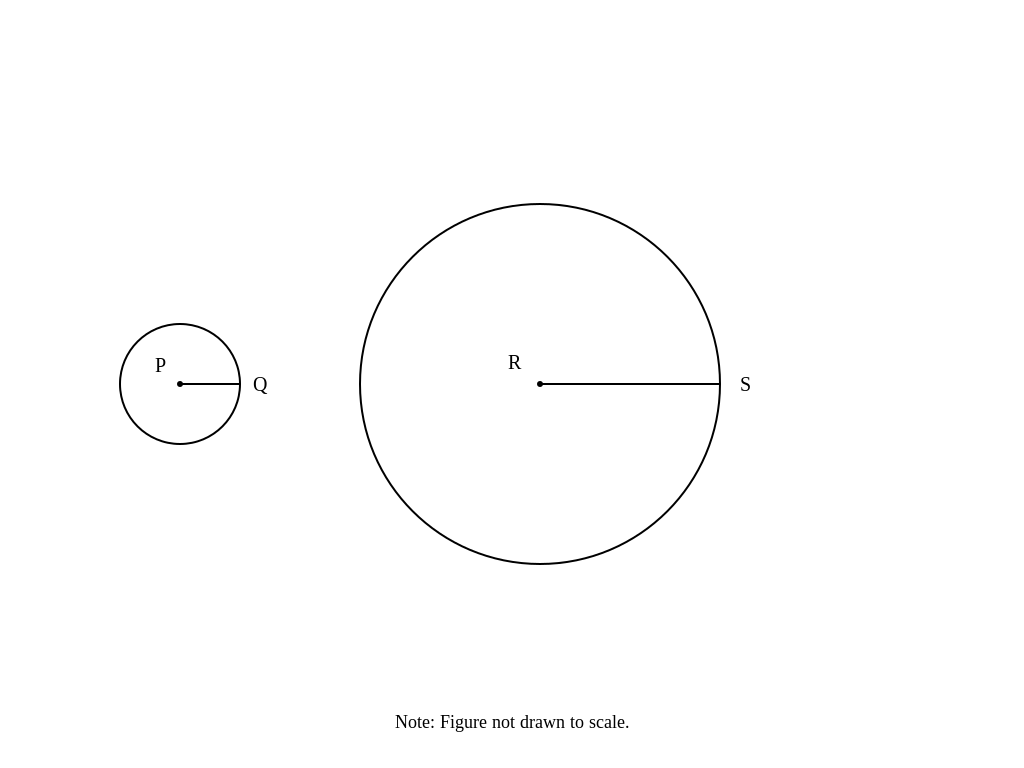
In the figure above, circle P is similar to circle R. The radius of circle P is \(\mathrm{4\ inches}\), and the circumference of circle P is \(\mathrm{24\pi\ inches}\). If the radius of circle R is \(\mathrm{12\ inches}\), what is the circumference of circle R?
\(72\pi\ inches\)
\(96\pi\ inches\)
\(144\pi\ inches\)
\(288\pi\ inches\)
1. TRANSLATE the problem information
Given facts:
- Circle P has radius = 4 inches
- Circle P has circumference = 24π inches
- Circle R has radius = 12 inches
- The circles are similar
- We need to find the circumference of circle R
2. INFER the relationship between the circles
Since the circles are similar, all their corresponding linear measurements are proportional. This means:
- The ratio of their radii equals the ratio of their circumferences
- We can find a scale factor from the radii and apply it to the circumference
Key insight: The scale factor applies to ALL linear measurements (radius, diameter, circumference) equally. This is what "similar" means for geometric figures.
3. SIMPLIFY to find the scale factor
Scale factor = radius of R / radius of P
\(\mathrm{Scale\ factor = \frac{12}{4} = 3}\)
This tells us that circle R is 3 times as large as circle P in all linear dimensions.
4. INFER how to find the circumference of circle R
Since the circumferences are proportional by the same scale factor:
Circumference of R = Circumference of P × scale factor
5. SIMPLIFY the calculation
\(\mathrm{Circumference\ of\ R = 24\pi \times 3}\)
\(\mathrm{Circumference\ of\ R = 72\pi\ inches}\)
Answer: (A) 72π inches
Why Students Usually Falter on This Problem
Most Common Error Path:
Weak INFER skill: Students might try to use the circumference formula \(\mathrm{C = 2\pi r}\) directly on circle R, calculating \(\mathrm{2\pi(12) = 24\pi\ inches}\). However, they might notice this doesn't match the pattern from circle P (where \(\mathrm{C = 24\pi}\) but \(\mathrm{2\pi r = 8\pi}\)). This inconsistency causes confusion, and students may abandon the systematic approach and guess, or they might assume the problem has an error and select Choice (A) (72π inches) accidentally through guessing.
Alternative error path: Students who notice the inconsistency might think they need to use the given circumference of P somehow but don't know how to connect it to finding the circumference of R without understanding the scale factor concept. This leads to confusion and random answer selection.
Second Most Common Error:
Conceptual confusion about scaling: Students might confuse linear scaling with area scaling. They know that when linear dimensions are scaled by k, areas scale by k². Applying this incorrectly to circumference:
\(\mathrm{Circumference\ of\ R = 24\pi \times 3^2}\)
\(\mathrm{= 24\pi \times 9}\)
\(\mathrm{= 216\pi\ inches}\)
This doesn't match any answer choice exactly, but they might look for the closest option or realize their error. However, this confusion about which scaling rule to apply (k vs k²) is a fundamental misunderstanding of what type of measurement circumference is.
The Bottom Line:
This problem tests whether students understand that similarity means ALL linear measurements scale by the same factor. The trick is recognizing that you can find the scale factor from one pair of corresponding measurements (the radii) and apply it to a different pair (the circumferences). Students who try to work with formulas instead of scaling relationships often get confused by the inconsistent data given for circle P.
\(72\pi\ inches\)
\(96\pi\ inches\)
\(144\pi\ inches\)
\(288\pi\ inches\)