
In the figure above, rectangle ABCD is similar to rectangle EFGH, where vertices A, B, C, and D correspond to...
GMAT Geometry & Trigonometry : (Geo_Trig) Questions
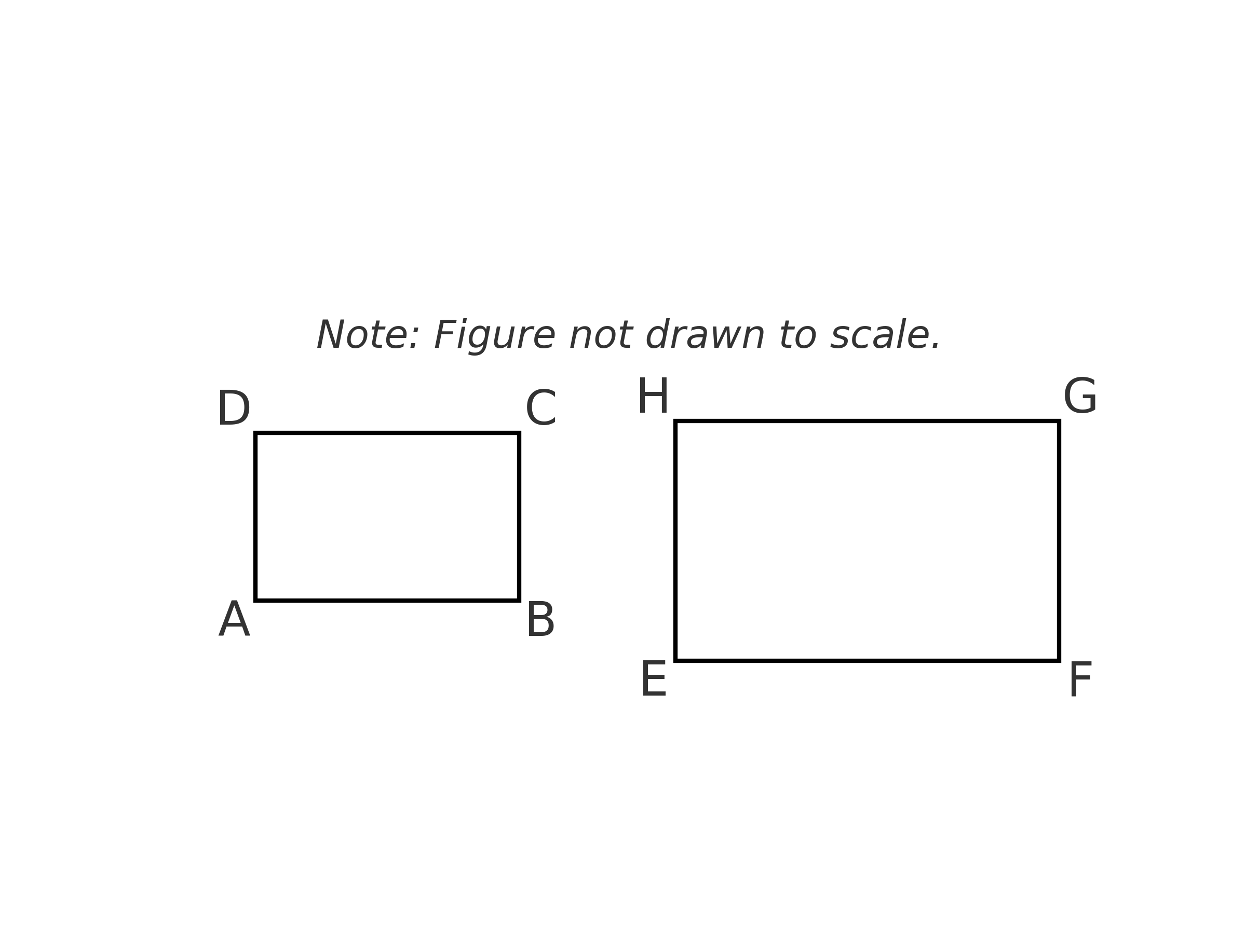
In the figure above, rectangle \(\mathrm{ABCD}\) is similar to rectangle \(\mathrm{EFGH}\), where vertices \(\mathrm{A, B, C,}\) and \(\mathrm{D}\) correspond to vertices \(\mathrm{E, F, G,}\) and \(\mathrm{H}\), respectively. The area of rectangle \(\mathrm{ABCD}\) is \(\mathrm{12}\), and the length of its side \(\mathrm{AD}\) is \(\mathrm{2}\). If the length of the corresponding side \(\mathrm{EH}\) is \(\mathrm{5}\), what is the area of rectangle \(\mathrm{EFGH}\)?
1. TRANSLATE the problem information
- Given facts:
- Rectangle \(\text{ABCD} \sim \text{Rectangle EFGH}\) (similar rectangles)
- Area of \(\text{ABCD} = 12\)
- Side \(\mathrm{AD} = 2\)
- Corresponding side \(\mathrm{EH} = 5\)
- Need to find: Area of EFGH
- What "corresponding" means: Since the vertices correspond in order \(\mathrm{A \leftrightarrow E, B \leftrightarrow F, C \leftrightarrow G, D \leftrightarrow H}\), side AD on the first rectangle matches with side EH on the second rectangle.
2. INFER the solution strategy
- Key strategic insight: We have two similar rectangles and need to find how their areas relate. Since we know one side from each rectangle, we can:
- Find the scale factor between them
- Use the area scaling rule (areas scale by \(\mathrm{k}^2\), not k)
- Why this approach works: We don't need to find all dimensions—the area scaling rule gives us a direct path from one area to the other.
3. SIMPLIFY to find the scale factor
The scale factor k from rectangle ABCD to rectangle EFGH is:
\(\mathrm{k} = \frac{\mathrm{EH}}{\mathrm{AD}} = \frac{5}{2}\)
4. INFER the area relationship
Since the rectangles are similar with scale factor \(\mathrm{k} = \frac{5}{2}\):
- Linear measurements scale by k
- But areas scale by \(\mathrm{k}^2\) (this is crucial!)
Area ratio \(= \mathrm{k}^2 = \left(\frac{5}{2}\right)^2 = \frac{25}{4}\)
5. SIMPLIFY to find the area of EFGH
Set up the proportion:
- \(\frac{\text{Area of EFGH}}{\text{Area of ABCD}} = \frac{25}{4}\)
- \(\frac{\text{Area of EFGH}}{12} = \frac{25}{4}\)
- \(\text{Area of EFGH} = 12 \times \frac{25}{4}\)
SIMPLIFY the arithmetic:
- \(\text{Area of EFGH} = \frac{12}{4} \times 25\)
- \(\text{Area of EFGH} = 3 \times 25\)
- \(\text{Area of EFGH} = 75\)
Answer: C. 75
Why Students Usually Falter on This Problem
Most Common Error Path:
Weak INFER skill: Using linear scale factor for area instead of squared scale factor
Many students correctly find \(\mathrm{k} = \frac{5}{2}\), but then incorrectly calculate:
- \(\text{Area of EFGH} = 12 \times \frac{5}{2} = 12 \times 2.5 = 30\)
This happens because they don't recognize (or forget) that while lengths scale by k, areas scale by \(\mathrm{k}^2\). They treat area as if it were a one-dimensional measurement.
This leads them to select Choice A (30).
Second Most Common Error:
Incomplete SIMPLIFY: Arithmetic error in computing \(12 \times \frac{25}{4}\)
Students might correctly set up \(\text{Area} = 12 \times \frac{25}{4}\) but then:
- Multiply \(12 \times 25 = 300\) first
- Forget to divide by 4, leaving their answer as 300
- Or divide incorrectly
However, since 300 is not among the answer choices, this error would cause confusion and likely lead to guessing or reworking.
Third Possible Error:
Conceptual confusion: Inverting the scale factor
Some students might compute \(\mathrm{k} = \frac{\mathrm{AD}}{\mathrm{EH}} = \frac{2}{5}\) instead of \(\mathrm{k} = \frac{\mathrm{EH}}{\mathrm{AD}} = \frac{5}{2}\), thinking about the ratio backwards. This would lead to:
- \(\text{Area of EFGH} = 12 \times \left(\frac{2}{5}\right)^2 = 12 \times \frac{4}{25} = \frac{48}{25} \approx 1.92\)
This is much smaller than 12, which should trigger suspicion (the larger rectangle should have a larger area), but it doesn't match any answer choice, leading to confusion and guessing.
The Bottom Line:
The critical insight is understanding that area scales as the square of linear dimensions. This is a fundamental property of two-dimensional scaling that students often confuse with simple proportional relationships. The \(\mathrm{k}^2\) rule is what distinguishes this problem from basic proportion problems.