
Right triangles PQR and STU are similar, where P corresponds to S. If the measure of angle Q is 18°,...
GMAT Geometry & Trigonometry : (Geo_Trig) Questions
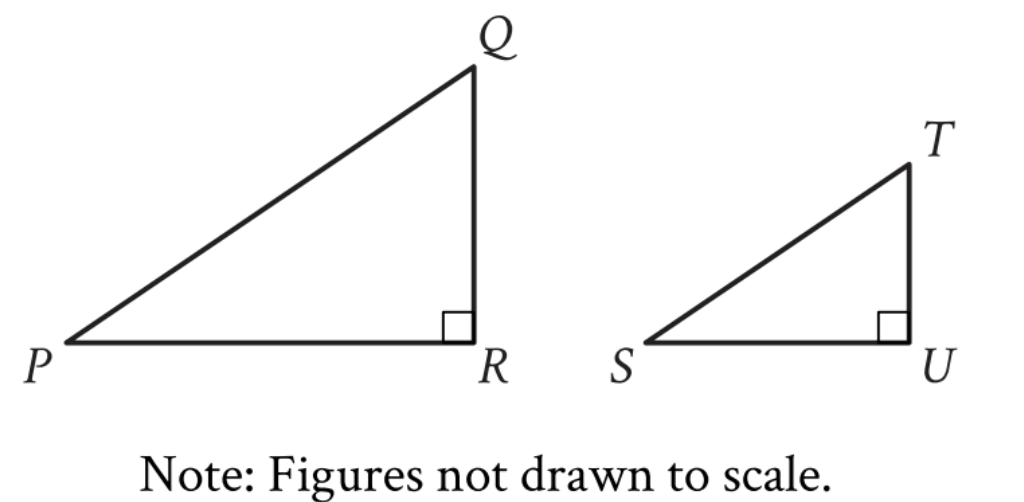
Right triangles PQR and STU are similar, where P corresponds to S. If the measure of \(\angle \mathrm{Q}\) is \(18°\), what is the measure of \(\angle \mathrm{S}\)?
\(18°\)
\(72°\)
\(82°\)
\(162°\)
1. TRANSLATE the problem information
Given information:
- Triangles PQR and STU are similar right triangles
- P corresponds to S
- Angle Q measures \(18°\)
- From the diagram: angles R and U are both marked as right angles (\(90°\))
What we need to find:
- The measure of angle S
2. INFER the complete angle correspondence
This is the crucial step! We're told P corresponds to S, but we need to figure out which angles in triangle PQR correspond to which angles in triangle STU.
Strategic reasoning:
- We know \(\mathrm{P \leftrightarrow S}\) (given)
- From the diagram, both angle R and angle U are right angles, so \(\mathrm{R \leftrightarrow U}\)
- Since there are only three angles in each triangle, the remaining angles must correspond: \(\mathrm{Q \leftrightarrow T}\)
Key insight: The angle we're given (angle Q = \(18°\)) does NOT correspond to the angle we're looking for (angle S). Instead, Q corresponds to T.
3. INFER angle measures using properties of similar triangles
In similar triangles, corresponding angles are congruent (equal in measure):
- Since \(\mathrm{Q \leftrightarrow T}\), then \(\mathrm{angle\ Q = angle\ T = 18°}\)
- Since \(\mathrm{R \leftrightarrow U}\), then \(\mathrm{angle\ R = angle\ U = 90°}\)
4. TRANSLATE and SIMPLIFY to find angle S
Now we can use the triangle angle sum property. In triangle STU:
\(\mathrm{Angle\ S + Angle\ T + Angle\ U = 180°}\)
Substitute the known values:
\(\mathrm{Angle\ S + 18° + 90° = 180°}\)
\(\mathrm{Angle\ S + 108° = 180°}\)
\(\mathrm{Angle\ S = 180° - 108°}\)
\(\mathrm{Angle\ S = 72°}\)
Answer: B. \(72°\)
Why Students Usually Falter on This Problem
Most Common Error Path:
Weak INFER skill: Students see that angle Q = \(18°\) and they're asked to find angle S. Since P corresponds to S (both are the "first" letter in each triangle), they incorrectly assume Q must correspond to the next angle they're asked about.
The problem states "P corresponds to S" and asks for angle S, while giving angle Q. Students might think: "If P goes with S, and they're asking about S, maybe Q is related to S too."
This leads them to incorrectly conclude that angle S = \(18°\).
This may lead them to select Choice A (\(18°\)).
Second Most Common Error:
Incomplete INFER and SIMPLIFY: Students correctly determine the angle correspondences and that angle T = \(18°\), but then add angles incorrectly or confuse which angles they've found.
For example, after finding that angle T = \(18°\) and knowing angle U = \(90°\), they might:
- Add these together: \(18° + 90° = 108°\) and mistakenly think this is angle S
- Subtract incorrectly: \(180° - 90° - 18°\) but make an arithmetic error
Or they might find \(90° - 18° = 72°\) through faulty reasoning about complementary angles.
While they might still arrive at \(72°\), or they might select Choice D (\(162°\)) if they compute \(180° - 18° = 162°\) by forgetting to account for the right angle.
The Bottom Line:
This problem tests whether students can carefully track angle correspondences in similar triangles. The key challenge is not being misled by the fact that you're given angle Q but asked for angle S—these are NOT corresponding angles. Students must use the diagram and given information to establish the complete correspondence pattern before applying properties of similar triangles.
\(18°\)
\(72°\)
\(82°\)
\(162°\)