
In the figure above, triangle FGH is similar to triangle JKL. The area of triangle JKL is 9 times the...
GMAT Geometry & Trigonometry : (Geo_Trig) Questions
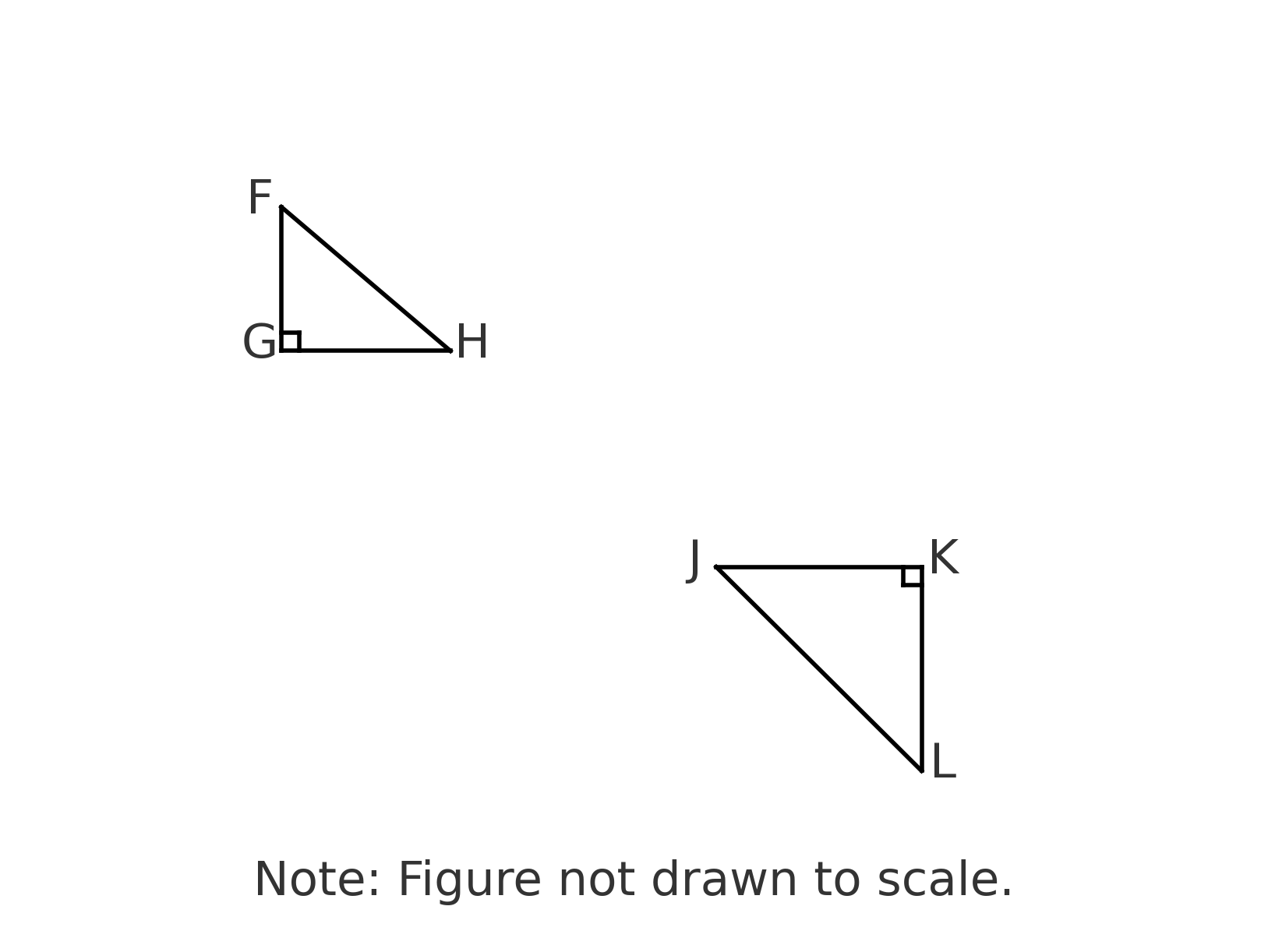
In the figure above, triangle \(\mathrm{FGH}\) is similar to triangle \(\mathrm{JKL}\). The area of triangle \(\mathrm{JKL}\) is \(9\) times the area of triangle \(\mathrm{FGH}\), and the measure of angle \(\mathrm{FHG}\) is \(32°\). What is the measure, in degrees, of angle \(\mathrm{JLK}\)?
58
96
32
288
1. TRANSLATE the similarity statement
The problem states "triangle FGH is similar to triangle JKL," written as \(\triangle\mathrm{FGH} \sim \triangle\mathrm{JKL}\).
What this notation tells us:
- The ORDER of the vertices matters
- F corresponds to J
- G corresponds to K
- H corresponds to L
This vertex correspondence is the key to identifying which angles are equal.
2. INFER which angles we're comparing
We need angle JLK (the angle at vertex L in triangle JKL).
From our vertex correspondence, L corresponds to H.
Therefore, angle JLK corresponds to angle FHG.
3. Apply the similarity property
INFER what similarity means for angles: Similar triangles have congruent corresponding angles. This is a fundamental property—angles don't change even when triangles are different sizes.
Since angle JLK corresponds to angle FHG:
- \(\angle\mathrm{JLK} = \angle\mathrm{FHG} = 32°\)
4. Check the area information
The problem mentions that the area of △JKL is 9 times the area of △FGH.
INFER whether this matters: This tells us the triangles are different sizes (scale factor is 3:1), but angle measures are UNCHANGED in similar figures. This information is designed to distract you—don't use it!
Answer: 32°, which is Choice C
Why Students Usually Falter on This Problem
Most Common Error Path:
Weak INFER skill—Getting distracted by the area ratio: Students see "9 times the area" and think this must be used in the solution. They might multiply the angle by 3 (since \(\sqrt{9} = 3\)) or by 9, getting:
- \(32° \times 3 = 96°\) → This may lead them to select Choice B (96)
- \(32° \times 9 = 288°\) → This may lead them to select Choice D (288)
The misconception is thinking that ALL measurements scale proportionally, when in fact angles remain constant in similar figures.
Second Most Common Error:
Poor TRANSLATE reasoning—Misunderstanding vertex correspondence: Students don't realize the order of vertices matters in similarity statements. They might:
- Not establish the correspondence \(\mathrm{H} \leftrightarrow \mathrm{L}\)
- Randomly guess which angles correspond
- Try to compare angle FHG with angle JKL instead of angle JLK
This leads to confusion and guessing among all answer choices.
The Bottom Line:
This problem tests whether you understand that similarity affects LINEAR measurements and AREAS (which scale by k²), but ANGLES remain congruent. The area information is deliberately placed to see if you'll get sidetracked. The key is staying focused on the fundamental property: corresponding angles in similar triangles are always equal.
58
96
32
288