
Triangles PMN and XUV shown are similar, where P, M, and N correspond to X, U, and V, respectively. The...
GMAT Geometry & Trigonometry : (Geo_Trig) Questions
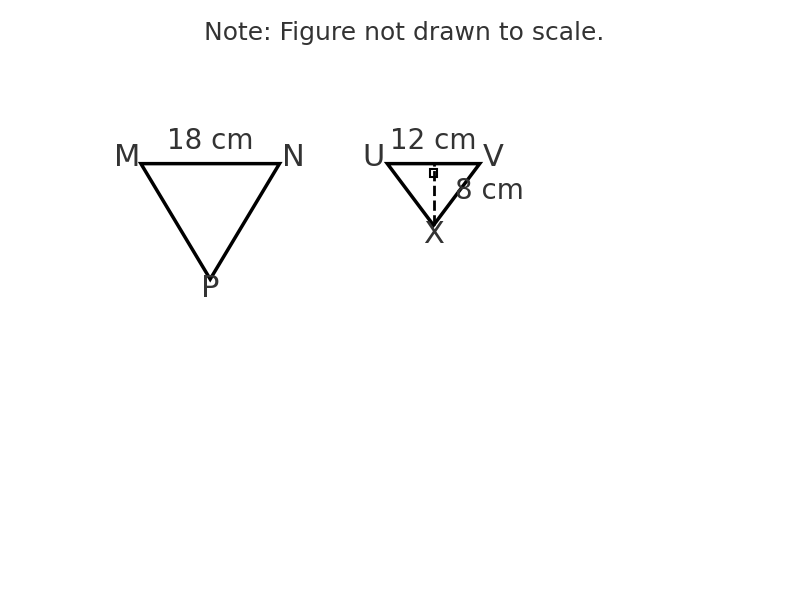
Triangles PMN and XUV shown are similar, where P, M, and N correspond to X, U, and V, respectively. The altitude from vertex X to side UV has length 8 cm. What is the length, in centimeters (cm), of the altitude from vertex P to side MN?
10
12
15
24
1. TRANSLATE the problem information
From the problem and diagram, identify:
Given information:
- Triangles PMN and XUV are similar
- Correspondence: P↔X, M↔U, and N↔V
- Side \(\mathrm{MN = 18\,cm}\) (from diagram)
- Side \(\mathrm{UV = 12\,cm}\) (from diagram)
- Altitude from X to UV = 8 cm
What we need to find:
- Altitude from P to MN
2. INFER which sides correspond
The correspondence notation tells us which vertices match up. Since M↔U and N↔V, the side MN in triangle PMN corresponds to side UV in triangle XUV.
This is crucial because we'll need to find the similarity ratio using these corresponding sides.
3. SIMPLIFY to find the similarity ratio
Calculate the ratio of corresponding sides:
\(\mathrm{Similarity\,ratio = \frac{MN}{UV} = \frac{18}{12} = \frac{3}{2}}\)
This tells us that triangle PMN is 3/2 times as large as triangle XUV.
4. INFER the relationship for altitudes
Here's the key insight: In similar triangles, ALL corresponding linear measurements are proportional by the same ratio—not just sides, but also altitudes, medians, and other lengths.
Since the triangles have similarity ratio 3/2, the altitude from P to MN must be 3/2 times the altitude from X to UV.
5. SIMPLIFY to calculate the altitude
Let h = altitude from P to MN
\(\frac{h}{8} = \frac{3}{2}\)
\(\mathrm{h = 8 \times \frac{3}{2} = 12\,cm}\)
Answer: 12 cm (Choice B)
Why Students Usually Falter on This Problem
Most Common Error Path:
Weak INFER skill: Students may not recognize that altitudes are proportional by the same ratio as the sides. They might try to use the altitude from X (which is 8 cm) and incorrectly assume it relates to some other calculation, or they might try to set up a proportion using the wrong pairs of measurements.
For example, they might think: "MN is 18 and UV is 12, so the altitude should be 18 - 12 = 6 more, giving 8 + 6 = 14." While 14 isn't among the choices, this confusion about how similarity works could lead them to guess randomly.
Second Most Common Error:
Poor SIMPLIFY execution: Students correctly identify that they need to multiply 8 by the ratio 18/12, but make an arithmetic error.
For instance, they might incorrectly compute:
- \(\frac{18}{12} = 1.5\), then \(\mathrm{8 \times 1.5 = 10}\) (choosing Choice A: 10)
- Or flip the ratio: \(\frac{12}{18} = \frac{2}{3}\), then \(\mathrm{8 \times \frac{2}{3} = \frac{16}{3} \approx 5.3}\), leading to confusion
Another common error: They might compute \(\frac{18}{12} \times 8 = \frac{18 \times 8}{12} = \frac{144}{12} = 12\), but make a mistake in the intermediate steps and arrive at 15 (choosing Choice C: 15) or 24 (choosing Choice D: 24).
The Bottom Line:
This problem tests whether students understand that similarity affects ALL linear measurements proportionally, not just the sides. The conceptual leap from "sides are proportional" to "altitudes must also be proportional by the same ratio" is where most students struggle. Once that connection is made, the problem becomes straightforward arithmetic.
10
12
15
24