
The graph shows a linear relationship between x and y. Which table gives three values of x and their corresponding...
GMAT Algebra : (Alg) Questions
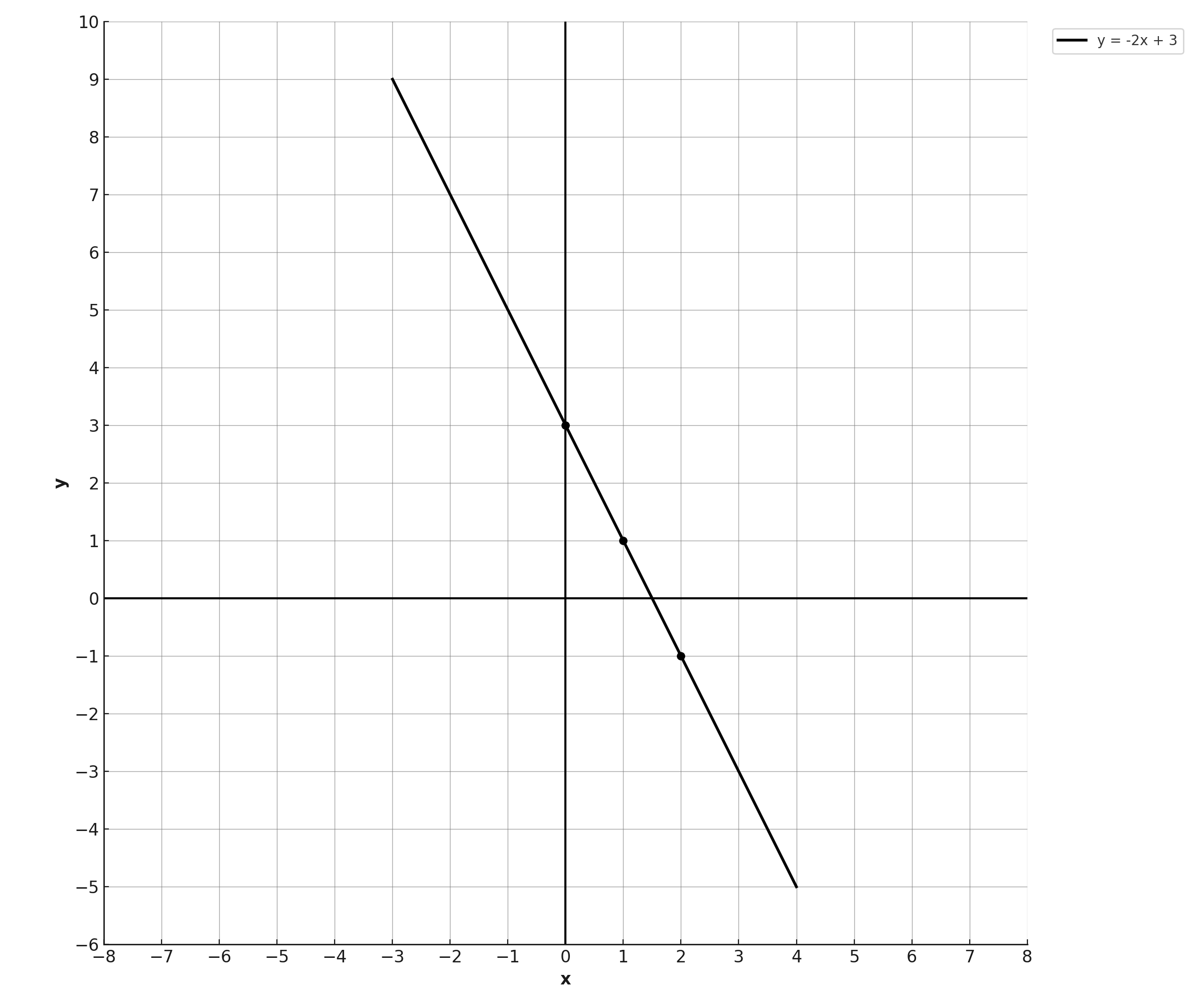
The graph shows a linear relationship between \(\mathrm{x}\) and \(\mathrm{y}\). Which table gives three values of \(\mathrm{x}\) and their corresponding values of \(\mathrm{y}\) for this relationship?
1. TRANSLATE the graph information
Looking at the graph carefully:
- Given information:
- The line crosses the y-axis at \(\mathrm{(0, 3)}\) — this is the y-intercept
- The line has a negative slope (it descends from left to right)
- Another clear point on the line is \(\mathrm{(1, 1)}\)
- The legend confirms the equation is \(\mathrm{y = -2x + 3}\)
2. INFER the verification strategy
Since the equation \(\mathrm{y = -2x + 3}\) is provided (and visible from the graph), I have two options:
- Try to read all the points in each table directly from the graph (difficult and imprecise)
- Use the equation to calculate the y-values for each x-value and compare with the tables (systematic and accurate)
The second approach is more reliable!
3. TRANSLATE what each table claims
I need to check which table gives values that satisfy \(\mathrm{y = -2x + 3}\):
Choice A claims: \(\mathrm{(0,0)}\), \(\mathrm{(1,2)}\), \(\mathrm{(2,4)}\)
Choice B claims: \(\mathrm{(0,3)}\), \(\mathrm{(1,2)}\), \(\mathrm{(2,1)}\)
Choice C claims: \(\mathrm{(0,3)}\), \(\mathrm{(1,1)}\), \(\mathrm{(2,-1)}\)
Choice D claims: \(\mathrm{(0,-3)}\), \(\mathrm{(-1,-1)}\), \(\mathrm{(2,1)}\)
4. SIMPLIFY by testing each table systematically
I'll substitute each x-value into \(\mathrm{y = -2x + 3}\):
Testing Choice A:
- When \(\mathrm{x = 0}\):
\(\mathrm{y = -2(0) + 3}\)
\(\mathrm{= 0 + 3}\)
\(\mathrm{= 3}\) - Table says \(\mathrm{y = 0}\), but should be 3 ✗
- No need to check further — this table is incorrect
Testing Choice B:
- When \(\mathrm{x = 0}\):
\(\mathrm{y = -2(0) + 3}\)
\(\mathrm{= 3}\) ✓ (matches table) - When \(\mathrm{x = 1}\):
\(\mathrm{y = -2(1) + 3}\)
\(\mathrm{= -2 + 3}\)
\(\mathrm{= 1}\) - Table says \(\mathrm{y = 2}\), but should be 1 ✗
- This table is incorrect
Testing Choice C:
- When \(\mathrm{x = 0}\):
\(\mathrm{y = -2(0) + 3}\)
\(\mathrm{= 0 + 3}\)
\(\mathrm{= 3}\) ✓ (matches table) - When \(\mathrm{x = 1}\):
\(\mathrm{y = -2(1) + 3}\)
\(\mathrm{= -2 + 3}\)
\(\mathrm{= 1}\) ✓ (matches table) - When \(\mathrm{x = 2}\):
\(\mathrm{y = -2(2) + 3}\)
\(\mathrm{= -4 + 3}\)
\(\mathrm{= -1}\) ✓ (matches table) - All three points match perfectly!
Testing Choice D (for completeness):
- When \(\mathrm{x = 0}\):
\(\mathrm{y = -2(0) + 3}\)
\(\mathrm{= 3}\) - Table says \(\mathrm{y = -3}\), but should be 3 ✗
- This table is incorrect
Answer: Choice C
Why Students Usually Falter on This Problem
Most Common Error Path:
Weak TRANSLATE skill: Misreading coordinates from the graph, especially the y-intercept or negative y-values.
Students may look at the graph too quickly and confuse which direction is positive on the y-axis. If they misread the y-intercept as -3 instead of +3, they might think the equation is \(\mathrm{y = 2x - 3}\) (a line with positive slope starting at -3). With this wrong equation, Choice D would appear to work: when \(\mathrm{x = 0}\), \(\mathrm{y = 2(0) - 3 = -3}\) ✓; when \(\mathrm{x = 1}\), \(\mathrm{y = 2(1) - 3 = -1}\) ✓; when \(\mathrm{x = 2}\), \(\mathrm{y = 2(2) - 3 = 1}\) ✓.
This may lead them to select Choice D \(\mathrm{(x=0, y=-3; x=1, y=-1; x=2, y=1)}\).
Second Most Common Error:
Inadequate SIMPLIFY execution: Making sign errors when working with negative numbers during substitution.
Students might correctly identify the equation as \(\mathrm{y = -2x + 3}\), but then make arithmetic mistakes with the negative slope. For example, they might calculate \(\mathrm{-2(1) + 3}\) as \(\mathrm{2 + 3 = 5}\), forgetting to apply the negative sign, or they might think the slope is -1 instead of -2. If they use \(\mathrm{y = -1x + 3}\) (slope of -1), then Choice B appears correct: when \(\mathrm{x = 1}\), \(\mathrm{y = -1(1) + 3 = 2}\) ✓; when \(\mathrm{x = 2}\), \(\mathrm{y = -1(2) + 3 = 1}\) ✓.
This may lead them to select Choice B \(\mathrm{(x=0, y=3; x=1, y=2; x=2, y=1)}\).
The Bottom Line:
This problem rewards careful, systematic work. Students need to accurately read the graph (especially paying attention to positive vs. negative values) and then carefully handle negative numbers in their calculations. The trap is that multiple answer choices start with the correct y-intercept (Choices B and C both have \(\mathrm{y = 3}\) when \(\mathrm{x = 0}\)), so students must verify all three points to ensure they have the right answer.