
The graph of a system of an absolute value function and a linear function is shown. What is the solution...
GMAT Advanced Math : (Adv_Math) Questions
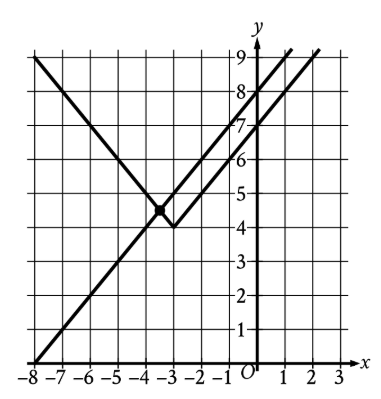
The graph of a system of an absolute value function and a linear function is shown. What is the solution to this system of two equations?
1. INFER what the question is asking
When you have a system of two equations, the solution is the point (or points) where their graphs intersect - where they cross each other.
- Given information:
- A graph showing an absolute value function (V-shaped)
- A graph showing a linear function (straight line)
- They intersect at least once
- What we need to find: The coordinates \(\(x, y\)\) of their intersection point
2. TRANSLATE the visual information from the graph
Looking at the graph, I need to locate where the V-shaped absolute value function crosses the linear function.
- Observation: There's an intersection point on the left side of the V
- TRANSLATE the approximate location:
- The x-coordinate appears to be between -4 and -3
- The y-coordinate appears to be between 4 and 5
3. TRANSLATE the answer choices into decimal form
To compare with what I see on the graph, let me convert fractions to decimals:
- A. \(\(0, 8\)\) - already in simple form
- B. \(\(\frac{7}{2}, \frac{9}{2}\) = \(3.5, 4.5\)\)
- C. \(\(-\frac{7}{2}, \frac{9}{2}\) = \(-3.5, 4.5\)\)
- D. \(\(-3, 4\)\) - already in simple form
4. APPLY CONSTRAINTS to eliminate wrong answers
Now I'll check which answer choice fits the ranges I observed:
- Choice A \(\(0, 8\)\): \(\mathrm{x} = 0\) is not between -4 and -3 ✗
- Choice B \(\(3.5, 4.5\)\): \(\mathrm{x} = 3.5\) is positive, not between -4 and -3 ✗
- Choice C \(\(-3.5, 4.5\)\): \(\mathrm{x} = -3.5\) IS between -4 and -3 ✓, \(\mathrm{y} = 4.5\) IS between 4 and 5 ✓
- Choice D \(\(-3, 4\)\): While \(\mathrm{x} = -3\) is close, looking carefully at the graph, the intersection is slightly to the left of -3, and slightly above 4 ✗
Only Choice C fits both the x-coordinate and y-coordinate ranges I observed.
Answer: C. \(\(-\frac{7}{2}, \frac{9}{2}\)\)
Why Students Usually Falter on This Problem
Most Common Error Path:
Weak TRANSLATE skill: Students struggle to accurately read coordinates from a graph, especially when the intersection point doesn't fall exactly on grid lines.
Some students might look at the graph and think the intersection is close to the integer point \(\(-3, 4\)\) because it's easier to identify whole number coordinates. They don't carefully observe that the point is actually between grid lines - at \(\mathrm{x} = -3.5\) and \(\mathrm{y} = 4.5\).
This may lead them to select Choice D \(\(-3, 4\)\).
Second Most Common Error:
Poor TRANSLATE reasoning: Students may correctly identify that they need an x-coordinate between -4 and -3, but fail to convert the fraction \(-\frac{7}{2}\) to decimal form \(\(-3.5\)\) to verify it falls in that range.
Without converting fractions to decimals, students can't easily check whether \(-\frac{7}{2}\) fits between -4 and -3 on the graph. This leads to confusion about which answer choice matches the visual information.
This causes them to get stuck and guess among the remaining choices.
The Bottom Line:
This problem tests whether you can bridge between visual and numerical representations. You need to read approximate coordinates from a graph AND translate between fraction and decimal forms to match the visual location with the algebraic answer choices.