
The graph of a system of two linear equations is shown in the xy-plane. The solution to the system is...
GMAT Algebra : (Alg) Questions
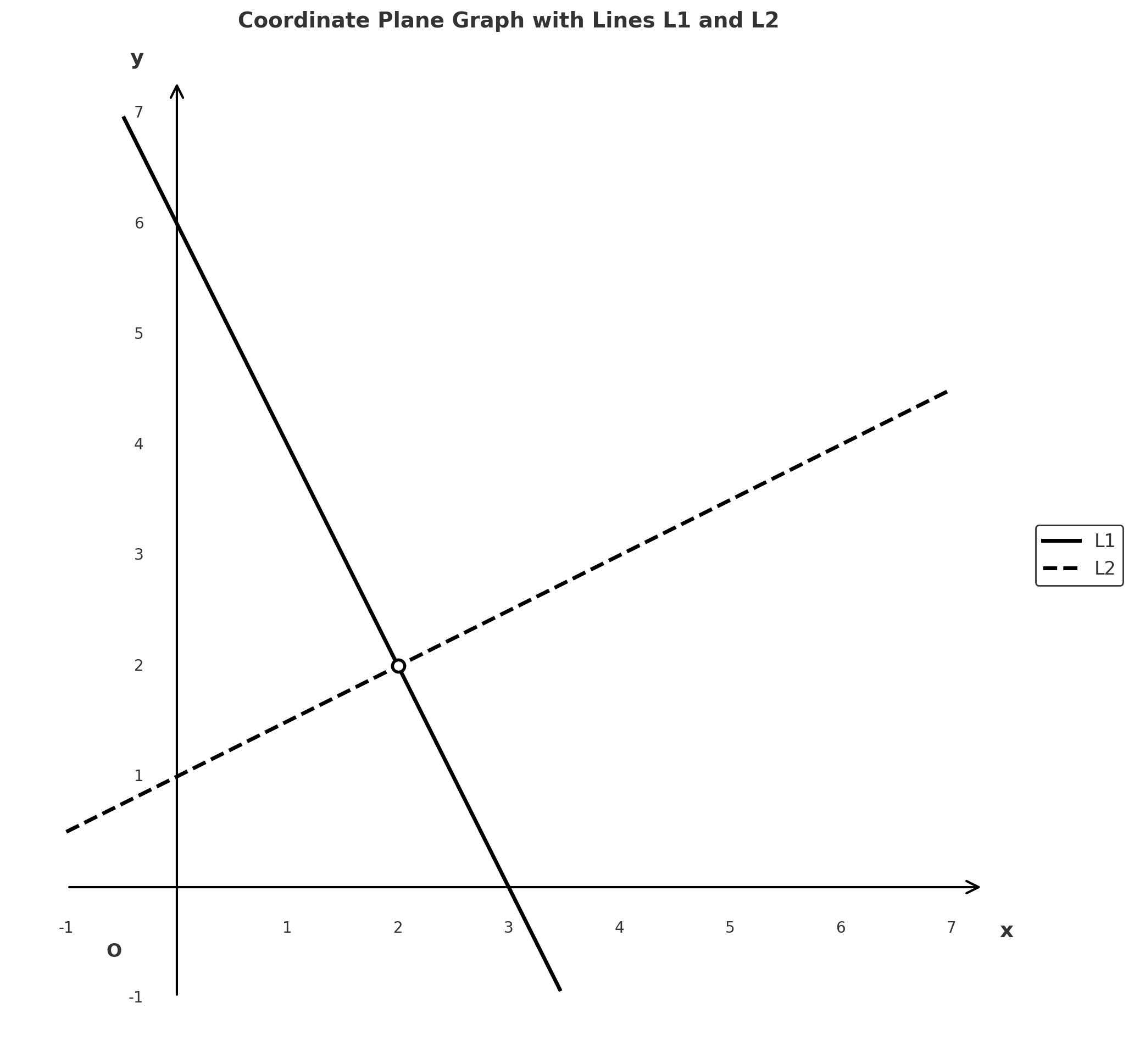
The graph of a system of two linear equations is shown in the xy-plane. The solution to the system is the point \(\mathrm{x}, \mathrm{y})\). What is the value of \(\mathrm{x} + \mathrm{y}\)?
1. TRANSLATE the visual information from the graph
The problem asks for the solution to a system of two linear equations shown graphically.
Key concept: The solution to a system of linear equations is the point where the lines intersect.
- Locate the intersection point: Look for where the solid line (L1) and dashed line (L2) cross. There's a circle marking this point.
- Read the coordinates carefully:
- Find the x-coordinate by looking straight down to the x-axis → \(\mathrm{x = 2}\)
- Find the y-coordinate by looking straight left to the y-axis → \(\mathrm{y = 2}\)
- The solution is \(\mathrm{(x, y) = (2, 2)}\)
2. SIMPLIFY to find the requested value
The question asks for \(\mathrm{x + y}\), not just the coordinates.
- Substitute the values:
- \(\mathrm{x + y = 2 + 2}\)
- \(\mathrm{= 4}\)
Answer: 4
Why Students Usually Falter on This Problem
Most Common Error Path:
TRANSLATE error - Switching x and y coordinates: Students sometimes confuse which coordinate is x and which is y, especially when reading quickly. They might correctly identify the intersection point but think "the first number I see is x" without properly checking the axes. Since the point is \(\mathrm{(2, 2)}\), this particular error wouldn't change the answer, but the habit causes errors on other problems.
TRANSLATE error - Misreading the grid position: Students may miscount the grid lines or misread where the intersection point falls. For example:
- Reading the point as (1, 2) would give \(\mathrm{x + y = 3}\)
- Reading the point as (2, 3) would give \(\mathrm{x + y = 5}\)
- Reading the point as (3, 2) would give \(\mathrm{x + y = 5}\)
This leads to selecting an incorrect answer.
Second Most Common Error:
Incomplete solution - Stopping too early: Students correctly identify the intersection point as \(\mathrm{(2, 2)}\) but then write that as their answer, forgetting that the question specifically asks for \(\mathrm{x + y}\), not just the coordinates. This causes them to write 2 or \(\mathrm{(2, 2)}\) instead of 4.
The Bottom Line:
This problem tests careful graph reading and attention to what the question actually asks for. The mathematical concepts are straightforward—the challenge is in precise visual interpretation and completing all steps of the problem.