
The graph of a system of a linear equation and a nonlinear equation is shown. What is the solution to...
GMAT Advanced Math : (Adv_Math) Questions
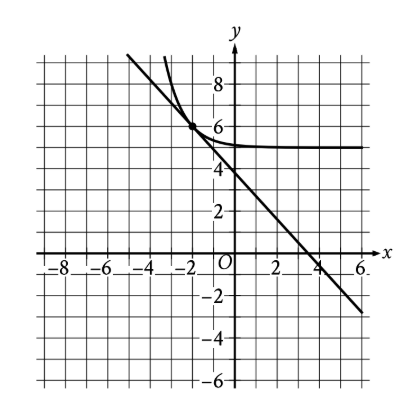
The graph of a system of a linear equation and a nonlinear equation is shown. What is the solution to this system?
1. INFER what the question is asking
The question asks for the solution to a system of equations shown graphically. Here's the key principle you need to know:
The solution to a system of equations is the point(s) where the graphs intersect.
Why? Because at the intersection point, both equations share the same x-value and y-value. That ordered pair satisfies both equations at the same time, which is exactly what "solution to the system" means.
2. VISUALIZE the graphs and locate the intersection
Looking at the coordinate plane:
- Two graphs are shown:
- A straight line (linear equation)
- A curved line (nonlinear equation)
- Your job: Find where these two graphs cross each other
- On this graph, they intersect at exactly one point
3. TRANSLATE the intersection point into coordinates
Now carefully read the coordinates of the intersection point:
- Look at where the graphs cross
- Follow straight down from this point to the x-axis: \(\mathrm{x = -2}\) (2 units to the left of the origin)
- Follow horizontally from this point to the y-axis: \(\mathrm{y = 6}\) (6 units above the origin)
- Write as an ordered pair: \(\mathrm{(-2, 6)}\)
Important: Be careful with negative values! The x-coordinate is -2 (negative), not +2.
4. Verify your answer matches a choice
Looking at the answer choices, \(\mathrm{(-2, 6)}\) corresponds to Choice B.
Answer: B. \(\mathrm{(-2, 6)}\)
Why Students Usually Falter on This Problem
Most Common Error Path:
Weak TRANSLATE skill: Misreading coordinates from the graph, especially negative values.
Students often make these reading errors:
- Missing the negative sign and reading the x-coordinate as positive 2 instead of -2
- Reversing the coordinates, thinking \(\mathrm{(x, y) = (6, -2)}\) instead of \(\mathrm{(-2, 6)}\)
- Reading from the wrong gridline due to rushing
When students misidentify which line crosses an axis, they might select Choice A: \(\mathrm{(6, 0)}\), which appears to be where the linear function crosses the x-axis (an intercept, not an intersection point).
Second Most Common Error:
Weak INFER skill: Not understanding what "solution to the system" means graphically.
Some students think:
- Any point on either graph is a solution
- The solution is where a line crosses an axis (x-intercept or y-intercept)
- The origin might be special
This conceptual confusion might lead them to select Choice D: \(\mathrm{(0, 0)}\) (mistakenly thinking the origin is always relevant) or Choice A: \(\mathrm{(6, 0)}\) (confusing an intercept with an intersection).
The Bottom Line:
This problem tests two fundamental skills: (1) understanding that intersection = solution for systems of equations, and (2) accurately reading coordinates from a graph. The challenge lies in carefully identifying the correct point and reading both coordinates accurately, especially when dealing with negative values.