
The graph of a system of a linear and a quadratic equation is shown. What is the solution \(\mathrm{(x, y)}\)...
GMAT Advanced Math : (Adv_Math) Questions
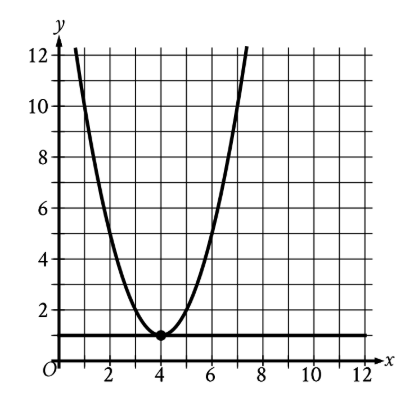
The graph of a system of a linear and a quadratic equation is shown. What is the solution \(\mathrm{(x, y)}\) to this system?
1. TRANSLATE what the problem is asking
- Given information:
- A graph showing both a quadratic equation (parabola) and a linear equation
- We need to find the solution \(\mathrm{(x, y)}\) to this system
- What we need to find:
- The point where the two graphs intersect
2. INFER the strategy
The key insight here: When solving a system of equations graphically, the solution is the point (or points) where the graphs intersect. This intersection point has coordinates that satisfy BOTH equations simultaneously.
So our approach is simple: Find where the two curves meet on the graph.
3. TRANSLATE the graph to identify the intersection point
Looking at the graph carefully:
- The parabola (U-shaped curve) opens upward
- Locate where the linear equation and quadratic equation cross each other
- The intersection appears to occur at \(\mathrm{x = 4}\) (count 4 units to the right of the origin)
- At \(\mathrm{x = 4}\), the y-coordinate is 1 (count 1 unit up from the x-axis)
Therefore, the intersection point is \(\mathrm{(4, 1)}\).
4. Verify against answer choices
Looking at the options:
- A. \(\mathrm{(0, 0)}\) - This is the origin, not where the graphs intersect
- B. \(\mathrm{(-4, 1)}\) - This has a negative x-value, outside our graph's visible range
- C. \(\mathrm{(4, -1)}\) - This has the correct x-coordinate but wrong y-coordinate (negative instead of positive)
- D. \(\mathrm{(4, 1)}\) - This matches our identified intersection point ✓
Answer: D. \(\mathrm{(4, 1)}\)
Why Students Usually Falter on This Problem
Most Common Error Path:
Weak TRANSLATE skill (misreading graph coordinates): Students may correctly identify where the graphs intersect but misread the y-coordinate. The vertex of the parabola is at \(\mathrm{y = 1}\) (one unit above the x-axis). If a student misreads this as \(\mathrm{y = -1}\) (one unit below the x-axis), they would get the wrong y-value.
This may lead them to select Choice C \(\mathrm{(4, -1)}\).
Second Most Common Error:
Weak INFER skill (conceptual confusion about what "solution" means): Some students might not understand that the solution to a system is specifically the intersection point. They might instead identify a special feature of one graph, such as the vertex of the parabola or where the parabola crosses the y-axis. If they identify where the parabola crosses the y-axis at the origin region without careful reading, they might think the origin is significant.
This may lead them to select Choice A \(\mathrm{(0, 0)}\) or causes confusion and guessing.
The Bottom Line:
This problem tests whether students can connect the visual representation of a system (intersecting graphs) to its algebraic meaning (common solution). The execution requires careful graph reading - a seemingly simple skill where small errors (like confusing positive and negative values or miscounting grid squares) lead directly to wrong answers.