
The graph shows the possible combinations of the number of pounds of tangerines and lemons that could be purchased for...
GMAT Algebra : (Alg) Questions
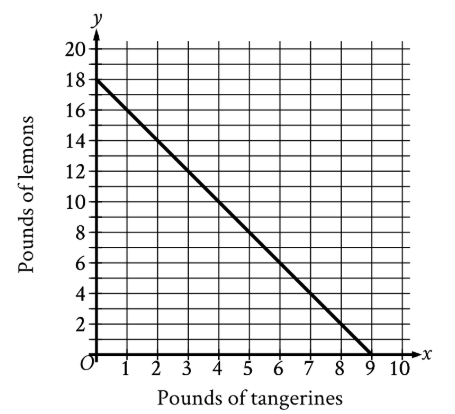
The graph shows the possible combinations of the number of pounds of tangerines and lemons that could be purchased for $18 at a certain store. If Melvin purchased lemons and 4 pounds of tangerines for a total of $18, how many pounds of lemons did he purchase?
7
10
14
16
1. TRANSLATE the problem information
The problem tells us:
- The graph shows combinations of tangerines (x-axis) and lemons (y-axis) that cost $18
- Melvin bought 4 pounds of tangerines
- We need to find how many pounds of lemons he bought
What this means mathematically:
- We're looking for the point on the line where \(\mathrm{x = 4}\)
- The y-coordinate of that point is our answer
2. VISUALIZE by locating the point on the graph
To read a graph for a specific x-value:
- Find \(\mathrm{x = 4}\) on the horizontal axis (pounds of tangerines)
- Move straight up from \(\mathrm{x = 4}\) until you hit the line
- From that intersection point, move horizontally to the y-axis
- Read the y-value
3. Read the y-coordinate
When \(\mathrm{x = 4}\), the line passes through \(\mathrm{y = 10}\).
This means: If Melvin bought 4 pounds of tangerines, he bought 10 pounds of lemons.
Answer: B. 10
Why Students Usually Falter on This Problem
Most Common Error Path:
Weak VISUALIZE skill: Students misread which axis represents which quantity
Some students see "4 pounds of tangerines" and look at the y-axis instead of the x-axis, or they confuse what they're solving for. They might:
- Think they need to find x when \(\mathrm{y = 4}\)
- Look at where \(\mathrm{y = 4}\) and read \(\mathrm{x = 14}\) from the graph
This may lead them to select Choice C (14)
Second Most Common Error:
Weak VISUALIZE skill: Students misread the grid lines on the graph
The graph has gridlines at every unit, and students might:
- Count incorrectly from the origin
- Misalign their reading of where \(\mathrm{x = 4}\) intersects the line
- Read \(\mathrm{y = 7}\) instead of \(\mathrm{y = 10}\)
This may lead them to select Choice A (7)
The Bottom Line:
This problem tests careful graph reading more than complex mathematics. The key is accurately matching the verbal description ("4 pounds of tangerines") to the correct axis (x-axis), then precisely reading the corresponding value on the other axis. Students who rush or don't carefully track which variable goes with which axis often make simple but costly errors.
7
10
14
16