
In the figure shown, angleACE and angleAED are right angles. The length of hypotenuse AD is 26, the length of...
GMAT Geometry & Trigonometry : (Geo_Trig) Questions
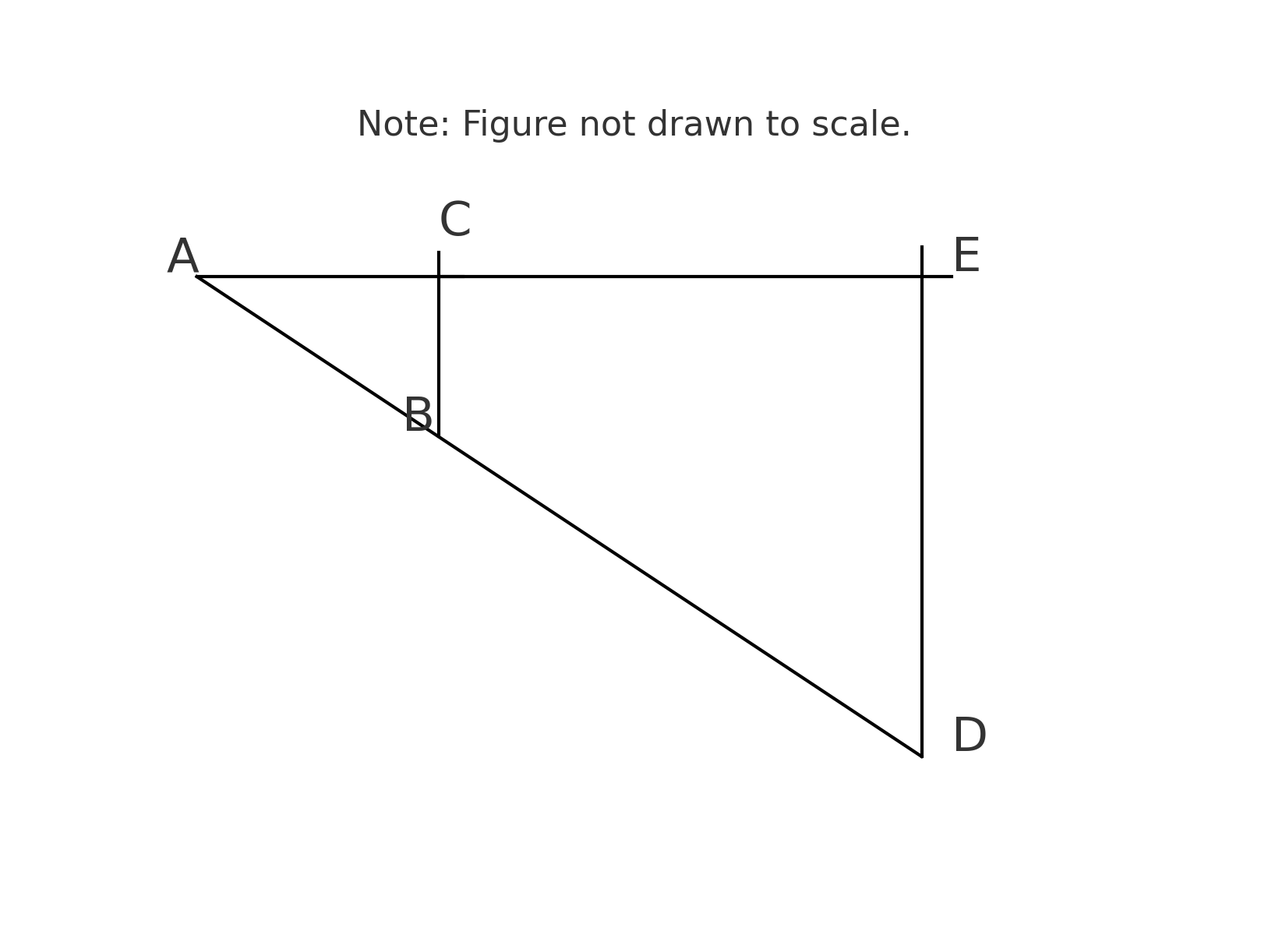
In the figure shown, \(\angle\mathrm{ACE}\) and \(\angle\mathrm{AED}\) are right angles. The length of hypotenuse \(\mathrm{AD}\) is \(26\), the length of side \(\mathrm{AE}\) is \(24\), and the length of segment \(\mathrm{AC}\) is \(6\). What is the area of trapezoid \(\mathrm{BCED}\)?
1. TRANSLATE the problem information
Looking at the figure and given information:
- Triangle ADE is a right triangle with:
- Right angle at E (\(\angle\mathrm{AED} = 90°\))
- Hypotenuse \(\mathrm{AD} = 26\)
- Base \(\mathrm{AE} = 24\)
- Height \(\mathrm{DE}\) = unknown
- Point C lies on segment AE with \(\mathrm{AC} = 6\)
- There's a right angle at C (\(\angle\mathrm{ACE} = 90°\)), meaning BC is perpendicular to AE
- Trapezoid BCED is formed with BC and DE as vertical segments
2. INFER the first necessary step
To find the area of trapezoid BCED, we need both parallel sides (BC and DE) and the height (CE). We can find DE immediately using the Pythagorean theorem, but BC requires more strategic thinking.
3. SIMPLIFY to find DE using the Pythagorean theorem
In right triangle ADE:
\(\mathrm{AE}^2 + \mathrm{DE}^2 = \mathrm{AD}^2\)
\(24^2 + \mathrm{DE}^2 = 26^2\)
\(576 + \mathrm{DE}^2 = 676\)
\(\mathrm{DE}^2 = 100\)
\(\mathrm{DE} = 10\)
Pro tip: Recognize this as a 5-12-13 Pythagorean triple scaled by 2 (10-24-26).
4. INFER the relationship between triangles ABC and ADE
This is the critical strategic insight:
- Both triangles share angle A
- Both have right angles: \(\angle\mathrm{ACE} = 90°\) and \(\angle\mathrm{AED} = 90°\)
- Therefore, by AA similarity, triangles ABC and ADE are similar
5. TRANSLATE the similarity into a proportion
Since the triangles are similar, their corresponding sides are proportional:
- BC corresponds to DE (both are heights)
- AC corresponds to AE (both are bases)
This gives us: \(\frac{\mathrm{BC}}{\mathrm{DE}} = \frac{\mathrm{AC}}{\mathrm{AE}}\)
6. SIMPLIFY to solve for BC
Substitute the known values:
\(\frac{\mathrm{BC}}{10} = \frac{6}{24}\)
\(\frac{\mathrm{BC}}{10} = \frac{1}{4}\)
\(\mathrm{BC} = \frac{10}{4} = 2.5\)
7. TRANSLATE to identify trapezoid dimensions
For trapezoid BCED:
- Parallel side 1: \(\mathrm{BC} = 2.5\)
- Parallel side 2: \(\mathrm{DE} = 10\)
- Height: \(\mathrm{CE} = \mathrm{AE} - \mathrm{AC} = 24 - 6 = 18\)
The height is the horizontal distance between the two vertical parallel sides.
8. SIMPLIFY to calculate the area
Using the trapezoid area formula:
\(\mathrm{Area} = \frac{1}{2}(\mathrm{b_1} + \mathrm{b_2})(\mathrm{h})\)
\(\mathrm{Area} = \frac{1}{2}(2.5 + 10)(18)\)
\(\mathrm{Area} = \frac{1}{2}(12.5)(18)\)
\(\mathrm{Area} = (12.5)(9)\)
\(\mathrm{Area} = 112.5\)
Answer: 112.5
Why Students Usually Falter on This Problem
Most Common Error Path:
Weak INFER skill: Not recognizing that triangles ABC and ADE are similar triangles
Many students successfully find \(\mathrm{DE} = 10\) using the Pythagorean theorem but then get stuck because they don't see how to find BC. They might try to use the Pythagorean theorem on triangle ABC directly, but they don't have enough information (only know \(\mathrm{AC} = 6\), need either BC or AB). Without recognizing the similar triangles, they cannot establish a proportion to find BC. This leads to confusion and guessing.
Second Most Common Error:
Conceptual confusion about trapezoid orientation: Misidentifying which segments are the parallel sides versus the height
Some students might mistakenly think that BC and CE are the two bases, or that AE is the height of the trapezoid. This confusion stems from not carefully TRANSLATING the figure into the correct trapezoid configuration. If they use BC and CE as bases with some incorrect height, they might calculate:
Incorrect area = \(\frac{1}{2}(2.5 + 18)(10) = \frac{1}{2}(20.5)(10) = 102.5\)
This would lead them to an answer near 102.5 if that were an option, or cause them to get stuck and guess.
The Bottom Line:
This problem requires you to see beyond the surface. The key challenge is recognizing that you have nested similar triangles—a large right triangle containing a smaller right triangle that shares an angle. Once you identify this similarity relationship, the proportion gives you BC, and the rest flows naturally. The trapezoid calculation itself is straightforward; the real test is whether you can INFER the geometric relationships hidden in the configuration.