
In the figure shown, AB = sqrt(34) units, AC=3 units, and CE=21 units. What is the area, in square units,...
GMAT Geometry & Trigonometry : (Geo_Trig) Questions
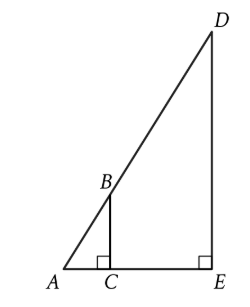
In the figure shown, \(\mathrm{AB = \sqrt{34}}\) units, \(\mathrm{AC=3}\) units, and \(\mathrm{CE=21}\) units. What is the area, in square units, of triangle \(\mathrm{ADE}\)?
1. TRANSLATE the problem information
Given:
- \(\mathrm{AB = \sqrt{34}}\) units
- \(\mathrm{AC = 3}\) units
- \(\mathrm{CE = 21}\) units
- Angles ACB and AED are right angles (shown by small squares in the figure)
- Point C lies on segment AE
- Point B lies on segment AD
What we need to find: Area of triangle ADE
2. INFER a key geometric relationship
Look at the two triangles in the figure: ABC and ADE.
- Both triangles contain angle A (they share it!)
- Triangle ABC has a right angle at C
- Triangle ADE has a right angle at E
Key insight: When two triangles have two pairs of congruent angles, they are similar by the AA (Angle-Angle) similarity criterion. This means:
- Triangle ABC ~ Triangle ADE
- All corresponding sides are proportional
This similarity relationship is the key to solving the problem!
3. SIMPLIFY to find BC using the Pythagorean theorem
In right triangle ABC:
- AB is the hypotenuse = \(\mathrm{\sqrt{34}}\)
- AC is one leg = 3
- BC is the other leg = ?
\(\mathrm{AB^2 = AC^2 + BC^2}\)
\(\mathrm{(\sqrt{34})^2 = 3^2 + BC^2}\)
\(\mathrm{34 = 9 + BC^2}\)
\(\mathrm{BC^2 = 25}\)
\(\mathrm{BC = 5}\)
4. INFER the length of AE
Looking at the figure, point C lies on segment AE between A and E.
Therefore: \(\mathrm{AE = AC + CE}\)
\(\mathrm{AE = 3 + 21 = 24}\) units
5. INFER the similarity ratio
Since triangles ABC and ADE are similar, their corresponding sides are proportional:
\(\mathrm{\frac{AC}{AE} = \frac{BC}{DE} = \frac{AB}{AD}}\)
Let's use the ratio \(\mathrm{\frac{AC}{AE}}\):
\(\mathrm{\frac{AC}{AE} = \frac{3}{24} = \frac{1}{8}}\)
This tells us that triangle ABC is 1/8 the size of triangle ADE, or equivalently, triangle ADE is 8 times larger than triangle ABC in all linear dimensions.
6. SIMPLIFY to find DE
Using the similarity ratio:
\(\mathrm{\frac{BC}{DE} = \frac{1}{8}}\)
\(\mathrm{\frac{5}{DE} = \frac{1}{8}}\)
\(\mathrm{DE = 5 \times 8 = 40}\) units
7. SIMPLIFY to calculate the area
For triangle ADE (right angle at E):
- Base = DE = 40 units
- Height = AE = 24 units
\(\mathrm{Area = \frac{1}{2} \times base \times height}\)
\(\mathrm{Area = \frac{1}{2} \times 40 \times 24}\)
\(\mathrm{Area = 480}\) square units
Answer: 480
Why Students Usually Falter on This Problem
Most Common Error Path:
Weak INFER skill: Students fail to recognize that triangles ABC and ADE are similar triangles. Without seeing this relationship, they cannot establish the proportions needed to find the dimensions of the larger triangle ADE.
Some students might try to use only the Pythagorean theorem on triangle ADE directly, but they don't have enough information (they need two of the three sides). Others might attempt to work with triangle ABC alone and never connect it to the larger triangle. This leads to confusion and guessing.
Second Most Common Error:
Conceptual gap with segment addition: Students don't recognize that C lies on segment AE, so they fail to calculate \(\mathrm{AE = AC + CE = 24}\). Without the correct value of AE, they cannot find the similarity ratio \(\mathrm{(\frac{3}{24} = \frac{1}{8})}\) and the entire solution path breaks down.
Some students might use only \(\mathrm{CE = 21}\) as if it were AE, leading to an incorrect similarity ratio of \(\mathrm{\frac{3}{21} = \frac{1}{7}}\), which would give \(\mathrm{DE = 35}\) and an incorrect area of \(\mathrm{\frac{1}{2}(35)(21) = 367.5}\). This causes them to get stuck since 367.5 isn't close to reasonable answer values.
The Bottom Line:
This problem requires students to see beyond individual triangles and recognize the similar triangle relationship. The key insight is that shared angles and right angles create similarity, which unlocks the proportions needed to find all missing dimensions. Students who focus only on applying the Pythagorean theorem without first establishing the geometric relationships will struggle to make progress.