
In triangle ABC shown below, the measure of angle ABC is 38° and the measure of angle BAC is 67°....
GMAT Geometry & Trigonometry : (Geo_Trig) Questions
In triangle ABC shown below, the measure of \(\angle \mathrm{ABC}\) is \(38°\) and the measure of \(\angle \mathrm{BAC}\) is \(67°\). Point D lies on the extension of side BC beyond point C, forming exterior angle ACD. What is the measure, in degrees, of exterior \(\angle \mathrm{ACD}\)?
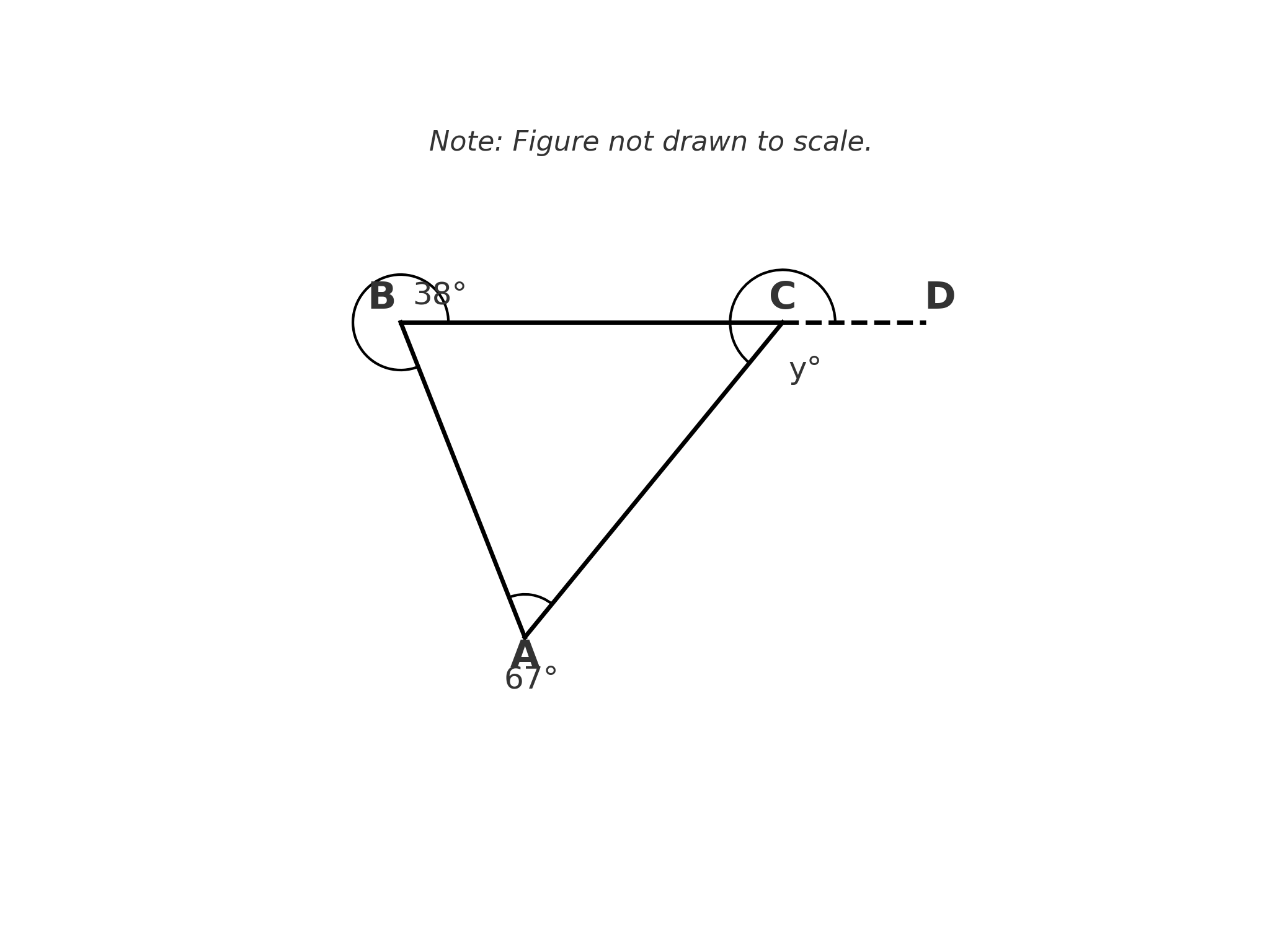
1. TRANSLATE the diagram and problem information
Looking at the figure, let me identify the key elements:
Given information:
- Triangle ABC has \(\angle\mathrm{ABC} = 38°\) (at vertex B)
- Triangle ABC has \(\angle\mathrm{BAC} = 67°\) (at vertex A)
- Point D lies on the extension of line BC beyond point C
- The angle marked \(y°\) is \(\angle\mathrm{ACD}\)
What we need to find:
- The measure of exterior angle ACD (labeled as \(y°\))
2. INFER the geometric relationship
The key insight here is recognizing what type of angle ACD is:
- Angle ACD is an exterior angle of triangle ABC
- It's formed by extending side BC beyond vertex C
- The angle is "outside" the triangle
This configuration means I should think about the exterior angle theorem.
3. INFER which angles to use
The exterior angle theorem states: An exterior angle of a triangle equals the sum of the two non-adjacent interior angles.
For this to work, I need to identify which interior angles are non-adjacent to \(\angle\mathrm{ACD}\):
- Angle ACB is adjacent to \(\angle\mathrm{ACD}\) (they share vertex C and side AC) - so I don't use this one
- \(\angle\mathrm{ABC}\) (38°) is non-adjacent to \(\angle\mathrm{ACD}\) ✓
- \(\angle\mathrm{BAC}\) (67°) is non-adjacent to \(\angle\mathrm{ACD}\) ✓
4. Apply the exterior angle theorem
Now I can apply the theorem directly:
\(\mathrm{Exterior\ angle\ ACD} = \angle\mathrm{ABC} + \angle\mathrm{BAC}\)
\(\angle\mathrm{ACD} = 38° + 67° = 105°\)
Answer: 105°
Why Students Usually Falter on This Problem
Most Common Error Path:
Weak INFER skill: Not recognizing that the exterior angle theorem applies directly, or not knowing this theorem at all.
Instead of using the direct relationship, students might try to find \(\angle\mathrm{ACB}\) first:
- Calculate \(\angle\mathrm{ACB} = 180° - 38° - 67° = 75°\)
- Then use the fact that ACD and ACB are supplementary: \(\angle\mathrm{ACD} = 180° - 75° = 105°\)
While this approach works, it takes more steps. More critically, if a student makes an arithmetic error in the first calculation, they'll get the final answer wrong. The exterior angle theorem is the more efficient path.
Second Most Common Error:
Misidentifying the angles (INFER error): Confusing which angles are the "non-adjacent" interior angles.
Some students might mistakenly try to use \(\angle\mathrm{ACB}\) (the interior angle at C) in their calculation because it seems geometrically close to \(\angle\mathrm{ACD}\). For example, they might incorrectly think:
- \(\angle\mathrm{ACD} = \angle\mathrm{ACB} + \angle\mathrm{ABC}\), or
- \(\angle\mathrm{ACD} = \angle\mathrm{ACB} + \angle\mathrm{BAC}\)
This conceptual confusion about which angles are "non-adjacent" to the exterior angle leads to incorrect calculations and guessing.
The Bottom Line:
This problem tests whether you can recognize an exterior angle configuration and recall the exterior angle theorem. The theorem provides a direct one-step calculation, but students who don't know it or can't identify which angles to use will either take a longer route (and risk arithmetic errors) or get confused about the geometric relationships.