
In the right triangle shown, segment AD is drawn from vertex A perpendicular to hypotenuse BC. If AB = 6...
GMAT Geometry & Trigonometry : (Geo_Trig) Questions
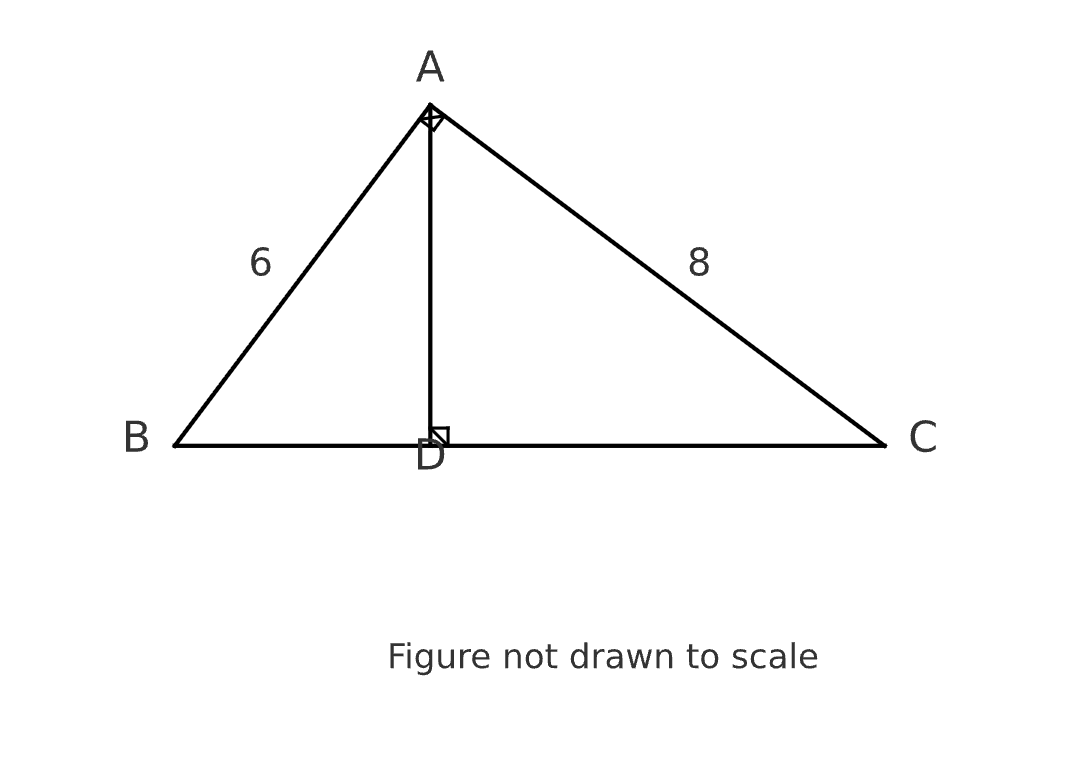
In the right triangle shown, segment \(\mathrm{AD}\) is drawn from vertex A perpendicular to hypotenuse \(\mathrm{BC}\). If \(\mathrm{AB = 6}\) and \(\mathrm{AC = 8}\), what is the length of \(\mathrm{AD}\)?
\(\mathrm{4.6}\)
\(\mathrm{4.7}\)
\(\mathrm{4.8}\)
\(\mathrm{5.0}\)
1. TRANSLATE the problem information
- Given information:
- Triangle ABC with right angle at vertex A
- \(\mathrm{AB = 6}\) (one leg of the right triangle)
- \(\mathrm{AC = 8}\) (other leg of the right triangle)
- BC is the hypotenuse
- AD is perpendicular to BC (altitude from right angle to hypotenuse)
- What we need to find:
- Length of AD
2. INFER the solution strategy
The key insight here is recognizing that we don't have the hypotenuse length yet, but we need it. So our strategy is:
- First, find BC using the Pythagorean theorem
- Then use the fact that area can be calculated in two different ways
3. SIMPLIFY to find the hypotenuse
Apply the Pythagorean theorem:
\(\mathrm{BC^2 = AB^2 + AC^2}\)
\(\mathrm{BC^2 = 6^2 + 8^2}\)
\(\mathrm{BC^2 = 36 + 64}\)
\(\mathrm{BC^2 = 100}\)
\(\mathrm{BC = 10}\)
This is a classic 6-8-10 right triangle (a multiple of the 3-4-5 Pythagorean triple).
4. INFER the area relationship
Here's where the magic happens. The area of triangle ABC can be calculated in two different ways:
- Using the two legs as base and height:
\(\mathrm{Area = \frac{1}{2} \times AB \times AC = \frac{1}{2} \times 6 \times 8 = 24}\)
- Using the hypotenuse as base and AD as height:
\(\mathrm{Area = \frac{1}{2} \times BC \times AD = \frac{1}{2} \times 10 \times AD = 5 \times AD}\)
Since both expressions represent the same area, we can set them equal!
5. SIMPLIFY to solve for AD
Set the two area expressions equal:
\(\mathrm{24 = 5 \times AD}\)
\(\mathrm{AD = \frac{24}{5}}\)
\(\mathrm{AD = 4.8}\)
Answer: C (4.8)
Why Students Usually Falter on This Problem
Most Common Error Path:
Weak INFER skill: Students may incorrectly assume a simple geometric relationship that doesn't actually exist. For example, they might think that the altitude to the hypotenuse divides the hypotenuse into two equal parts, or that the altitude equals half the hypotenuse length.
Using this faulty reasoning: \(\mathrm{AD = \frac{BC}{2} = \frac{10}{2} = 5}\)
This may lead them to select Choice D (5.0).
Second Most Common Error:
Weak INFER skill: Students might not recognize that they need to find BC first before they can solve for AD. They might try to use the given side lengths (6 and 8) directly in some incorrect formula or relationship, leading to confusion about how to proceed.
This causes them to get stuck and guess among the answer choices.
The Bottom Line:
This problem requires understanding that a triangle's area is invariant—it doesn't matter which side you choose as the base, the area remains the same. This insight allows you to create an equation with the unknown altitude. Students who try to find a direct geometric relationship without using the area approach often struggle or arrive at incorrect answers.
\(\mathrm{4.6}\)
\(\mathrm{4.7}\)
\(\mathrm{4.8}\)
\(\mathrm{5.0}\)