
In triangle MNO, MN is extended to point P. The measure of angleMON is 119°, and the measure of angleOMP...
GMAT Geometry & Trigonometry : (Geo_Trig) Questions
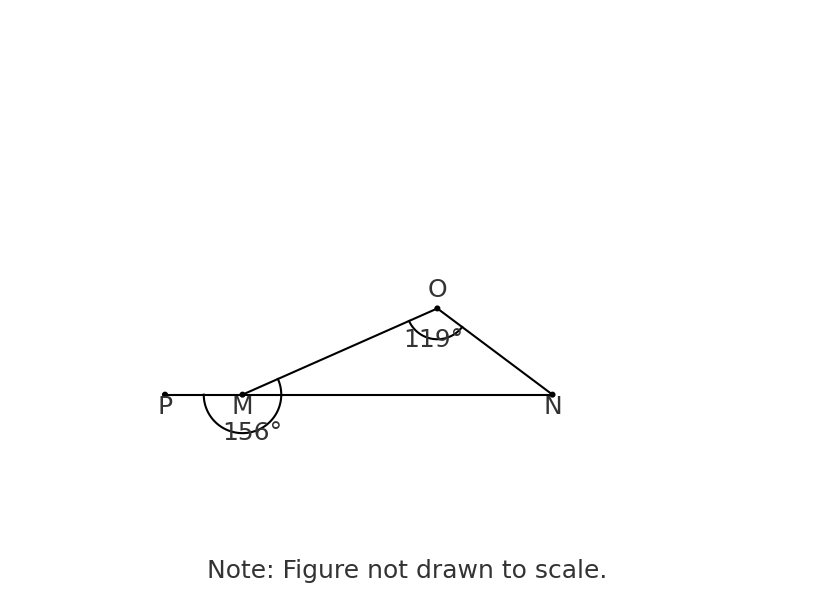
In triangle MNO, MN is extended to point P. The measure of \(\angle\mathrm{MON}\) is \(119°\), and the measure of \(\angle\mathrm{OMP}\) is \(156°\). What is the measure of \(\angle\mathrm{OMN}\)?
In the figure above, express your answer in degrees.
1. TRANSLATE the problem information
Given:
- Triangle MNO
- MN is extended to point P (so P-M-N are collinear with M between P and N)
- \(\angle\mathrm{MON} = 119°\) (interior angle at vertex O)
- \(\angle\mathrm{OMP} = 156°\) (angle at M on the exterior side)
- Need to find: \(\angle\mathrm{OMN}\) (interior angle at vertex M)
2. INFER the geometric relationship
Key insight: Look at point M carefully. The line segment MN is extended backward to point P. This means:
- Points P, M, and N all lie on the same straight line
- Angle \(\angle\mathrm{OMN}\) is inside the triangle (interior angle)
- Angle \(\angle\mathrm{OMP}\) is outside the triangle (exterior angle)
- These two angles are adjacent and their outer sides (MP and MN) form a straight line
Therefore: \(\angle\mathrm{OMN}\) and \(\angle\mathrm{OMP}\) form a linear pair, which means they're supplementary angles that sum to 180°.
3. SIMPLIFY to find the answer
Set up the equation:
\(\angle\mathrm{OMN} + \angle\mathrm{OMP} = 180°\)
Substitute the known value:
\(\angle\mathrm{OMN} + 156° = 180°\)
Solve:
\(\angle\mathrm{OMN} = 180° - 156° = 24°\)
Answer: 24° (Choice B)
Why Students Usually Falter on This Problem
Most Common Error Path:
Weak INFER skill: Not recognizing the simple linear pair relationship and instead attempting to use the triangle angle sum theorem (all angles in a triangle sum to 180°).
A student might think: "I know \(\angle\mathrm{MON} = 119°\). If I can find \(\angle\mathrm{MNO}\), then I can use the triangle angle sum to find \(\angle\mathrm{OMN}\)." They might incorrectly reason that \(\angle\mathrm{MNO}\) and \(\angle\mathrm{OMP}\) have some direct relationship, or make calculation errors trying to work through multiple steps. Through faulty reasoning about the angle relationships, they might calculate: \(\angle\mathrm{OMN} = 180° - 119° - 24° = 37°\).
This may lead them to select Choice D (37°).
Second Most Common Error:
Poor TRANSLATE reasoning: Confusing which angle is which, particularly mixing up \(\angle\mathrm{OMN}\) (interior) with \(\angle\mathrm{OMP}\) (exterior), or not understanding what "MN is extended to point P" means geometrically.
If a student doesn't correctly identify the angles from the diagram and description, they might subtract the two given angles: \(156° - 119° = 37°\), thinking this represents some meaningful relationship.
This may also lead them to select Choice D (37°).
The Bottom Line:
This problem tests whether you can identify the most direct path to the solution. The key is recognizing that when a line segment is extended, the interior and exterior angles at that vertex form a linear pair - a much simpler relationship than trying to use triangle angle sum. Once you see this geometric relationship, the problem becomes a simple one-step subtraction from 180°.