
In the figure above, triangle RST is a right triangle, and SU is an altitude to the hypotenuse RT. The...
GMAT Geometry & Trigonometry : (Geo_Trig) Questions
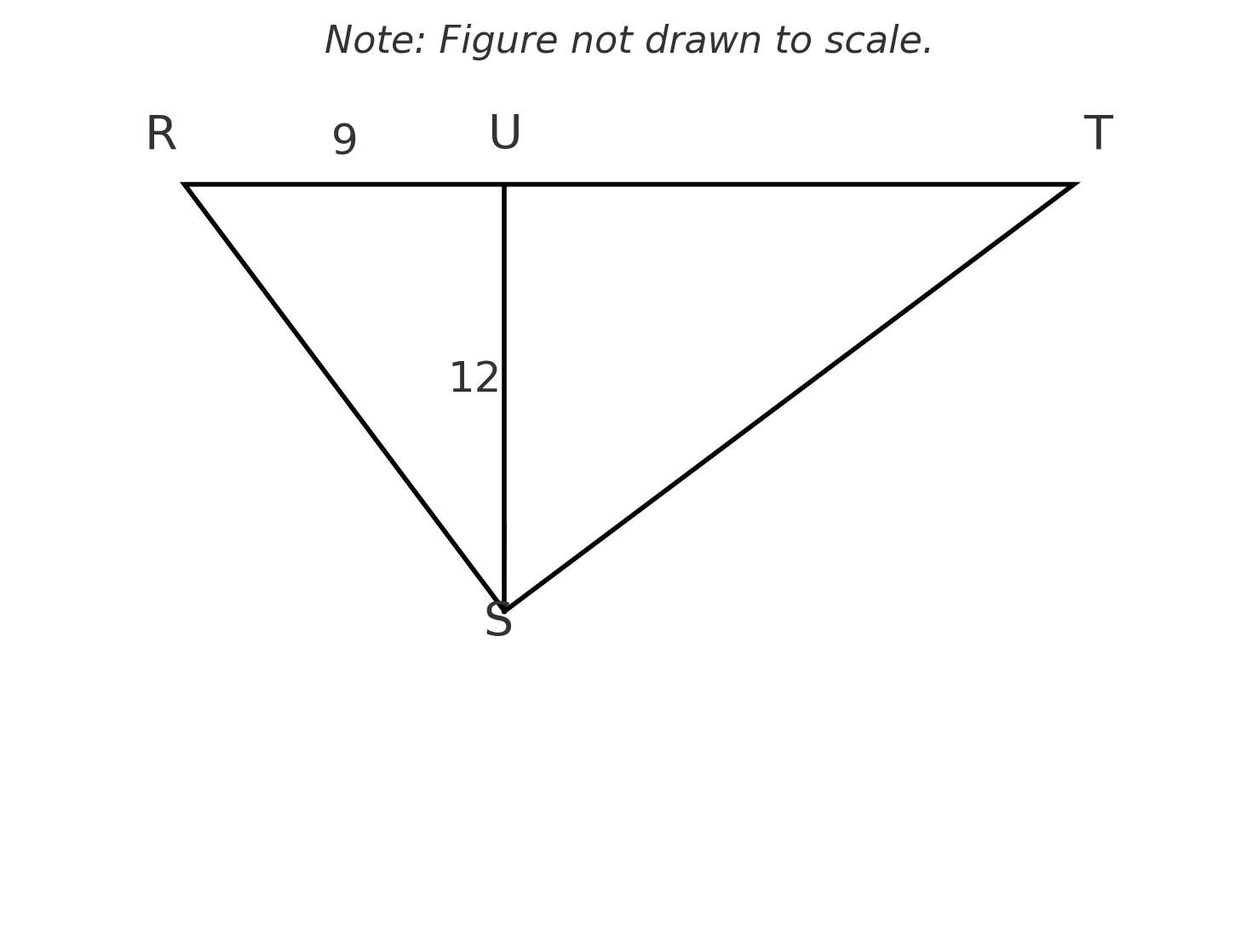
In the figure above, triangle \(\mathrm{RST}\) is a right triangle, and \(\mathrm{SU}\) is an altitude to the hypotenuse \(\mathrm{RT}\). The length of \(\mathrm{RU}\) is \(\mathrm{9}\) and the length of \(\mathrm{SU}\) is \(\mathrm{12}\). What is the length of \(\mathrm{UT}\)?
1. TRANSLATE the geometric configuration
Looking at the figure, let me identify what we have:
- Given information:
- Triangle RST with right angle at vertex S
- SU is an altitude (perpendicular segment) from S to hypotenuse RT
- U is the point where the altitude meets the hypotenuse
- \(\mathrm{RU = 9}\) (one segment of the hypotenuse)
- \(\mathrm{SU = 12}\) (the altitude length)
- What we need to find:
- \(\mathrm{UT}\) (the other segment of the hypotenuse)
2. INFER the key geometric relationship
This is a classic configuration! When you draw an altitude from the right angle to the hypotenuse in a right triangle, you create a special relationship.
The altitude (SU) is the geometric mean of the two segments it creates on the hypotenuse (RU and UT).
This means: \(\mathrm{SU^2 = RU \times UT}\)
Why does this work? The altitude creates two smaller right triangles (RSU and TSU) that are similar to each other. This similarity relationship produces the geometric mean property.
3. TRANSLATE the relationship into an equation
Substitute the known values into the formula:
- \(\mathrm{SU = 12}\)
- \(\mathrm{RU = 9}\)
- \(\mathrm{UT = ?}\) (what we're solving for)
The equation becomes:
\(\mathrm{12^2 = 9 \times UT}\)
4. SIMPLIFY to find UT
Calculate the left side:
\(\mathrm{144 = 9 \times UT}\)
Divide both sides by 9:
\(\mathrm{UT = 144 \div 9}\)
\(\mathrm{UT = 16}\)
Answer: 16
Why Students Usually Falter on This Problem
Most Common Error Path:
Missing Conceptual Knowledge: Geometric Mean Theorem
Many students don't recognize this specific configuration or haven't learned (or don't remember) the geometric mean theorem for altitudes to the hypotenuse. Without this knowledge, they might:
- Try to use the Pythagorean theorem directly on triangle RST (but they don't have enough information about the legs RS and ST)
- Attempt to find individual side lengths without recognizing the relationship between the segments
- Try to use basic proportions without understanding which triangles are similar
This leads to confusion and guessing, or getting stuck after setting up incorrect equations.
Second Most Common Error:
Weak INFER skill: Confusing which segments to use
Even if students know about similar triangles or the geometric mean theorem, they might set up the wrong proportion. For example, they might write:
\(\mathrm{RU/SU = UT/SU}\) (incorrect proportion)
which would give \(\mathrm{9/12 = UT/12}\), leading to \(\mathrm{UT = 9}\)
Or they might try: \(\mathrm{RU/UT = SU/something}\), but not know what to put on the right side.
These incorrect setups lead to wrong numerical answers or getting stuck partway through.
The Bottom Line:
This problem requires recognizing a specific geometric configuration (altitude to hypotenuse in a right triangle) and knowing the special relationship it creates. The calculation itself is straightforward once you know which formula to apply—the challenge is in the geometric reasoning, not the arithmetic.